Kankelibranchus alhenae
A cryptic nudibranch with size-dependent color and form.

Kankelibranchus alhenae is a sea slug, specifically a nudibranch and a shell-less marine gastropod mollusk, belonging to the family Polyceridae.
This species was described from seven specimens collected at depths of 1 to 8 meters near Maria La Gorda, in Guanahacabibes, Pinar del Rio, Cuba.
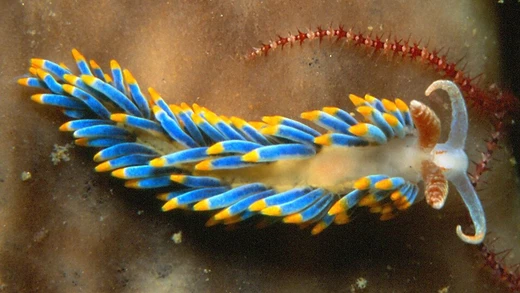
Its body is hyaline white with a reticulate orange pattern that resembles the branches of the bryozoan *Cauda* sp. on which the slugs live. This pattern becomes more complex as the animal grows. In the smallest individuals, 1–2 mm long, only four fragmented orange lines appear on the front half of the body and four more on the tail, with some white pigment and a yellowish spherical structure in the middle of the tail. At 15 mm, the orange network is more apparent, and conical tubercles, snow-white dots, and black dots appear; white pigment is more abundant on the front half, black on the back. On the back of the tail and its sides, there are larger white tubercles. In animals 20–25 mm long, the orange network is even more visible, and the white tubercles on the front half form a cross on the head, with a long arm stretching between the two rhinophores. The head is as wide as the gill region, and the body appears robust to slender, with parallel sides that narrow abruptly to the tail tip.
On the cephalic veil, all animals have six processes: three large and two small, the latter behind the rhinophores, mostly orange. In 1–2 mm animals, these velar processes are simple or have 2–3 branches; at 15 mm, at least five are more branched; at 25 mm, there is a thick trunk in the lower half and up to five branches in the upper part. Six more branched processes are found on each side of the body, from the gills to the tail in 1–2 mm specimens, with the front ones larger; their number and complexity increase with size, reaching 12 in 25 mm specimens, though the first six are always more developed. On the back of the tail, there are also branched processes, which increase with size and are pigmented white or whitish yellow.
The gill is at the end of the front half of the body. It has three simple leaves in 1–2 mm animals and five leaves in larger ones, with the front gill leaf largest and most branched.
Quick Facts
- Genus
- Kankelibranchus
- Species
- alhenae
Facts from the source article.
Lore & Background
This species was described from seven specimens collected at 1–8 m depth at Maria La Gorda, Guanahacabibes, Pinar del Rio, Cuba. The general colouration of the body is hyaline white, with a reticulate orange pattern similar to branches of the bryozoan Cauda sp. on which the animals were living. The fabric and complexity of this pattern increases with the size of the animals.
In the smallest individuals (1–2 mm), there are only four fragmented orange lines in the anterior half of the body and four more on the tail, with some white pigment and a yellowish spherical structure in the middle of the tail. At 15 mm, the orange network becomes more apparent, with conical tubercles and snow-white and black dots. In the largest animals (20–25 mm), the orange pattern is more pronounced, and white tubercles on the anterior half form a cross on the head between the two rhinophores.
The head is as wide as the gill region, with the sides of the body parallel, narrowing abruptly to the tip of the tail. On the cephalic veil there are six processes, three large and two small, the latter behind the rhinophores, predominantly orange. The number and branching of these processes increase with size. Six more branched processes are found on each side of the body from the gills to the tail, increasing to 12 in 25 mm specimens. The gill is placed at the end of the anterior half of the body, with three simple leaves in small animals and five leaves in larger ones, the anterior leaf largest and most branched.
Reader's Guide
Kankelibranchus alhenae is significant for its detailed description of ontogenetic variation in color and morphology, which is rare in nudibranch taxonomy. The species exhibits a striking resemblance to the bryozoan Cauda sp. on which it lives, suggesting cryptic mimicry. The description documents changes from 1–2 mm to 25 mm, including the development of orange reticulation, tubercles, and branched processes. The gill structure also changes, with the interior becoming dark grey to black in older individuals. The rhinophores are cylindrical and robust, with 10 lamellae in larger animals and a long apical mucron. The species was described from a limited number of specimens (seven) from a single location in Cuba, providing a baseline for future studies of Caribbean polycerid nudibranchs. Its legacy lies in the detailed account of how color and form shift with growth, offering insights into the ecology and development of shell-less marine gastropods.
More in Nudibranchs and Sea Slugs, Part 2 1-24
Spotted an error? Know more?
Reader corrections go straight into our review queue. Suggest an edit · How this site is sourced