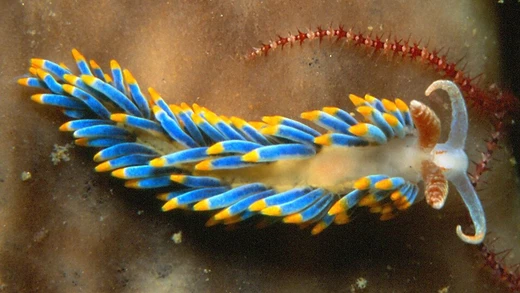
Kaloplocamus peludo
A nudibranch with orange body, brown dots, and two appendage types.

Kaloplocamus peludo is a sea slug, specifically a nudibranch and a shell-less marine gastropod mollusk belonging to the family Polyceridae.
The living animal is generally orange. Its entire back is covered with regularly spaced brown dots of similar size, except at the tips of the side appendages, which are pale yellow. An opaque white line runs irregularly from the front of the head to the rear of the back; this line splits around the gill leaves, encircles them, and then rejoins behind them. The rear tip of the foot is thin and pointed, colored yellow like the tips of the side appendages.
The body has two types of appendages. The first type is longer and wider, with three pairs positioned along the sides. These have branched tips, where each branch has a rounded base and a long, thin, sharp extension. The entire length of these appendages is covered with small, sharp outgrowths. The second type is thin and long, with many small, sharp, simple branches. These appear on the sides, foot, back, and oral veil—15 to 17 per side, with six on the oral veil.
The rhinophores have a lamellate club and a stalk with small, thin, sharp branches. Each rhinophoral sheath edge has three branches: the middle one resembles the large side appendages, while the other two match the smaller body appendages. The oral tentacles are simple, cylindrical folds of the mantle. There are three tripinnate gill leaves, which bear long, simple, thin branches like the smaller appendages.
The type locality is Batangas, Luzon Island, Philippines. The original description also reports the species across a wide area of the Indo-Pacific, from the Philippines, Papua New Guinea, Palau, the Marshall Islands, and Japan to Tanzania. It has since been recorded from Heron Island, Australia.
Quick Facts
- Genus
- Kaloplocamus
- Species
- peludo
Facts from the source article.
Lore & Background
The living animal has a general orange coloration, with brown dots covering the whole dorsum except at the apices of the lateral appendages, which are pale yellow. These brown dots are similar in size and regularly distributed. An opaque white, irregularly shaped line runs from the front of the head to the posterior end of the notum, bifurcating at the level of the branchial leaves, surrounding them, and reemerging behind them. The posterior end of the foot is thin and acute, colored yellow like the lateral appendage apices.
Two types of appendages are observed. The first type comprises three pairs of lateral appendages along the margin of the sides; these are the longest and widest, with a ramified apex where each ramification has a rounded base and a long, thin, sharp prolongation, and the whole length is covered by little, acute ramifications. The second type consists of thin, long appendages with many small, sharp, thin, and long simple ramifications, present on the sides of the body, foot, dorsum, and oral veil in numbers of 15–17 per side, with 6 on the oral veil. The rhinophores have a lamellate clavus and a peduncle with little, thin, and sharp ramifications; each rhinophoral sheath edge has three ramifications, the middle one virtually identical to the lateral appendages, the other two similar to the smaller tentacles. The oral tentacles are simple cylindrical folds of the mantle. There are three tripinnate branchial leaves with long, simple, thin ramifications like the smaller appendages.
Reader's Guide
Kaloplocamus peludo is a species of sea slug in the family Polyceridae, originally described from Batangas, Luzon Island, Philippines. Its significance lies in its detailed morphological description, which documents two distinct types of appendages—a feature that aids in distinguishing it from related nudibranchs. The species has been reported across a wide area of the Indo-Pacific, including the Philippines, Papua New Guinea, Palau, Marshall Islands, Japan, Tanzania, and subsequently from Heron Island, Australia. The description emphasizes the regular distribution of brown dots, the opaque white dorsal line, and the structure of the rhinophores and branchial leaves, providing a clear basis for identification. Its legacy is as a well-characterized member of the Polyceridae, contributing to the understanding of nudibranch diversity in tropical and subtropical waters. The species is referenced in external resources such as the SeaSlug Forum, indicating its role in ongoing marine biodiversity documentation.
Did You Know?
- The dorsum has an opaque white, irregularly shaped line that bifurcates at the level of the branchial leaves.
- There are three pairs of lateral appendages, each with a ramified apex covered in little, acute ramifications.
- The rhinophoral sheath edge has three ramifications, with the middle one virtually identical to the lateral appendages.
More in Nudibranchs and Sea Slugs, Part 2 1-24
Spotted an error? Know more?
Reader corrections go straight into our review queue. Suggest an edit · How this site is sourced