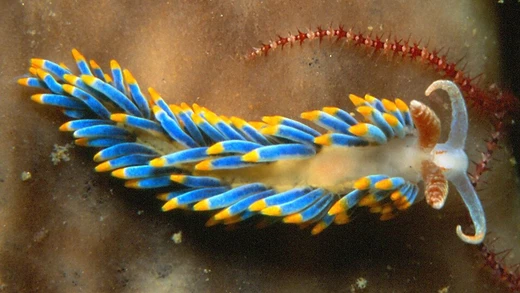
Kaloplocamus maru
A nudibranch with orange body and white diamond spot.

Kaloplocamus maru is a sea slug, a shell-less marine gastropod mollusk in the nudibranch family Polyceridae. The living animal is generally orange, with brown dots covering the entire back except for the pale yellow tips of the lateral appendages. A white diamond-shaped spot runs from behind the rhinophores to the tail, just behind the branchial leaves. The tip of the foot is pointed and matches the color of the appendage tips.
Two types of appendages appear on the body. The first type is longer and wider, positioned along the sides, with branched tips that have rounded bases and long, thin, sharp extensions; smaller sharp branches cover the rest of these appendages. The second type is thin and long, with many small, sharp, simple branches, and these occur across the entire body, sides, foot, and back. The oral veil has four appendages: two longer ones at the lateral edges and two shorter ones in the center. The rhinophores have a lamellate club and a stalk bearing sharp branches. Each rhinophoral sheath has three branches along its edge; the middle branch looks just like the lateral appendages, while the other two resemble the smaller body tentacles. The oral tentacles are simple, cylindrical folds of the mantle. The three branchial leaves are tripinnate, with the same simple, thin branches as the smaller appendages.
The type locality for this species is Palau.
Quick Facts
- Genus
- Kaloplocamus
- Species
- maru
Facts from the source article.
Lore & Background
The living animal has a general orange color, with brown dots covering the whole dorsum except the tips of the lateral appendages, which are pale yellow. A white diamond-shaped spot runs from behind the rhinophores to the tail just behind the branchial leaves. The end of the foot is acute and shares the pale yellow color of the appendage apices. Two types of appendages are observed: longer and wider ones positioned at the margin of the sides, with apical ramifications rounded at the base and a long, thin, sharp prolongation, plus small acute ramifications covering the rest; and a second type that is thin, long, with many small sharp, thin, and long simple ramifications, present on the entire body, sides, foot, and dorsum. The oral veil has four appendages—two longer at the lateral edges and two shorter in the center. The rhinophores have a lamellate clavus and a peduncle with acute ramifications; each rhinophoral sheath edge has three ramifications, the middle one virtually identical to the lateral appendages. The oral tentacles are simple folds of the mantle with the appearance of cylinders. The three branchial leaves are tripinnate, with the same simple and thin ramifications as the smaller appendages.
Reader's Guide
Kaloplocamus maru is described solely from its type locality in Palau. Its significance lies in the detailed morphological description of its appendages, which are categorized into two distinct types: longer, wider marginal appendages with apical ramifications, and thinner, longer appendages with many small sharp ramifications covering the entire body. The species also features a white diamond-shaped dorsal spot, a characteristic that aids in identification. The rhinophoral sheaths and oral veil appendages are also described in detail, contributing to the understanding of the genus Kaloplocamus within the family Polyceridae. The description of the branchial leaves as tripinnate with simple ramifications further distinguishes this species. No ecological or behavioral data are provided in the source, so its legacy is primarily taxonomic, based on the morphological traits recorded from the type specimen.
Did You Know?
- The dorsum has a white diamond-shaped spot running from behind the rhinophores to the tail.
- The end of the foot is acute and has a similar color to the appendage apices.
- The three branchial leaves are tripinnate with simple and thin ramifications.
More in Nudibranchs and Sea Slugs, Part 2 1-24
Spotted an error? Know more?
Reader corrections go straight into our review queue. Suggest an edit · How this site is sourced