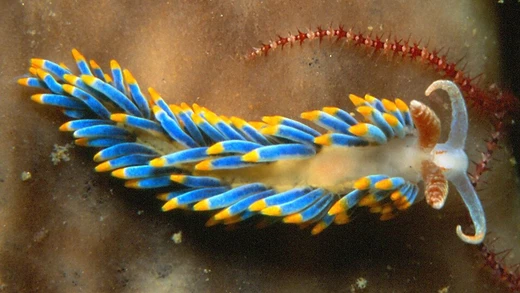
Kaloplocamus dokte
A transparent nudibranch with grape-like lateral appendage tips.

Kaloplocamus dokte is a sea slug, specifically a nudibranch and a shell-less marine gastropod mollusc belonging to the family Polyceridae. Its body is ovoid in shape, though the rear part of the foot is noticeably elongated. Most of the animal is opaque white, but the posterior foot and eight velar appendages are highly transparent. The central and upper parts of the body are translucent, allowing the digestive gland to be seen. There are three tripinnate gill leaves, which are a translucent red-carmine. The rhinophores share this color but are more translucent, with white dots at their tips. The long, large lateral appendages are entirely opaque white except at their tips, where they branch into many rounded, almost globular ramifications that resemble a bunch of grapes and are creamier in tone. There are four pairs of these lateral appendages; they are smooth along their length, with branching only at the tips and only on the outer side—the inner side remains smooth. The type locality is Barracuda Point, Madang, Papua New Guinea, and the species has also been reported from the Philippines and Indonesia.
Quick Facts
- Genus
- Kaloplocamus
- Species
- dokte
Facts from the source article.
Lore & Background
When alive, Kaloplocamus dokte appears ovoid but the posterior portion of the foot is elongated. Most of the animal is opaque white except for the posterior end of the foot and the eight velar appendages, which are highly transparent. The dorsal and central portions of the body are translucent, revealing the digestive gland. The three tripinnate branchial leaves are a translucent red-carmine, and the rhinophores share that color but are more translucent with white dots on the apex.
The long, large lateral appendages are totally opaque white except at the apex, where they ramify and become more cream in tone. There are four pairs of lateral appendages, smooth with ramifications only at the apex. These ramifications are rounded, almost globular, and numerous, resembling a bunch of grapes. They occur only on the exterior portion of the lateral appendage; the interior portion is smooth over its entire length.
The type locality is Barracuda Point, Madang, Papua New Guinea. In the original description it has also been reported from the Philippines and Indonesia.
Reader's Guide
Kaloplocamus dokte is a species of sea slug in the family Polyceridae, described from Barracuda Point, Madang, Papua New Guinea, with additional reports from the Philippines and Indonesia. Its significance lies in its unique morphological features: the body is ovoid with an elongated posterior foot, and most of the animal is opaque white except for the highly transparent posterior foot and eight velar appendages. The dorsal and central body regions are translucent, allowing the digestive gland to be visible. The three tripinnate branchial leaves are a translucent red-carmine, and the rhinophores share this color but are more translucent with white dots on the apex. The four pairs of lateral appendages are smooth and opaque white, except at the apex where they ramify into rounded, globular structures resembling a bunch of grapes—a feature that distinguishes this species. These ramifications occur only on the exterior portion of each appendage. The species is documented in the original description from Papua New Guinea, the Philippines, and Indonesia, and is listed in external links such as Sunshine Coast nudibranchs.
More in Nudibranchs and Sea Slugs, Part 2 1-24
Spotted an error? Know more?
Reader corrections go straight into our review queue. Suggest an edit · How this site is sourced