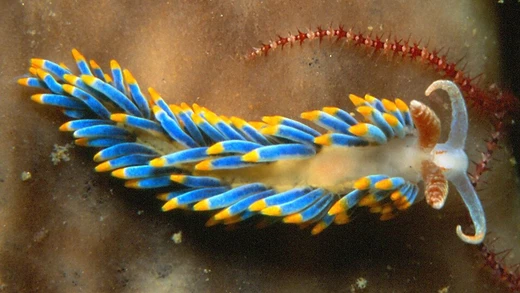
Hexabranchus morsomus
A large Caribbean sea slug with striking defensive swimming behavior.

The Caribbean Spanish Dancer, *Hexabranchus morsomus*, is a sea slug belonging to the family Hexabranchidae. This marine mollusk can grow up to 400 mm long. Its oval to elongate body has a reddish background with mottled white and yellow patches on the back, which is covered in small conical tubercles. The club-shaped rhinophores and large gill, made of several multi-pinnated leaves, are prominent features. The mantle margin often curls up over part of the back, covering white areas.
This species is found under rocks or coral rubble, mainly on living reefs, at depths from 0 to 33 meters. Its range includes the Caribbean Sea, with records from St. Kitts, the Netherlands Antilles, Honduras, Panama, Costa Rica, Venezuela, St. Lucia, Martinique, Antigua, Grenada, St. Vincent and the Grenadines, Trinidad and Tobago, Aruba, Puerto Rico, the Virgin Islands, and Sint Maarten. When threatened, it unrolls its mantle margins to reveal bright white patches and then swims by contracting its body and mantle. Members of the genus *Hexabranchus* feed on various sponges.
Quick Facts
- Taxon
- Hexabranchus morsomus
Facts from the source article.
Lore & Background
Hexabranchus morsomus occurs in the Caribbean Sea, including waters around St. Kitts and the Netherlands Antilles, and has also been identified in Honduras, Panama, Costa Rica, Venezuela, St. Lucia, Martinique, Antigua, Grenada, St. Vincent & the Grenadines, Trinidad and Tobago, Aruba, Puerto Rico, Virgin Islands, and Sint Maarten. Its body is oval to elongate, with a small dorsum bearing conical tubercles. The rhinophores are club shaped, and the gill is large, composed of several multi-pinnated leaves. The background color is reddish with mottled white and yellow patches on the dorsum, and the mantle margin is usually curled up over a small portion of the dorsum covering white areas. It is found under rocks or coral rubble, primarily on living reefs, at depths from 0 m to 33 m. Its defensive behavior consists of unrolling the mantle margins to expose bright white areas, followed by swimming by contracting the body and mantle margin. Species of the genus Hexabranchus prey on a variety of sponges.
Reader's Guide
Hexabranchus morsomus is a species of sea slug in the family Hexabranchidae, known from the Caribbean Sea and adjacent waters. Its large size, up to 400 mm, and distinctive reddish coloration with mottled white and yellow patches make it a notable member of its genus. The species exhibits a unique defensive behavior: unrolling its mantle margins to expose bright white areas and then swimming by contracting the body and mantle margin. This behavior, along with its habitat under rocks or coral rubble on living reefs, contributes to its ecological role. As a predator of a variety of sponges, it plays a part in the reef community. The species has been documented in multiple Caribbean locations, including St. Kitts, the Netherlands Antilles, Honduras, Panama, Costa Rica, Venezuela, and many islands. Its depth range extends from the surface to 33 meters. The scientific literature includes a study by Valdés (2002) on the number of species in the genus Hexabranchus, indicating ongoing taxonomic interest.
Did You Know?
- Hexabranchus morsomus can reach up to 400 mm in length.
- Its defensive behavior includes unrolling mantle margins to expose bright white areas and swimming by contracting the body and mantle margin.
Frequently Asked Questions
What is Hexabranchus morsomus?
It is a large Caribbean sea slug commonly known as the Spanish Dancer, classified in the family Hexabranchidae. Its body shows a reddish base color overlaid with mottled white and yellow patches, and its back is textured with small conical bumps.
How big does Hexabranchus morsomus grow?
This nudibranch can reach a maximum length of about 400 mm, roughly 16 inches, making it one of the more impressive-sized sea slugs you'll encounter in Caribbean waters.
Where can I find Hexabranchus morsomus in the wild?
It inhabits living reefs throughout the Caribbean Sea, typically sheltering beneath rocks or coral rubble at depths from the surface down to 33 meters. Its range stretches from St. Kitts and the Netherlands Antilles in the north all the way to Panama and Costa Rica in the south.
What makes Hexabranchus morsomus stand out among other sea slugs?
Its most famous trait is a defensive swimming behavior, where it actively propels itself through the water to flee from threats rather than relying solely on hiding. It is also visually striking, with prominent club-shaped rhinophores and a large gill composed of several feathery, multi-pinnated leaf-like structures.
What does the mantle of Hexabranchus morsomus look like?
The mantle margin frequently curls upward and drapes over part of the back, partially concealing the white areas beneath. Combined with the conical tubercles scattered across the body, this gives the slug a layered, textured appearance that distinguishes it from flatter-bodied nudibranchs.
More in Nudibranchs and Sea Slugs, Part 2 1-24
Spotted an error? Know more?
Reader corrections go straight into our review queue. Suggest an edit · How this site is sourced