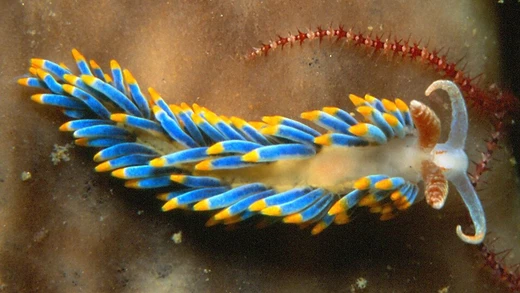
Crowned nudibranch
A variably coloured nudibranch native to southern Africa, invasive in Australia.

The crowned nudibranch (Polycera capensis) is a species of dorid nudibranch, a marine gastropod mollusc in the family Polyceridae. It is notable for its variable coloration and its status as an invasive species in eastern Australia, where it was introduced around Sydney during the 1920s.
Quick Facts
- Genus
- Polycera
- Species
- capensis
Facts from the source article.
Lore & Background
The crowned nudibranch has a smooth body with a white or grey ground colour, often marked with black, yellow, or orange longitudinal stripes along the notum, though these may be absent. Its head bears six yellow projections, and its gills and rhinophores are black, sometimes spotted with yellow. A pair of yellow projections sits alongside the gills. The animal can reach 50 mm in total length.
A DNA sequencing study found that specimens identified as P. capensis actually comprise two species, one of which appears to be the Twin-crowned nudibranch described by Gosliner in 1987. This indicates taxonomic uncertainty within the group.
The species feeds on bryozoans of the genus Bugula. Its egg ribbon is described as a wavy white collar.
Reader's Guide
The crowned nudibranch is significant both as a native component of southern African marine ecosystems and as an introduced species in eastern Australia. Its presence in Australia, first recorded around Sydney in the 1920s, is attributed to vessel biofouling, and it has since expanded southward along the east coast, becoming established as far south as Tasmania. This range expansion highlights the role of human transport in altering marine species distributions. The species' variable coloration and the discovery of cryptic diversity through DNA sequencing underscore the importance of genetic studies in nudibranch taxonomy. Its diet, restricted to bryozoans of the genus Bugula, ties it to specific prey availability. The egg ribbon, a wavy white collar, is a characteristic reproductive feature. The unresolved taxonomic split with the Twin-crowned nudibranch means that some historical records may refer to more than one species, affecting distribution and ecological data.
Did You Know?
- The crowned nudibranch was introduced to Sydney, Australia, around the 1920s via vessel biofouling.
- Its gills and rhinophores are black and may be spotted with yellow.
- A DNA study revealed that specimens identified as P. capensis may include a second species, the Twin-crowned nudibranch.
- The species feeds exclusively on bryozoans of the genus Bugula.
More in Nudibranchs and Sea Slugs, Part 2 1-24
Spotted an error? Know more?
Reader corrections go straight into our review queue. Suggest an edit · How this site is sourced