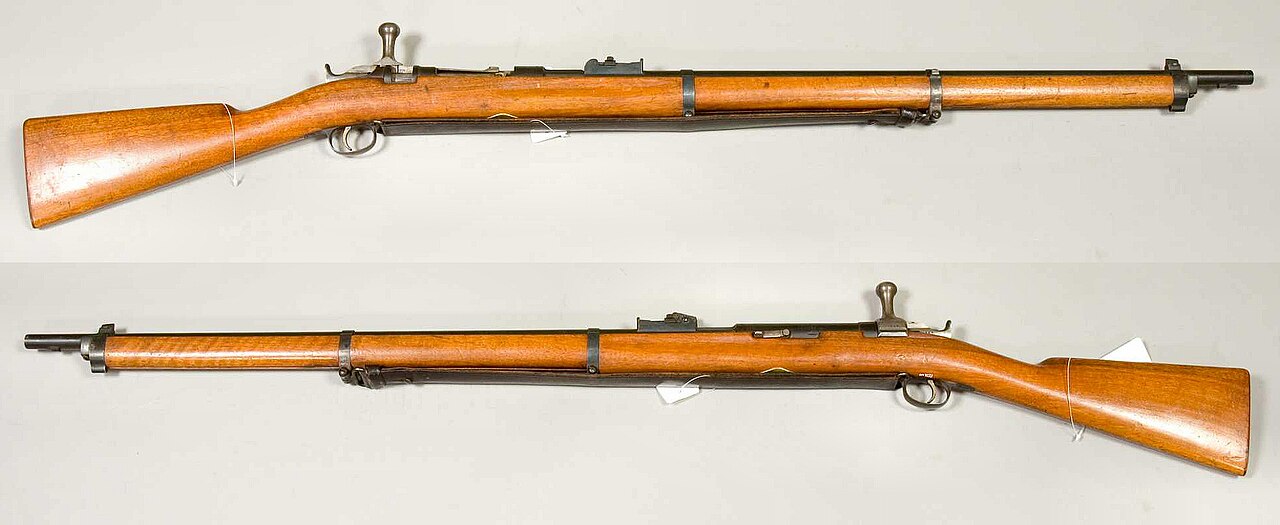
Jarmann M1884
A Norwegian bolt-action repeater firing 10.15 mm black powder cartridges from an 8-round tubular magazine.

Armémuseum (The Swedish Army Museum) · Public domain
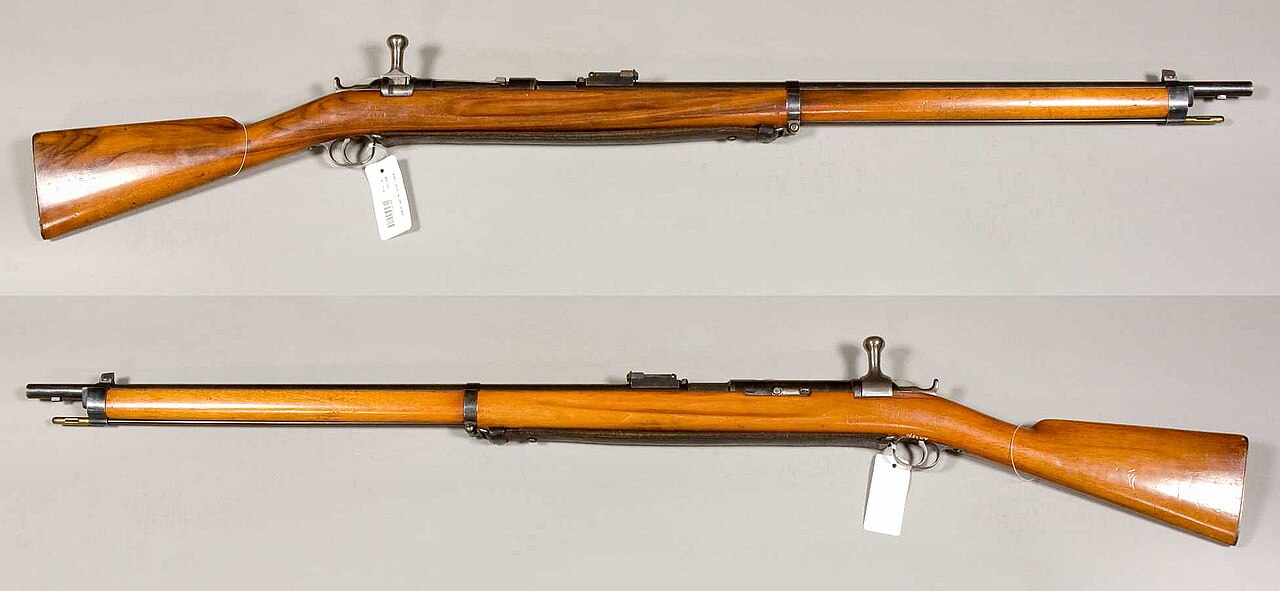
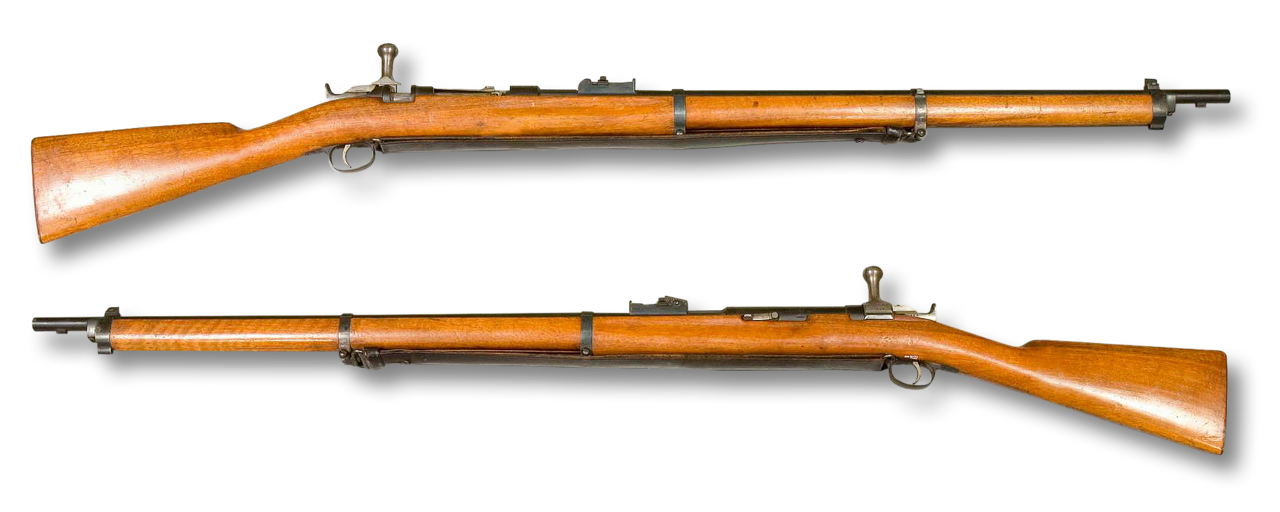
The Jarmann M1884 is a Norwegian bolt-action repeating rifle. Jacob Smith Jarmann, a Norwegian engineer, designed it in 1878, and it was adopted in 1884. This rifle and its later updates shifted the Norwegian Army away from single-shot black-powder weapons toward modern repeaters. Thousands were built for the Norwegian Armed Forces in the 1880s, and Sweden used it to a very limited extent. After Norway phased it out, some were converted into harpoon guns.
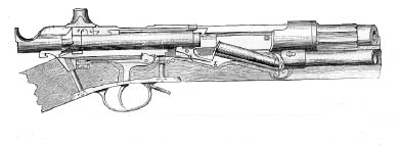
The rifle fires a 10.15 mm black powder cartridge from an 8-round tubular magazine located beneath the barrel. Its bolt does not rotate; instead, the bolt handle rotates to lock the action. The action is known for being smooth but is not strong enough for modern ammunition, as the rotating bolt handle provides the only locking. Jarmann first designed a breech-loading rifle in 1849 that used cardboard cartridges, but the military rejected it. In the 1870s, he left daily workshop duties to work on his bolt-action design. His patent claimed three unique features: an extractor that also limited the bolt’s rearward travel; a rotating bolt handle that locked the bolt to the receiver when forward; and the way the extractor attached to the bolt body. The rifle has no separate ejector; the extractor pushes the spent round onto the elevator, and friction ejects it from the receiver.
A joint Norwegian-Swedish rifle commission first tested the design. Initial results were positive but highlighted the need for a magazine. Several prototype repeaters were built. Ole Herman Johannes Krag, designer of the Krag–Petersson and Krag–Jørgensen rifles, created two magazines for the Jarmann: one nearly identical to the Krag–Petersson’s, and another that foreshadowed the Krag–Jørgensen’s. Jarmann himself made prototypes with under-barrel tubular magazines or detachable side-mounted magazines over the bolt; the side-mounted type was deemed unusable in the field. The final choice was a tubular magazine similar to the Kropatschek design, possibly inspired by it or by the Krag–Petersson magazine. Despite its pioneering design, the Jarmann M1884 is not considered a success.
Quick Facts
- Origin
- Norway
- Designer
- Jacob Smith Jarmann
- Design Date
- 1878
- Service
- 1884 to 1900 (reissued to second line units in 1905)
- Cartridge
- 10.15×61mmR
- Action
- Bolt action
- Rate
- Unknown, but as fast as the operator could operate the action
- Velocity
- 485 to 500 m/s (1,191 to 1,640 ft/s)
- Range
- 430 m (with iron sight)
- Max Range
- 2,400 m (10.15 x 61R rimmed)
- Weight
- 4.5 kg (10 lb)
- Length
- Unknown
Facts from the source article.
Lore & Background
Jacob Smith Jarmann designed his first breech-loading rifle in 1849, firing cardboard cartridges, but it was turned down. In the 1870s, he stepped down from his workshop to work on his newly invented bolt-action rifle. The design was first tested by a joint Norwegian-Swedish rifle commission, whose favorable tests highlighted the desirability of a repeating weapon. Several magazine-fed prototypes were built, including designs by Ole Herman Johannes Krag, who created two different magazines for the Jarmann. Jarmann himself made prototypes with tubular magazines under the barrel or detachable magazines mounted sideways over the bolt, but the tubular magazine was selected for the weapon.
Reader's Guide
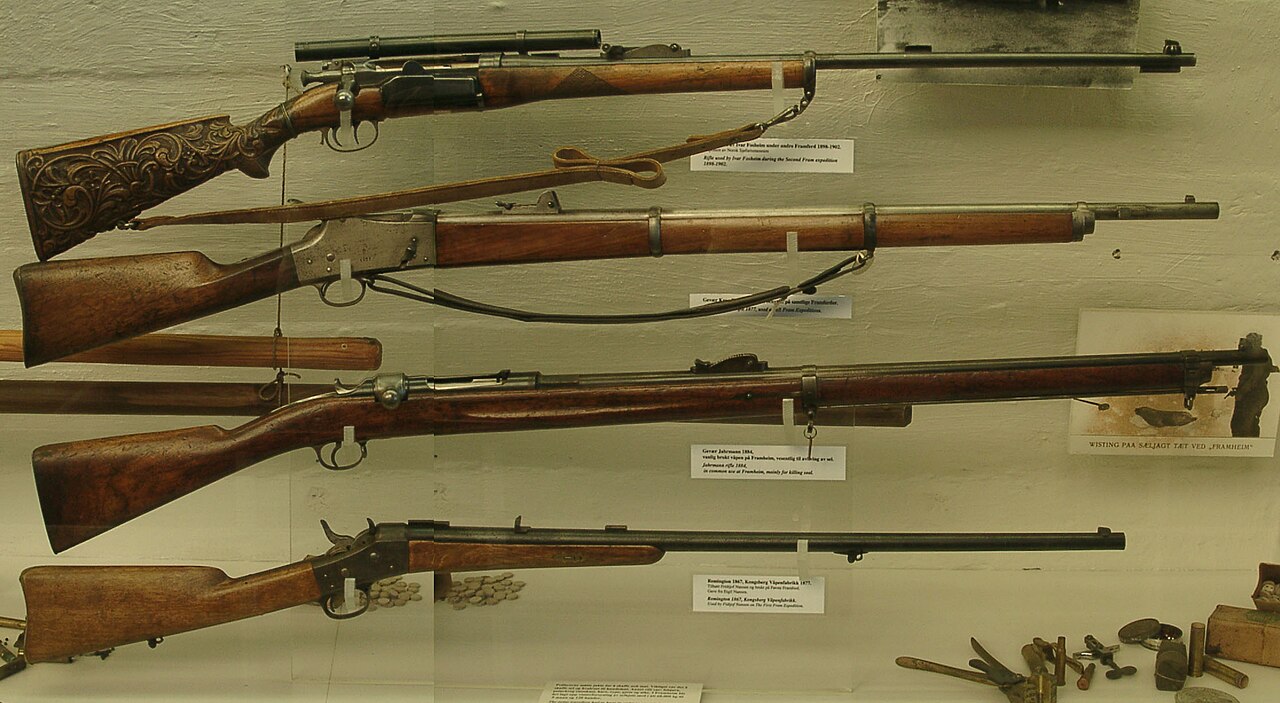
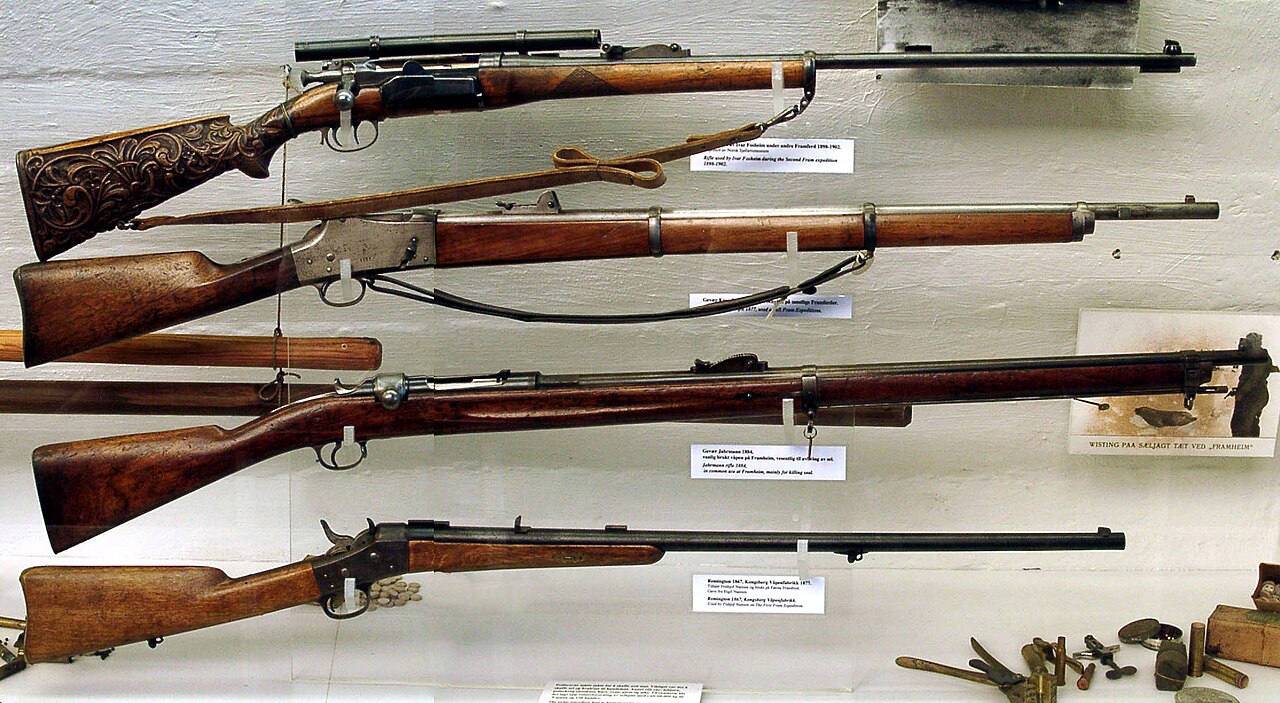
The Jarmann M1884 was a trailblazer with its pioneering design, but it cannot be considered successful. The combination of tubular magazine and centerfire ammunition was referred to as 'too excitable,' especially with pointed bullets, and the weapon's balance changed with every shot. Despite these issues, it was remarkably accurate for its time, with a spread at 600 meters of only 46 cm with jacketed bullets, compared to 96 cm for the Remington M1867. It replaced the Remington M1867 and the last kammerladers in Norwegian service, but within a decade it was eclipsed by the Krag–Jørgensen rifle. After being phased out, many were rebuilt as M28 harpoon guns or sold to civilians. The Jarmann's significance lies in its role as a transitional weapon that introduced repeating and smokeless-powder technology to the Norwegian military, despite its eventual obsolescence.
Did You Know?
- The Jarmann M1884 does not have a separate ejector; it relies on the extractor pushing the spent round onto the elevator, with friction safely ejecting the round.
- The sights were graduated from 200 m to 1600 m, with an additional sidemounted volley sight for indirect fire from 1600 m to 2400 m.
- More than 5 million cartridges were manufactured for the M1884, including variations for ball, gallery, blank, dummy, and harpoon rounds.
- The Jarmann was used by second-line units in 1905 when war between Norway and Sweden was considered imminent.
A Proprietary Action Built on Three Patented Principles
The Jarmann M1884's bolt mechanism stands apart from virtually every other rifle of its era. Rather than relying on lugs or a rotating bolt to seal the breech, the design locks the action solely through a rotating bolt handle that clamps the bolt into the receiver when in the forward position. This made the action smooth to operate but inherently limited in structural strength, rendering it unsuitable for modern high-pressure loads. Three specific features were deemed novel enough to warrant patent protection: the extractor, which simultaneously pulled spent cases from the chamber and acted as a mechanical stop limiting how far the bolt could travel rearward; the locking geometry of the rotating handle itself; and the method by which the extractor was fixed to the bolt body. Perhaps most idiosyncratic, the action omitted a dedicated ejector entirely. Instead, the extractor simply shoved the spent round downward onto the elevator, and the friction generated during that brief contact was sufficient to toss the case clear of the receiver.
From Rejected Prototype to National Standard
Jacob Smith Jarmann's path to military adoption was neither swift nor certain. As early as 1838 he had produced a breech-loading rifle firing cardboard cartridges, but the armed forces of the day dismissed it, reasoning that a weapon capable of thirteen rounds per minute would outstrip any realistic ammunition supply chain. Decades later, in the 1870s, Jarmann stepped away from the day-to-day management of his workshop to devote himself to a new bolt-action design. The resulting rifle first attracted the attention of a joint Norwegian-Swedish rifle commission, whose initial trials were favorable but pointedly noted the absence of a magazine. Several magazine-fed prototypes followed: Ole Herman Johannes Krag, already known for the Krag–Petersson, contributed two distinct magazine designs, while Jarmann himself experimented with tubular magazines beneath the barrel and detachable side-mounted boxes over the bolt. The side-mounted option was judged impractical for field use, and the tubular arrangement was ultimately selected. After further refinement, the weapon was formally adopted in 1884, transforming the Norwegian Army from a force of single-shot black-powder rifles into one equipped with modern repeating firearms.
A Cartridge Family Built for Transition
The 10.15 x 61R round developed alongside the rifle by the same Norwegian-Swedish commission tells a story of technological transition. The original loading paired a paper-wrapped lead bullet with black powder, but the cartridge was later reloaded with smokeless powder and a full metal jacket, marking the weapon's evolution from a black-powder platform to a modern one. Over the life of the M1884, more than five million service cartridges were produced, supplemented by several thousand specialty rounds. The identified variants span a wide functional range: rounded and flat-tipped ball loads for field use; gallery rounds with plain lead bullets for indoor or short-range practice; blanks fitted with unpainted wooden projectiles and various ridge patterns pressed into the case for drill and signaling; dummy rounds distinguished by red or brown wooden inserts, crimped neck rings, and ridge configurations for training and testing; and, most unusually, dedicated harpoon rounds—essentially sealed blanks—manufactured exclusively for the M28 harpoon gun into which surplus rifles were later converted.
Sights, Accuracy, and an Unlikely Second Life
For its period, the Jarmann M1884 was a remarkably precise instrument. The original sight leaves were graduated from 200 to 1,600 metres, and an additional sidemounted volley sight extended the scale to 2,400 metres, intended for coordinated company-level indirect fire where simultaneous volleys would statistically ensure some rounds struck target. During production, rifles bearing serial numbers above 4,330 received a concealed battle sight on the rear of the sight leaf, set to a fixed range of roughly 430 metres—close to the weapon's maximum point-blank distance. Sights were calibrated using improved ammunition that pushed muzzle velocity to between 485 and 500 metres per second. Despite its accuracy, the combination of a tubular magazine with centerfire ammunition earned the unflattering label "too excitable," particularly with pointed projectiles, and the weapon's balance shifted with every round fired—issues shared by all tubular-magazine firearms. After the M1884 was phased out of Norwegian service, a number of the rifles were rebuilt as harpoon guns, while a small quantity saw limited use in Sweden.
Gallery
Frequently Asked Questions
What is the Jarmann M1884?
It is a Norwegian bolt-action repeating rifle that helped transition the Norwegian Army from single-shot black-powder arms to modern magazine-fed weapons. Adopted in 1884, thousands were manufactured for Norwegian military use during the 1880s.
Who created the Jarmann M1884?
The rifle was designed by Jacob Smith Jarmann, a Norwegian engineer, who completed the design in 1878. It entered Norwegian military service six years later, in 1884.
What is special about the Jarmann M1884's bolt mechanism?
Rather than rotating the bolt body to lock it in place, this design keeps the bolt stationary and secures it by rotating the bolt handle. This non-rotating bolt action was a distinctive engineering choice for its era.
What cartridge does the Jarmann M1884 use and what is its magazine capacity?
The rifle fires a 10.15 mm black powder round from an 8-round tubular magazine mounted beneath the barrel.
What became of Jarmann M1884 rifles after they left military service?
After Norway retired the model, a portion of the remaining stock was converted into harpoon guns for other uses. Sweden had employed the rifle only in very small numbers during its period of service.
More in Norwegian inventions 1-24
Spotted an error? Know more?
Reader corrections go straight into our review queue. Suggest an edit · How this site is sourced