Buddy (electric car)
Norwegian electric city car produced from early 2000s to 2013.

OTFW , Berlin · CC BY-SA 3.0
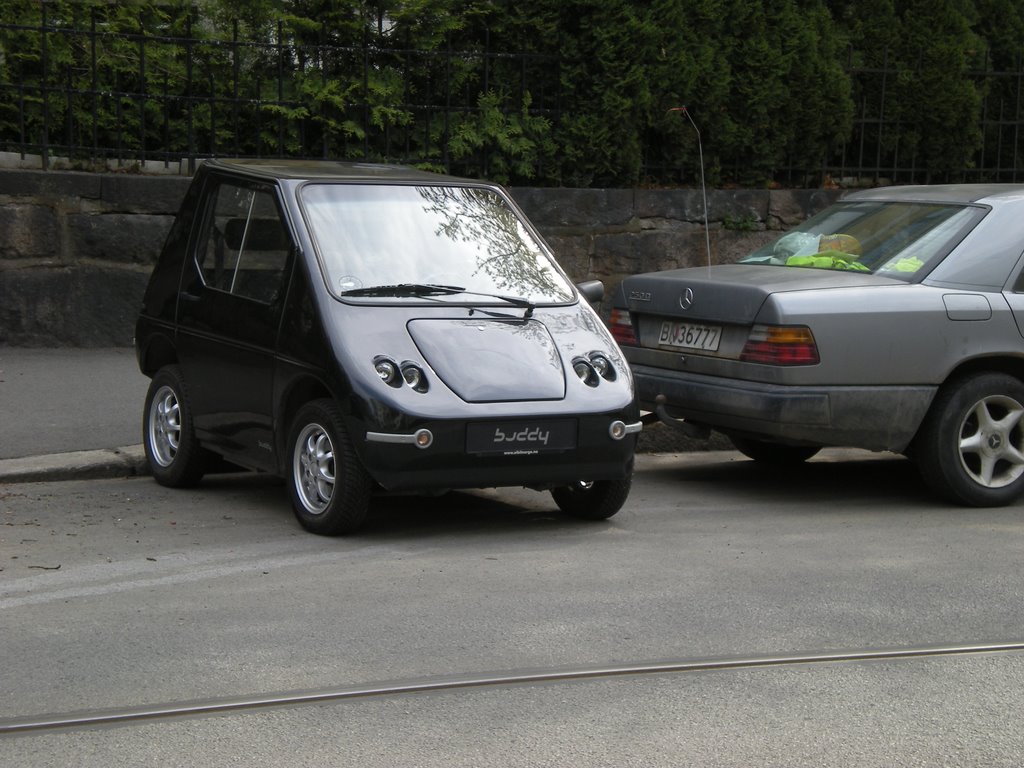
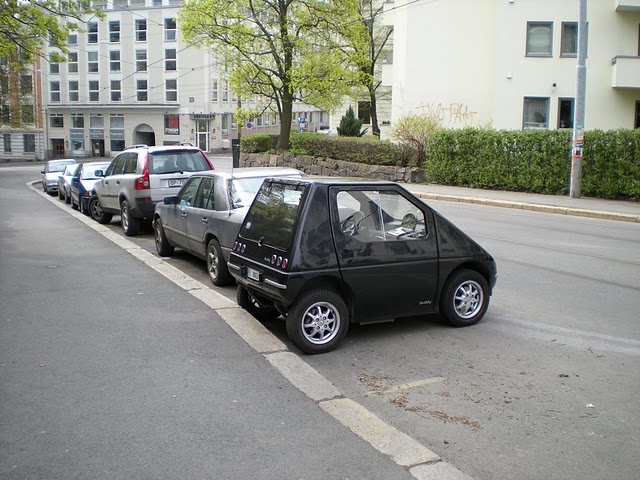
The Buddy is a Norwegian electric city car produced by Buddy Electric (formerly Pure Mobility and Elbil Norge AS) at Økern in Oslo during the early 2000s. It is the sixth generation of the Kewet electric vehicle, originally developed in Hadsund, Denmark, with the first model made in 1991. In 2007, the Buddy and its predecessor, the Kewet, accounted for 20% of electric cars in Norway.
Quick Facts
- Manufacturer
- Buddy Electric (formerly known as Pure Mobility)
- Class
- heavy quadricycle
- Motor
- 72V Sepex 13 kW brushed DC motor
- Wheelbase
- 1550 mm (61.0 in)
- Length
- 2440 mm (96 in)
- Height
- 1440 mm (56.7 in)
- Predecessor
- Kewet
- Production
- 2005–2013
- Model Years
- 2006–2013
Facts from the source article.
Lore & Background
The Buddy is the sixth generation of the Kewet electric vehicle, which was first developed in Hadsund, Denmark, in 1991. Production alternated between Hadsund and Nordhausen, Germany. Over the first five generations, more than 1,000 vehicles were produced and sold in 18 countries. In 1998, all rights were acquired by ElBil Norge AS (then called Kollega Bil AS), which further developed the vehicle. In autumn 2005, a new model was presented, initially called Kewet Buddy Citi-Jet 6, later known simply as the Buddy.
The Buddy is a simple, functional electric city car with a range of 20 to 60 km (12 to 37 mi) depending on season, topography, and driving style. Its maximum speed is 80 km/h (50 mph), and its length is 244 cm (96 in). The car has a hot galvanized steel tube frame with safety cage but no proper deformation zones. The body was originally thin fiberglass; later versions used an innovative polymer pDCPD. The electric motor is a 72V Sepex 13 kW direct current motor with brushes. The car lacks servo assistance, ABS, ESP, and airbags.
Two models were available: the standard version and the BuddyCab with a folding roof. In 2007, production at Økern was 5–6 vehicles per week, with a theoretical capacity of 500 annually. As of late 2008, plans existed for an additional factory in Portugal with projected production of 5,000 cars per year. ElBil Norge AS later rebranded as Pure Mobility AS, declared bankruptcy in 2011, and was liquidated in 2014.
Reader's Guide
The Buddy represents a notable chapter in early electric vehicle adoption, particularly in Norway. Combined sales of the Kewet and Buddy totaled about 1,500 vehicles through October 2013, with 1,087 registered in Norway. In 2006, the Buddy ranked 29th in sales by automotive brands in Norway, ahead of Jaguar, Fiat, Smart, and Porsche. About 80% of Buddys were delivered in strong, bright colors with decorative elements such as flowers, hearts, clouds, and flames. The car was classified in the EU as a heavy quadricycle, requiring only an ordinary driver's license. Its production ceased after the 2013 model year, but the Buddy appeared in the Hollywood film *Downsizing* (2017) and the Norwegian drama *1001 Grams* (2014). The vehicle's legacy lies in its role as a pioneering electric city car in a market that later became a global leader in electric vehicle adoption.
Did You Know?
- In 2007, the Buddy and its predecessor the Kewet made up 20% of electric cars in Norway.
- The Buddy's body was originally made of thin fiberglass; later versions used an innovative polymer called pDCPD.
- 125 Buddies were sold in Norway in 2011, representing 6% of all electric vehicles sold in the country that year.
A Danish-Born Lineage
The Buddy electric car traces its roots to 1991, when the first Kewet was built in Hadsund, Denmark. Over the following years, production shifted between Hadsund and Nordhausen in Germany, and more than a thousand vehicles from the first five Kewet generations found buyers across eighteen countries. In 1998, the Norwegian firm Kollega Bil AS—later renamed ElBil Norge AS—acquired all rights to the vehicle. The company spent the intervening years refining the design before unveiling a refreshed model in the autumn of 2005. Initially marketed as the Kewet Buddy Citi-Jet 6, the car was eventually shortened to simply "Buddy." By 2007, the Buddy and its Kewet predecessor together accounted for roughly a fifth of all electric vehicles on Norwegian roads. Through October 2013, combined sales of the Kewet and Buddy generations had reached approximately 1,500 units worldwide, of which 1,087 were registered in Norway.
Deliberate Simplicity as an Engineering Philosophy
The Buddy was conceived as a straightforward, functional city car rather than a technologically ambitious one. Its structure rests on a hot-galvanized steel tube frame forming a safety cage, yet it deliberately omits conventional deformation zones. Body panels were originally thin fiberglass, later replaced with a polymer called pDCPD that cut costs and weight while improving impact resistance. Power comes from a 72-volt Sepex 13 kW brushed DC motor, and the car tops out at 80 km/h with a seasonal range of 20 to 60 km. There is no power steering, no ABS, no ESP, and no airbags; the braking and steering response is described as vague and difficult to finesse. Lead-acid batteries weighing roughly 395 kg provide about 10.5 kWh of usable energy, recharging in six to eight hours from a standard grounded outlet. The vehicle seats three adults, measures 244 cm in length, and is classified in the EU as a heavy quadricycle, meaning an ordinary driver's license suffices. In 2007, the Økern factory in Oslo was turning out five to six cars per week, with a theoretical annual capacity of 500.
A Colourful Presence on Norwegian Streets
In a country where most new cars arrive in dark or muted shades, the Buddy stood out as a splash of personality. Around 80 percent of the vehicles were delivered in bold, bright colours, and many carried playful decorative motifs—flowers, hearts, clouds, even flames. One owner had a Buddy painted to match the cloud pattern on his night-table lamp. This idiosyncratic charm helped the car build a loyal following. In 2006, Buddy ranked twenty-ninth among all automotive brands selling in Norway, edging ahead of Jaguar, Fiat, Smart, and Porsche. By 2011, 125 Buddies were sold that year, representing six percent of the nation's total electric-vehicle market. The registered fleet in Norway grew steadily: by September 2013, 1,087 units were on the road, broken down across the various Kewet and Buddy generations, with the 2005–2009 Citi-Jet 6 accounting for 634 of them and the 2010–2013 M9 for 379.
Rise, Rebranding, and Collapse
The company behind the Buddy went through several identity changes. Originally established in 1992 as Kollega Bil AS, it became ElBil Norge AS in 2003, then rebranded as Pure Mobility AS. The firm was owned by founders Jan-Petter Skram and Viggo Vargum, with external backing from Hafslund Venture AS, members of the Selvaag family, and other investors. In 2005, the owners poured NOK 12 million into expanding the Økern factory, and the company reported profitability in both 2004 and 2005, maintaining a 90 percent owner-equity-to-debt ratio. Ambitions grew: in late 2008, plans were announced for a Portuguese factory capable of producing 5,000 cars a year, and a development fleet was being tested with lithium-ion battery systems. Yet the trajectory reversed sharply. Pure Mobility declared bankruptcy in 2011, was liquidated in 2014, and Buddy production ceased after the 2013 model year, ending a project that had spanned more than two decades.
Gallery


Frequently Asked Questions
What is the Buddy electric car?
The Buddy is a small electric city car built for urban driving in Norway. It was manufactured in Oslo during the early 2000s and stayed in production until 2013.
Who made the Buddy electric car?
Buddy Electric, a company that previously operated under the names Pure Mobility and Elbil Norge AS, produced the vehicle. Its factory was located in the Økern district of Oslo.
What is the Buddy's connection to the Kewet?
The Buddy is the sixth generation in the Kewet electric vehicle lineage, a line that began in Hadsund, Denmark, with the original model arriving in 1991. Each successive generation kept the compact electric city-car concept while updating the design.
How significant was the Buddy in Norway's EV market?
In 2007 the Buddy and its Kewet predecessor together represented about one-fifth of all electric cars on Norwegian roads. That made the platform one of the most common EVs in the country at the time.
When did Buddy production end?
Manufacturing of the Buddy ran from the early 2000s until 2013, giving the model more than a decade of service. It served as a staple of Norway's early electric-vehicle fleet throughout that period.
More in Norwegian inventions 1-24
Spotted an error? Know more?
Reader corrections go straight into our review queue. Suggest an edit · How this site is sourced