
AVR microcontrollers
8-bit RISC microcontrollers with on-chip flash memory.

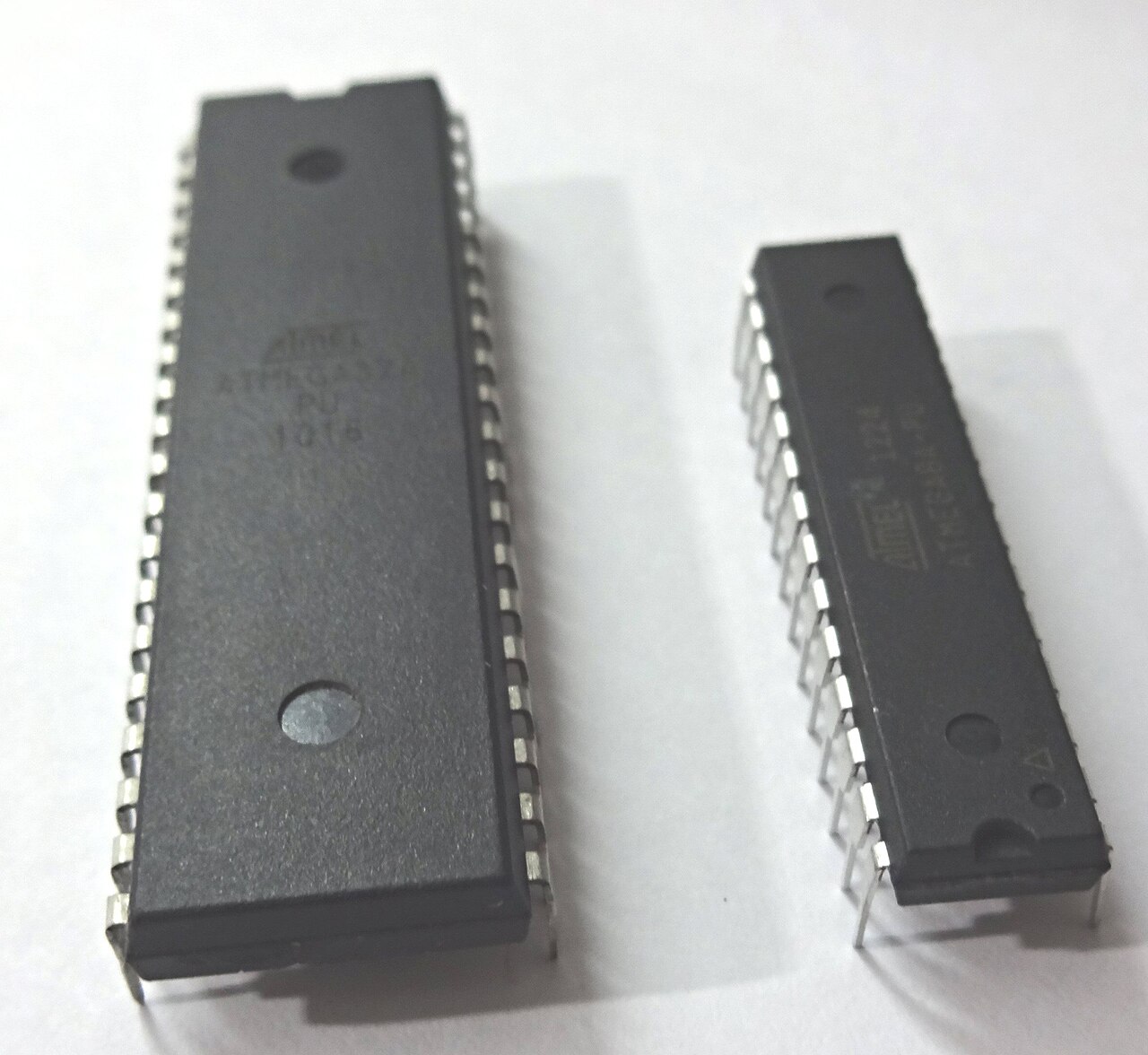
Vahid alpha at English Wikipedia · CC BY 3.0
AVR is a family of 8-bit RISC single-chip microcontrollers developed since 1996 by Atmel, which was acquired by Microchip Technology in 2016. Based on a modified Harvard architecture, AVR was one of the first microcontroller families to use on-chip flash memory for program storage, replacing one-time programmable ROM, EPROM, or EEPROM used by other microcontrollers at the time. They are widely used as embedded systems, especially in hobbyist and educational applications, popularized by their inclusion in many Arduino development boards.
- Introduced
- 1997
- Field
- Microcontrollers
- Developer
- Atmel (acquired by Microchip Technology in 2016)
- Architecture
- 8-bit RISC, modified Harvard
- Known for
- On-chip flash memory, Arduino platform integration
- Units shipped by 2003
- 500 million
Lore & Background
The AVR architecture was conceived by two students at the Norwegian Institute of Technology (NTH), Alf-Egil Bogen and Vegard Wollan. Atmel states that the name AVR is not an acronym, though it is commonly accepted to stand for 'Alf and Vegard's RISC processor.' The original AVR MCU was developed at Nordic VLSI (now Nordic Semiconductor) in Trondheim, Norway, where Bogen and Wollan worked as students. It was known as a μRISC and was available as silicon IP. When the technology was sold to Atmel, the architecture was further developed by Bogen and Wollan at Atmel Norway, a subsidiary of Atmel. The designers worked closely with compiler writers at IAR Systems to ensure efficient compilation of high-level languages.
Reader's Guide
The AVR microcontroller family has had a significant impact on embedded systems, particularly in education and hobbyist communities through the Arduino platform, which debuted in 2005 featuring ATmega8 AVR microcontrollers. Its use of on-chip flash memory for program storage was innovative at the time, simplifying development and reprogramming. The architecture includes 32 single-byte registers and is classified as 8-bit RISC. AVRs are generally classified into families such as tinyAVR, megaAVR, AVR Dx, XMEGA, and application-specific variants. In 2006, Atmel released the unrelated 32-bit AVR32 architecture, but later focused on ARM Cortex-M and Cortex-A cores. The AVR line remains relevant for low-power, cost-sensitive applications, with continued development of new series like the tinyAVR 0/1/2 and megaAVR 0-series in 2016, and the AVR Dx family in 2020.
From Trondheim to the World: The Birth of AVR
The AVR architecture traces its origins to two students at the Norwegian Institute of Technology, Alf-Egil Bogen and Vegard Wollan, who conceived the design in the mid-1990s. Their work took shape at Nordic VLSI, a local ASIC design firm in Trondheim, Norway, where the two were employed as students. The original chip was called μRISC, short for Micro RISC, and was offered as a silicon intellectual-property building block rather than a finished microcontroller product. When Atmel acquired the technology from Nordic VLSI, Bogen and Wollan continued refining the internal architecture at Atmel Norway, a subsidiary of the parent company. A notable aspect of the development process was the close collaboration between the hardware designers and compiler engineers at IAR Systems, who worked together to ensure the instruction set would compile high-level languages efficiently. The 8-bit AVR architecture was formally introduced in 1997, and the name AVR, while officially not an acronym according to Atmel, is widely understood to honor its two creators: Alf and Vegard's RISC processor.
Flash, Harvard, and a Pinout That Mattered
At the time of its introduction, AVR stood out among microcontroller families for a critical design choice: it was one of the first to embed flash memory directly on the chip for program storage. Competing devices of that era relied on one-time programmable ROM, EPROM, or EEPROM, which made iterative development far more cumbersome. The AVR's 8-bit RISC core operates on a modified Harvard architecture, meaning program instructions and data live in physically separate memory systems with distinct address spaces, yet special instructions allow the processor to read data items from program memory when needed. This hybrid approach gives designers the speed benefits of separated instruction and data paths while retaining enough flexibility to treat program memory as a data source. The first commercially notable part in the line, the AT90S8515, was packaged in a 40-pin DIP with a pinout deliberately matching the 8051 microcontroller, including the same external multiplexed address and data bus layout. The only pin-level difference was the polarity of the RESET line, active-low on AVR versus active-high on the 8051, making migration from the established 8051 ecosystem considerably smoother for engineers already familiar with that platform.
The Arduino Effect and a Maker-Culture Legacy
Few microcontroller families have achieved the kind of cultural penetration in maker and educational circles that AVR has, largely thanks to the Arduino platform. Released in 2005, Arduino boards were built around ATmega8 AVR microcontrollers, giving millions of students, hobbyists, and tinkerers their first hands-on experience with embedded systems. The AVR's combination of on-chip flash, a straightforward 8-bit RISC instruction set, and accessible tooling made it an ideal teaching and prototyping platform. By 2003, Atmel had already shipped 500 million AVR flash microcontrollers, a testament to the architecture's broad embedded-systems adoption well before Arduino amplified its visibility. The family's versatility is reflected in its wide range of device classes: the compact ATtiny series for space-constrained projects, the feature-rich ATmega series with extended instruction sets and extensive peripheral sets, and the XMEGA line adding capabilities like DMA, an Event System, and cryptography support. This breadth means an AVR-based solution can scale from a simple sensor node to a more complex application, all within the same architectural family a beginner might first encounter on an Arduino board.
A Family That Keeps Growing, and a 32-Bit Side Quest
The AVR family has undergone significant expansion since its 1997 debut. In 2016, Atmel was acquired by Microchip Technology, and that same year saw the release of the improved tinyAVR 0/1/2-series and megaAVR 0-series, both introducing an Event System, enhanced peripherals, and an improved AVRxt instruction set with better call timing and hardware multiply. The AVR Dx family, launched in the early 2020s, targets human-computer interaction, analog signal conditioning, and functional safety, with sub-families like the DA, DB, DD, and EA series each adding specialized features such as on-chip op-amps, MultiVoltage IO, programmable gain amplifiers, and high-channel-count 12-bit ADCs. In a separate architectural direction, Atmel released the 32-bit AVR32 in 2006, a completely unrelated design with a 32-bit data path, SIMD, and DSP instructions intended to compete with ARM-based processors. However, AVR32 never achieved the same ecosystem momentum; Linux support was dropped in kernel 4.12, and GCC compiler support was never mainlined, remaining available only through a vendor-supported fork. This contrast underscores how the 8-bit AVR line, with its deep hobbyist and industrial following, remained the family's enduring core.
Gallery
Frequently Asked Questions
What are AVR microcontrollers?
AVR is a family of 8-bit RISC single-chip microcontrollers that have been in production since the late 1990s. They use a modified Harvard architecture to separate instruction and data pathways within the chip.
Who created AVR microcontrollers and who owns them now?
Atmel, a semiconductor company, designed the AVR architecture starting in 1996. In 2016, Microchip Technology acquired Atmel and now manufactures the AVR line.
What made AVR microcontrollers groundbreaking when they launched?
They were among the first microcontroller families to include on-chip flash memory for storing programs, letting developers erase and rewrite code repeatedly. This replaced older one-time-programmable ROMs and EPROMs that required physical reprogramming.
Why do so many hobbyists and students use AVR microcontrollers?
Their integration into the Arduino platform made them an accessible entry point into embedded programming for beginners worldwide. The combination of low cost, abundant community support, and reprogrammable flash memory keeps them a staple in maker education.
How much commercial impact did AVR microcontrollers have?
By 2003, Atmel had shipped roughly 500 million AVR units, demonstrating massive adoption across consumer electronics and industrial applications. Their continued presence in the market speaks to the durability of the original 1996 design.
More in Norwegian inventions 1-24
Spotted an error? Know more?
Reader corrections go straight into our review queue. Suggest an edit · How this site is sourced