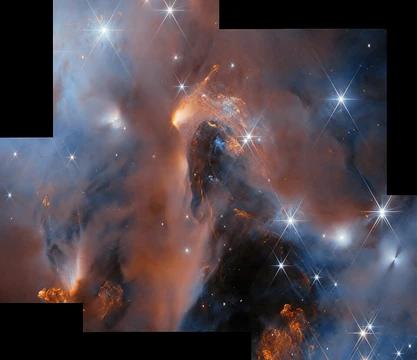
NGC 2935
A large star-forming burst galaxy in Hydra with a nuclear disk.

NGC 2935 is a large intermediate spiral galaxy located in the constellation Hydra. It is notable for its star-forming burst activity and for hosting a star-forming disk around its core, as observed by the Hubble Space Telescope. The galaxy is also the namesake of a small group of three galaxies.
Quick Facts
- Epoch
- J2000
- Constellation Name
- Hydra
- Sbrightness
- 23.9 mag/arcsec^2
- Ra
- 09 · 36 · 44.8615
- Dec
- -21 · 07 · 41.53
- Z
- 0.007575
- H Radial V
- 2271 ± 3 km/s
- Dist Ly
- 27.890 ± 0.736 Mpc
- Appmag V
- 12.1
Facts from the source article.
Lore & Background
NGC 2935 was discovered by German-British astronomer William Herschel on 20 March 1786. It was classified by Gérard de Vaucouleurs as morphological type (R2')SAB(s)b in his galaxy atlas, with a luminosity class of II and a broad HI line. The galaxy is a star-forming burst galaxy. Observations from the Hubble Space Telescope have revealed a star-forming disk around its core, with a semi-major axis estimated at 530 pc (~1730 light years) at the galaxy's estimated distance.
Four supernovae have been discovered in NGC 2935: SN 1975F (type unknown, mag. 15) discovered by Yvonne Dunlap and Justus R. Dunlap of the Corralitos Observatory on 11 June 1975; SN 1996Z (Type Ia, mag. 16) discovered by Wayne Johnson on 16 May 1996; SN 2021mwj (Type II, mag. 17.674) discovered by ATLAS on 21 May 2021; and SN 2021aczp (Type II, mag. 18.878) discovered by ATLAS on 1 November 2021.
NGC 2935 is part of a small group of three galaxies named after it, which also includes NGC 2983 and NGC 2986. The galaxy's distance measurements show a discrepancy: its speed relative to the cosmic microwave background gives a Hubble distance of 38.4 ± 2.7 Mpc, while the average of 29 redshift-based measurements yields a distance of 27.890 ± 3.962 Mpc, which lies outside the Hubble distance values.
Reader's Guide
NGC 2935 holds significance as a well-studied example of an intermediate spiral galaxy with active star formation. Its classification by de Vaucouleurs as (R2')SAB(s)b places it within a detailed morphological scheme, and its luminosity class II indicates a relatively bright galaxy. The presence of a star-forming disk around its core, imaged by the Hubble Space Telescope, provides insight into nuclear star formation processes. The galaxy's status as a star-forming burst galaxy further underscores its role in studies of galactic evolution and starburst phenomena.
The four supernovae recorded in NGC 2935, spanning from 1975 to 2021, contribute to the understanding of supernova rates and types in such galaxies. The discrepancy between its Hubble distance and the average redshift-based distance highlights ongoing challenges in extragalactic distance measurements. As the brightest member of its namesake group, NGC 2935 serves as a reference point for studying galaxy interactions and group dynamics. Its broad HI line and morphological features make it a target for radio and optical surveys investigating the structure and kinematics of spiral galaxies.
Did You Know?
- NGC 2935 was discovered by William Herschel on 20 March 1786.
- Four supernovae have been discovered in NGC 2935: SN 1975F, SN 1996Z, SN 2021mwj, and SN 2021aczp.
- The galaxy is the namesake of a small group that also includes NGC 2983 and NGC 2986.
More in NGC Objects, Part 4 1-24
Spotted an error? Know more?
Reader corrections go straight into our review queue. Suggest an edit · How this site is sourced