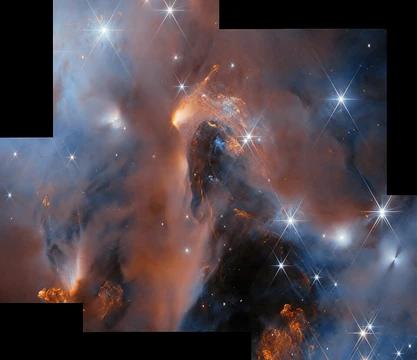
NGC 2520
An open cluster in Puppis, also catalogued as NGC 2527.

NGC 2520 is an open cluster of stars in the constellation of Puppis. It was observed by John Herschel on February 5, 1837, and was catalogued as a different object from NGC 2527, though it is now recognized as the same cluster.
Quick Facts
- Epoch
- J2000
- Constellation
- Puppis
- Ra
- 08 · 04 · 58
- Dec
- -28 · 08 · 48
- Dist Ly
- 601 pc
- Appmag V
- 6.5
- Mass Msol
- 740
- Age
- 445 million years / 810 million years
- Names
- NGC 2520, Cr 174
Facts from the source article.
Lore & Background
NGC 2520 was first discovered as NGC 2527 by William Herschel on December 9, 1784. His son John Herschel later observed the cluster on January 7, 1831, and again on February 5, 1837, on which occasion he identified it as a different object, leading to the separate NGC 2520 designation. The cluster is poor and lacks central concentration, classified as Trumpler class III1p. Its core radius is 1 parsec (3.3 light years), and its tidal radius is 5.1 parsecs (17 light years), marking the average outer limit beyond which stars are unlikely to remain gravitationally bound. Within the central part of the cluster, 37 probable member stars are located, and 96 probable members lie within the angular radius. The brightest stars are A-type, with the brightest being an A3 star of magnitude 9.38. One white dwarf has been detected in the cluster. The cluster's age is estimated, and its turn-off mass is 2.8 solar masses, with a metallicity of -0.01, similar to the Sun.
Reader's Guide
NGC 2520, identical to NGC 2527, represents a case of double cataloguing due to John Herschel's later observation. The cluster is notable for its low stellar density and lack of central concentration, characteristics that place it in Trumpler class III1p. Its core and tidal radii define a relatively small, loosely bound system. The presence of a white dwarf and the turn-off mass of 2.8 solar masses provide constraints on its stellar population and evolutionary state. The cluster's metallicity, nearly solar, indicates a composition similar to the Sun's. Located 3.8 degrees south of Rho Puppis, it appears as a moderately large, bright patch of haze in 50mm binoculars, with no stars visible by direct vision. The cluster's dual designation in the NGC catalog underscores the historical process of observation and cataloguing in the 18th and 19th centuries.
Did You Know?
- NGC 2520 is also catalogued as NGC 2527.
- It was discovered by William Herschel on December 9, 1784.
- John Herschel observed it on February 5, 1837, and catalogued it as a different object.
- The cluster has a tidal radius of 5.1 parsecs (17 light years).
Frequently Asked Questions
What is NGC 2520?
NGC 2520 is an open star cluster situated in the constellation Puppis. It is the very same grouping of stars that was originally entered into the catalogue under the designation NGC 2527.
Who discovered NGC 2520 and when?
William Herschel first observed the cluster on December 9, 1784, recording it as NGC 2527. John Herschel later pointed his telescope at it on February 5, 1837, and it was initially logged as a separate entry before the two designations were merged.
What is NGC 2520's Trumpler classification?
The cluster carries the Trumpler type III1p, which tells observers it is a moderately rich open cluster with a small number of prominent stars and a faint hint of surrounding nebulosity.
How big is NGC 2520?
Its core radius spans roughly one parsec, equivalent to about 3.3 light years across the densest central portion of the cluster.
Why do NGC 2520 and NGC 2527 refer to the same object?
William Herschel originally logged the cluster as NGC 2527 back in 1784, while John Herschel's 1837 observation was entered as a distinct catalogue item. Later astronomers recognised that both designations pointed to the identical stellar grouping in Puppis, so the entries were unified.
More in NGC Objects, Part 4 1-24
Spotted an error? Know more?
Reader corrections go straight into our review queue. Suggest an edit · How this site is sourced