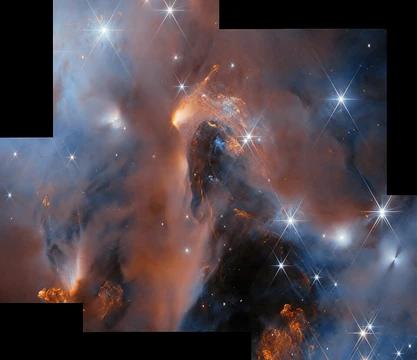
NGC 2484
A large lenticular radio galaxy with active nucleus and gamma-ray jets.

NGC 2484 is a large lenticular galaxy located in the Lynx constellation, approximately 590 million light-years from the Milky Way. It spans about 283,000 light-years across and is classified as a Fanaroff and Riley radio galaxy, notable for its active galactic nucleus and extragalactic jets that produce gamma-rays.
Quick Facts
- Constellation Name
- Lynx
- Z
- 0.040825
- H Radial V
- 12,339 km/s
- Appmag V
- 14.9
- Dist Ly
- 180.31 ± 12.62 Mpc
- Epoch
- J2000
- Ra
- 07 · 58 · 28.1081
- Dec
- +37 · 47 · 11.808
- Notes
- Radio galaxy
- Names
- PGC 22350, UGC 4125, 2MASX J07582810+3747121, MCG+06-18-004, 7C 075509.69+375523.00, NVSS J075828+374713, 4C +37.21, 3C 189, NSA 015647, IRCF J075828.1+374711, CALIFA 3011, B2 0755+37, LEDA 22350
Facts from the source article.
Lore & Background
NGC 2484 was discovered on 21 January 1885 by French astronomer Edouard Stephan, who described it as 'very faint, very small round with a bright middle and mottled, but not resolved.' It hosts an active galactic nucleus and a central radio source designated 3C 189. Studies of its magnetic environment revealed a complex rotation measure, with an unusual stripe along its jet axis showing a low uniform rotation measure in the approaching lobe and arc-like structures with sign reversals in the receding lobes. The amplitude across the source is inconsistent, likely caused by compressed gas around the lobe's leading edges.
X-ray observations indicate NGC 2484 is a low-power radio galaxy with multiple X-ray components, each spanning a wide range of linear sizes that follow cluster X-ray luminosity and temperature correlations. The intergalactic medium appears sufficient to confine the outer radio structures, though no relationship between the galaxy's presence and gas friction was found. NGC 2484 is one of eight galaxies included in the 4th Fermi Point Source Catalogue, alongside MRK 421, MRK 501, NGC 315, 3C 264, 3C 274, FR 0 galaxy, and 4C 39.12, most of which have low redshifts.
Reader's Guide
NGC 2484 holds significance as a Fanaroff and Riley radio galaxy with an active galactic nucleus and gamma-ray emission, placing it among a select group of extragalactic sources studied for high-energy phenomena. Its inclusion in the 4th Fermi Point Source Catalogue highlights its role in gamma-ray astronomy, alongside other notable low-redshift objects. The complex rotation measure and anisotropic fluctuations observed in its magnetic environment provide insights into the dynamics of radio lobes and the interaction of jets with the intergalactic medium. The unusual stripe along its jet axis and arc-like RM structures with sign reversals offer evidence of compressed gas at lobe edges, contributing to understanding of magnetic field behavior in radio galaxies. X-ray studies revealing multiple gas components with varying linear sizes that follow cluster correlations help characterize the thermal environment of low-power radio galaxies, showing that the intergalactic medium can confine outer radio structures without a direct link to gas friction. As one of only eight galaxies in the 4th Fermi catalogue, NGC 2484 serves as a benchmark for studying active galactic nuclei, jet physics, and the interplay between radio and gamma-ray emission in the local universe.
Did You Know?
- NGC 2484 is about 283,000 light-years across, making it a large lenticular galaxy.
- It hosts a central radio source called 3C 189.
Frequently Asked Questions
Who is NGC 2484?
NGC 2484 is a large lenticular galaxy residing in the Lynx constellation, sitting roughly 590 million light-years beyond the Milky Way. It was first recorded on 21 January 1885.
What are NGC 2484's powers/role?
It earns its spot as a Fanaroff and Riley radio galaxy thanks to a highly active galactic nucleus that launches extragalactic jets capable of producing gamma-rays. In fan-encyclopedia terms, its 'superpower' is converting nuclear energy into vast, relativistic outflows.
How big is NGC 2484?
The galaxy spans approximately 283,000 light-years across, making it a broad, disk-like lenticular system. That places it in the same size neighborhood as the Milky Way's stellar disk.
Where in the sky can I find NGC 2484?
Aim your telescope or imaging rig toward the Lynx constellation, the faint winter figure tucked between Gemini and Ursa Major. At nearly 600 million light-years it is well past the reach of a backyard scope, so most fans encounter it through deep-sky survey data.
Why is NGC 2484 important?
Its combination of lenticular morphology, Fanaroff and Riley radio classification, and detectable gamma-ray jets makes it a useful benchmark for studying how active nuclei drive extragalactic outflows in galaxies that lack prominent spiral arms. It helps astronomers test models of jet power and energy transport in a relatively clean, unobstructed system.
More in NGC Objects, Part 4 1-24
Spotted an error? Know more?
Reader corrections go straight into our review queue. Suggest an edit · How this site is sourced