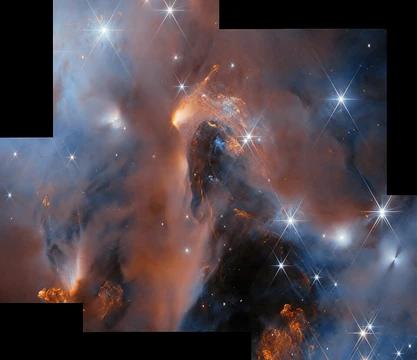
NGC 2427
Barred spiral galaxy with asymmetric arms and many HII regions.

NGC 2427 is a barred spiral galaxy located in the constellation Puppis. It lies at a distance of about 35 million light years from Earth and spans approximately 50,000 light years across. Discovered by John Herschel on March 1, 1835, the galaxy is notable for its bright short bar and two asymmetric spiral arms of low surface brightness.
Quick Facts
- Epoch
- J2000
- Ra
- 07 · 36 · 28.035
- Dec
- -47 · 38 · 11.05
- Dist Ly
- 35.3 ± 4.8 Mly (10.8 ± 1.5 Mpc)
- Z
- 0.003242 ± 0.000010
- H Radial V
- 972 ± 3 km/s
- Appmag V
- 11.6
- Constellation Name
- Puppis
- Names
- ESO 208- G 027, IRAS 07350-4731, PGC 21375
Facts from the source article.
Lore & Background
NGC 2427 features a bright short bar and two main spiral arms that are asymmetric and of low surface brightness. The arms contain many knots and HII regions, the largest of which are about one arcsecond across. When observed in H-alpha, the bar appears well defined and narrow, extending about one arcminute long across the galactic bulge. Many faint HII regions are visible in the inner and extended eastern disk of the galaxy. Due to its location near the galactic plane and its high inclination, tracing the spiral arms in H-alpha is difficult. The nucleus is very small and faint, hosting a nuclear star cluster that is 3.2 arcseconds across. The total star formation rate is estimated to be 1.1 solar masses per year. NGC 2427 is a member of a galaxy group that also includes NGC 2502, ESO 208- G 021, and ESO 209- G 009.
Reader's Guide
NGC 2427 is significant as a nearby barred spiral galaxy that offers a detailed view of star formation processes in a low-surface-brightness disk. Its many HII regions and knots, particularly the large ones about one arcsecond across, provide targets for studying individual star-forming complexes. The galaxy's high inclination and proximity to the galactic plane make it a challenging but valuable object for understanding how orientation affects observations of spiral structure in H-alpha. The presence of a nuclear star cluster 3.2 arcseconds across adds to its interest for studies of galactic nuclei. As a member of a small galaxy group, NGC 2427 also contributes to understanding group dynamics and interactions. Its discovery by John Herschel in 1835 places it within the rich history of southern sky surveys. The galaxy's asymmetric arms and well-defined bar, combined with its moderate star formation rate of 1.1 solar masses per year, make it a useful case for comparing barred and unbarred spiral galaxies in terms of star formation efficiency and arm morphology.
Frequently Asked Questions
What is NGC 2427?
NGC 2427 is a barred spiral galaxy located in the constellation Puppis. It is characterized by a bright, compact central bar and two spiral arms that are asymmetric in shape and relatively faint in surface brightness.
How far away is NGC 2427 from Earth?
The galaxy sits at a distance of roughly 35 million light years, placing it within the relatively nearby universe for deep-sky observers.
Who discovered NGC 2427 and when?
John Herschel first recorded the galaxy on March 1, 1835, as part of his extensive survey of southern-sky deep-sky objects.
What makes NGC 2427 visually distinctive?
Its standout feature is the short, luminous bar at the core, flanked by two spiral arms that do not mirror each other and glow at low surface brightness. The disk also contains numerous HII regions, signaling ongoing star formation.
How large is NGC 2427?
The galaxy spans approximately 50,000 light years in diameter, making it broadly comparable in scale to our own Milky Way.
More in NGC Objects, Part 4 1-24
Spotted an error? Know more?
Reader corrections go straight into our review queue. Suggest an edit · How this site is sourced