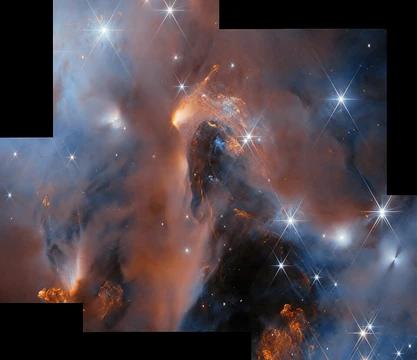
NGC 2362
A young open cluster in Canis Major, rich in B-type stars.

NGC 2362, also known as Caldwell 64, is an open cluster of stars in the southern constellation of Canis Major. It is sometimes called the Tau Canis Majoris Cluster after its brightest member star system, Tau Canis Majoris.
Quick Facts
- Epoch
- J2000
- Constellation
- Canis Major
- Ra
- 07 · 18 · 41.0
- Dec
- −24 · 57 · 18
- Dist Ly
- 1.480 ±
- Appmag V
- 3.8
- Age
- 5.0 Myr
- Names
- Caldwell 64, Cr 136
Facts from the source article.
Lore & Background
NGC 2362, also cataloged as Caldwell 64, is an open star cluster in the southern constellation Canis Major. Italian court astronomer Giovanni Batista Hodierna first recorded it in 1654. William Herschel described it as a "beautiful cluster," and William Henry Smyth noted its "beautiful appearance, the bright white star being surrounded by a rich gathering of minute companions, in a slightly elongated form, and nearly vertical position." Though once classified as a nebula, Robert J. Trumpler found no nebulosity in 1930. Its brightest member is the star system Tau Canis Majoris, giving the cluster its alternate name, the Tau Canis Majoris Cluster.
The cluster lies roughly 1.48 kiloparsecs from the Sun and is linked to the giant nebula Sh2-310, which sits at the same distance about one degree to the east. This large H II region is ionized by the brighter stars of NGC 2362. At 4 to 5 million years old, the cluster is young but lacks star-forming gas and dust, meaning star formation has stopped. It is a massive open cluster, containing over 500 solar masses, with an estimated 100 to 150 member stars and an additional 500 stars forming a halo around it. Only about 35 of these members show signs of a debris disk. The cluster includes one slightly evolved O-type star, Tau Canis Majoris, and roughly 40 B-type stars still on the main sequence. As of 2005, only one candidate classical Be star had been identified.
Reader's Guide
NGC 2362 is significant as a young open cluster that has already ceased star formation, providing a snapshot of early stellar evolution. Its association with the giant H II region Sh2-310, which is ionized by the cluster's brighter members, links it to ongoing processes in the interstellar medium. The cluster's mass of over 500 solar masses and its population of around 40 B-type stars on the main sequence, along with one slightly evolved O-type star, make it a valuable laboratory for studying massive star evolution. The presence of only about 35 debris disks among its members suggests that planet formation may be limited or has progressed rapidly. Its historical recognition by Hodierna, Herschel, and Smyth, as well as its earlier misclassification as a nebula, add to its legacy as an object of enduring astronomical interest.
Did You Know?
- NGC 2362 is also known as Caldwell 64.
- It was discovered by Giovanni Batista Hodierna in 1654.
- The brightest member star system is Tau Canis Majoris.
- Only one candidate classical Be star had been found in the cluster as of 2005.
Discovery & Observational History
First catalogued by the Italian court astronomer Giovanni Batista Hodierna, who made his observation in 1654, NGC 2362 carries a long and somewhat tangled observational history. Hodierna's discovery placed the object in the southern constellation Canis Major, and it later earned the designation Caldwell 64. Over the centuries, astronomers offered vivid descriptions of what they saw through their instruments. William Herschel simply praised it as a beautiful cluster, while William Henry Smyth provided a more detailed portrait, noting a bright white star encircled by a rich gathering of tiny companions arranged in a slightly elongated, nearly vertical configuration. Because of its brightest member, the system is occasionally referred to as the Tau Canis Majoris Cluster. For a period, the object was mistakenly catalogued as a nebula, a confusion that persisted until 1930, when Robert J. Trumpler examined the region and found no supporting evidence of nebulosity, effectively correcting the record and reclassifying it as what it truly is: a stellar cluster.
Stellar Population & Composition
NGC 2362 is a massive open cluster whose stellar inventory tells a story of rapid evolution. At an estimated four to five million years of age, it is still remarkably young by astronomical standards, yet it already contains a slightly evolved O-type star in Tau Canis Majoris, alongside roughly forty B-type stars still burning steadily on the main sequence. The cluster's total mass exceeds five hundred solar masses, distributed across an estimated one hundred to one hundred and fifty confirmed member stars, with an additional five hundred stars thought to form a diffuse halo surrounding the core. Despite its youth, only about thirty-five of the cluster's stars show evidence of debris disks, suggesting that disk dissipation is already well underway. As of 2005, just one candidate classical Be star had been identified among the members, a relatively sparse finding for a population dominated by hot, massive stars. The overall composition paints a picture of a cluster in the early stages of shedding its most volatile components.
Location & the Sh2-310 Nebular Link
Situated roughly 1.48 kiloparsecs from the Sun in the southern sky, NGC 2362 occupies a region of Canis Major that has attracted attention not only for its stellar content but for its connection to a nearby giant nebula. Approximately one degree to the east of the cluster lies Sh2-310, a vast H II region at essentially the same distance, indicating a physical association between the two objects. This nebula is a giant ionized hydrogen region, and its glow is driven by the intense ultraviolet radiation emitted by the brighter, hotter members of NGC 2362. In other words, the cluster's massive stars are actively shaping the surrounding interstellar medium, ionizing the gas and producing the luminous nebular emission observed in Sh2-310. This relationship underscores how even a relatively compact group of stars can exert a powerful influence on its local environment, lighting up and structuring the nebular material in its vicinity for millions of years.
A Young Cluster Past Its Formative Years
Perhaps the most striking aspect of NGC 2362 is the apparent contradiction between its youth and its current state. At merely four to five million years old, the cluster is still in its early evolutionary chapter, yet it is entirely devoid of the gas and dust clouds that typically fuel ongoing star formation. This absence signals that the star-formation process within the cluster has effectively ceased, a remarkable fact for an object so young. The likely explanation is that the cluster's massive members, particularly the O-type and B-type stars, have already blown away or dispersed the surrounding natal material through intense radiation and stellar winds. The result is a system that has completed its building phase and now consists almost entirely of stars in various stages of post-formation evolution. With no reservoir of raw material remaining, NGC 2362 will not produce any new stars, and its future will be defined by the gradual dispersal of its members and the slow evolution of its existing population.
Frequently Asked Questions
What is NGC 2362?
NGC 2362 is a young open star cluster catalogued as Caldwell 64, sitting in the southern sky within Canis Major. Fans often call it the Tau Canis Majoris Cluster because that bright star system anchors the group.
How old is NGC 2362 and what does that mean for its appearance?
At roughly four to five million years old, it's still in its infancy by stellar standards, which is why the cluster is packed with hot, blue B-type stars. Its total mass exceeds 500 solar masses, making it a genuinely massive young grouping.
Where exactly is NGC 2362 in the sky and how far away is it?
It lies in Canis Major, about 1.48 kiloparsecs (roughly 4,800 light-years) from the Sun. That distance puts it firmly in the Milky Way's disk, well within easy reach of backyard telescopes in the southern hemisphere.
How many stars does NGC 2362 actually contain?
The core membership runs around 100 to 150 stars, but there's a looser halo of roughly another 500 stars loosely associated with the group. So the full visual field can look considerably denser than the strict catalog count suggests.
Why do fans and amateur astronomers love targeting NGC 2362?
Its youth means the cluster glows with vivid blue-white B-type stars, giving it a striking, high-contrast look even in modest apertures. Being a relatively bright, compact open cluster in a well-known constellation, it's a go-to target for southern-hemisphere stargazers who want a satisfying, colorful field without chasing faint deep-sky objects.
More in NGC Objects, Part 4 1-24
Spotted an error? Know more?
Reader corrections go straight into our review queue. Suggest an edit · How this site is sourced