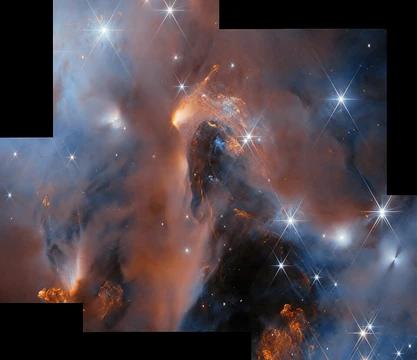
NGC 2467
A star-forming region with a skull-like appearance and triggered star formation.

NGC 2467, also called the "Skull and Crossbones Nebula," is a region where new stars are born, and its shape has sometimes been compared to a colorful mandrill. Large hydrogen gas clouds there provide the material for incubating stars. This area was featured in the book *Hubble's Universe: Greatest Discoveries and Latest Images* by Terence Dickinson.
For a long time, NGC 2467 was thought to be the core of the Puppis I stellar group. However, it is not a single open cluster. Instead, it is a mix of several star groups that appear along the same line of sight but are actually at different distances and moving at different speeds. One group is young and far away, beyond Puppis OB2, while another, closer group with older stars lies at about the same distance as Puppis OB1.
The region is dominated by a massive young star called HD 64315, which is an O6 type star. Two star clusters are also present: Haffner 19 (H19) and Haffner 18 (H18). H19 is a compact cluster that contains a Strömgren sphere, which is ionized by a hot B0 V-type star. H18 holds a very young star, FM3060a, which has just formed and is still wrapped in its birth cloud of gas. H19 is estimated to be about 2 million years old, while H18's age is debated, with some estimates as low as 1 million years. Other early-type stars, like HD 64568, are also in the field, but their connection to the clusters is not clear.
The H II region of NGC 2467 has been studied to understand how stars form. A key question is whether the massive O or B stars already present can trigger the formation of new stars. One study using the Spitzer Space Telescope, during its cold mission before its helium supply ran out, found 45 young stellar objects (YSOs), or protostars, mostly along the edge of the HII region. Their concentrated distribution, aligned with ionization fronts, suggests that star formation was triggered. These protostars are located where shock fronts, moving ahead of the ionization fronts, compress the molecular gas.
Estimates place H19, H18, and the S311 nebula (which contains HD 64315) at distances of about 6.4, 5.9, and 6.3 kiloparsecs, respectively, putting them in the Perseus Arm of the Milky Way. There is a notable disagreement between distances measured by kinematic methods and those measured photometrically. Despite this, H19 and H18 may be considered a binary cluster.
Quick Facts
- Epoch
- J2000
- Ra
- 07 · 52 · 24.22
- Dec
- -26 · 24 · 58.40
- Dist Ly
- 4420
- Dist Pc
- 1355
- Constellation
- Puppis
- Names
- Cr 164, Gum 9, Sh 2-311, ESO 493-25
Facts from the source article.
Lore & Background
NGC 2467 had long been considered the nucleus of the Puppis I association, but it does not represent a distinct open cluster. Instead, it is a superimposition of several stellar groups along the same line of sight with distinctly different distances and radial velocities. One group is young and very distant beyond Puppis OB2, while another nearer group with later-type stars lies at a similar distance as Puppis OB1. The region is dominated by the massive young star HD 64315, of spectral type O6. Two stellar clusters exist in the area: Haffner 19 (H19) and Haffner 18 (H18). H19 is a compact cluster containing a Strömgren sphere ionized by a hot B0 V-type star. H18 contains a very young star, FM3060a, that has just come into existence and is still surrounded by its birth cocoon of gas. The age of H19 is estimated at 2 Myr, while the age of H18 is somewhat controversial, with some considering it as young as only 1 Myr. The field also contains other early-type stars such as HD 64568, whose relationship with the clusters is unclear.
Reader's Guide
The H II region of NGC 2467 has been the target of various investigations to elucidate the process of star formation. Unresolved questions include understanding the degree to which stars already formed in such regions, especially massive O or B stars, can affect the future formation of stars: whether these pre-existing stars trigger the formation of others. One investigation using the Spitzer Space Telescope discovered 45 young stellar objects (YSOs), or protostars, in the region during its 'cold' mission. The YSOs are mostly along the edge of the HII region, and their concentrated distribution spatially correlated with ionization fronts provides evidence for triggered star formation. The newly forming protostars are concentrated in areas where the shock front driven in advance of the ionization front compresses the molecular gas. It has been estimated that H19, H18, and the S311 nebula are about 6.4 kpc, 5.9 kpc, and 6.3 kpc away, placing them in the Perseus Arm of the Milky Way. A significant discrepancy has existed between distances estimated kinematically versus photometrically. Regardless, H19 and H18 may be considered a binary cluster.
Did You Know?
- NGC 2467 is nicknamed the 'Skull and Crossbones Nebula' and has also been likened to a colorful mandrill.
- The region contains 45 young stellar objects discovered by the Spitzer Space Telescope during its cold mission.
- Haffner 19 and Haffner 18 may be considered a binary cluster, with estimated ages of 2 Myr and possibly as young as 1 Myr, respectively.
- The massive star HD 64315, of spectral type O6, dominates the region.
Frequently Asked Questions
What is NGC 2467 and why is it nicknamed the Skull and Crossbones Nebula?
NGC 2467 is a star-forming region in the Perseus Arm where vast hydrogen gas clouds are actively incubating new stars. It earned the "Skull and Crossbones Nebula" nickname because its overall silhouette resembles a skull with crossed bones, though some observers also see a colorful mandrill face in the structure.
What is the dominant star in NGC 2467?
The most massive and luminous star anchoring the region is HD 64315, classified as an O6 spectral type. Its intense radiation helps drive the triggered star-formation processes seen throughout the nebula.
Is NGC 2467 a single open cluster?
No—despite long being misidentified as the core of the Puppis I stellar group, it is actually a line-of-sight superposition of several distinct star groups at different distances. The two principal groups, Haffner 19 and Haffner 18, sit roughly 6.4 and 5.9 kiloparsecs away, respectively.
How old are the stellar groups within NGC 2467?
Haffner 19 is estimated at about 2 million years, while Haffner 18's age is still debated, with some researchers arguing it may be as young as 1 million years. This youth is consistent with the region's ongoing, triggered star-formation activity.
Where can I see NGC 2467 featured in popular astronomy books?
The region was highlighted in Terence Dickinson's *Hubble's Universe: Greatest Discoveries and Latest Images*, which showcases its striking skull-like morphology and the colorful gas clouds that make it a favorite target for deep-sky observers.
More in NGC Objects, Part 4 1-24
Spotted an error? Know more?
Reader corrections go straight into our review queue. Suggest an edit · How this site is sourced