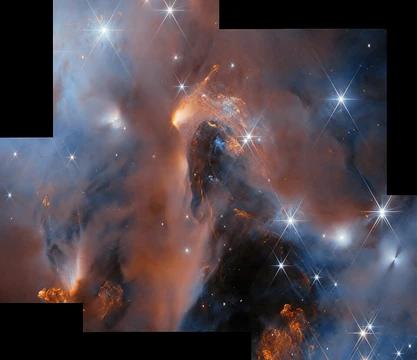
NGC 2442
An intermediate spiral galaxy known as the Meathook Galaxy.

NGC 2442 is an intermediate spiral galaxy located about 50 million light-years away in the constellation Volans. It is commonly known as the Meathook Galaxy or the Cobra and Mouse, and is notable for being a single galaxy that was historically recorded as two separate objects, NGC 2442 and NGC 2443.
Quick Facts
- Epoch
- J2000
- Ra
- 07 · 36 · 23.8
- Dec
- -69 · 31 · 51
- Z
- 1466 ± 5 km/s
- Appmag V
- 11.2
- Constellation Name
- Volans
- Notes
- SW part is NGC 2442 / while NE part is NGC 2443
- Names
- PGC 21373
Facts from the source article.
Lore & Background
The galaxy was discovered by Sir John Herschel on December 23, 1834, during his survey of southern skies using an 18.25-inch diameter reflecting telescope from an observatory in Cape Town, South Africa. When John Louis Emil Dreyer compiled the New General Catalogue, he used William Herschel's earlier observations that described two objects in a "double nebula," giving the northernmost the designation NGC 2443 and the southernmost NGC 2442. Herschel's later observations noted that the two objects were actually a single large nebula.
Associated with NGC 2442 is HIPASS J0731-69, a cloud of gas devoid of any stars. It is likely that the cloud was torn loose from the galaxy by a companion. Several supernovae have been observed in NGC 2442: SN 1999ga (Type II, mag. 18) discovered on 19 November 1999; SN 2015F (Type Ia, mag. 16.8) discovered on 9 March 2015, which reached magnitude 12.9 and was the brightest supernova of 2015; Gaia16cfr (also known as AT 2016jbu), initially considered a supernova imposter but later suggested to be a genuine but strange supernova; and SN 2026etu (Type Ia, mag. 18.547) discovered on 1 March 2026.
Reader's Guide
NGC 2442 holds significance as a striking example of a galaxy that was initially misidentified as two separate nebulae due to its shape, a confusion resolved by later observations. Its popular names, the Meathook Galaxy and the Cobra and Mouse, reflect its distinctive appearance. The galaxy has been the subject of multiple Hubble Space Telescope and European Southern Observatory images, featured in Astronomy Picture of the Day on several occasions. The presence of the starless gas cloud HIPASS J0731-69, likely torn from the galaxy by a companion, provides insight into galactic interactions. The supernovae observed within NGC 2442, including the exceptionally bright SN 2015F and the debated nature of Gaia16cfr, contribute to its legacy as a site of ongoing stellar death and research into supernova classification.
Did You Know?
- NGC 2442 and NGC 2443 are two parts of a single intermediate spiral galaxy.
- SN 2015F reached magnitude 12.9, making it the brightest supernova of 2015.
- HIPASS J0731-69 is a cloud of gas devoid of any stars associated with NGC 2442.
Discovery and the Dual-Designation Mystery
Sir John Herschel first recorded this object on the night of December 23, 1834, while conducting his ambitious survey of the southern heavens from a portable observatory he had erected in Cape Town, South Africa. Peering through his 18.25-inch reflecting instrument—affectionately called his "20-foot telescope"—he noted what appeared to be a single, sprawling nebula. Yet the formal catalogue entry that would define this galaxy for generations came from a different source. When John Louis Emil Dreyer assembled the New General Catalogue of Nebulae and Clusters of Stars, he relied on the earlier notes of William Herschel, who had described two distinct objects arranged as a "double nebula." Dreyer assigned the northern component the number NGC 2443 and the southern component NGC 2442, a split that persisted long after John Herschel's own observations made clear the two were merely the two hooks of one continuous spiral structure. Today the galaxy is popularly called the Meathook Galaxy or the Cobra and Mouse, a nod to its distinctive curved morphology that explains why the original observers mistook its arms for separate entities.
Physical Nature and Galactic Neighborhood
Situated roughly fifty million light-years from Earth in the southern constellation Volans, NGC 2442 is classified as an intermediate spiral galaxy—a form that sits between the grand-design spirals with their sweeping, well-defined arms and the more chaotic barred types. Its membership in the compact galaxy group LGG 147 places it in a small gravitational neighborhood that includes at least five confirmed companions: NGC 2397, NGC 2434, NGC 2443 (its own twin designation), and PGC 20690. One of the most intriguing features associated with this system is HIPASS J0731-69, a vast cloud of neutral hydrogen gas that contains no stars whatsoever. Astronomers believe this stellar-free cloud was ripped away from NGC 2442's outer disk by the tidal pull of a passing companion galaxy, leaving behind a ghostly remnant of material that now drifts independently through the group. The existence of such a stripped gas cloud provides a tangible record of gravitational interactions that have shaped the galaxy's present-day structure and may continue to influence its evolution within the LGG 147 cluster.
A Prolific Record of Stellar Explosions
NGC 2442 has proven an unexpectedly prolific host of stellar explosions, with three confirmed supernovae—and possibly a fourth—recorded in the modern era. The first, SN 1999ga, was a Type II event reaching magnitude 18, spotted on November 19, 1999 by the Perth Astronomical Research Group. Nearly sixteen years later, on March 9, 2015, Berto Monard discovered SN 2015F, a Type Ia explosion that initially registered at magnitude 16.8 before brightening dramatically to magnitude 12.9, earning it the distinction of being the brightest supernova of that entire year. The most recent confirmed event, SN 2026etu, was another Type Ia discovered by the ATLAS survey system on March 1, 2026, at magnitude 18.547. The recurrence of thermonuclear Type Ia explosions in this single intermediate spiral underscores the ongoing stellar evolution and mass-transfer processes within its disk, while the Type II event reminds us that massive-star deaths continue to punctuate the galaxy's history at intervals spanning decades.
The Enigmatic Gaia16cfr Transient
Perhaps no transient event in NGC 2442 has generated more debate than the brightening first detected on December 1, 2016, and initially catalogued as Gaia16cfr (also tracked as AT 2016jbu). At the time of discovery, the object was classified as a supernova imposter—a phenomenon in which a star undergoes a dramatic but non-explosive luminosity surge, often triggered by tidal disruption or binary interaction, without the full thermonuclear or core-collapse signature of a true supernova. The event peaked at a Gaia apparent magnitude of 19.3, corresponding to an absolute magnitude of roughly minus twelve, a luminosity that placed it firmly in the range expected for genuine stellar explosions. For six years the classification remained settled, but a paper published in August 2022 challenged that consensus, presenting evidence that the 2016 event was in fact a bona fide supernova of an unusual and poorly understood subtype. This reclassification has made NGC 2442 a case study in how transient astrophysics continues to refine its categories, and it leaves the possibility open that the galaxy's true supernova count may be four rather than three.
Frequently Asked Questions
What is NGC 2442?
NGC 2442 is an intermediate spiral galaxy situated roughly 50 million light-years from Earth in the southern constellation Volans. Its distinctive shape has earned it the popular nicknames Meathook Galaxy and Cobra and Mouse.
Who discovered NGC 2442 and when?
Sir John Herschel identified this galaxy on December 23, 1834, during his extensive survey of the southern sky.
Why does NGC 2442 also appear as NGC 2443?
Early cataloguers mistakenly logged the same spiral as two distinct entries, assigning it both the 2442 and 2443 designations. Modern observations confirm it is a single galaxy, but the duplicate number persists in many references.
What constellation is NGC 2442 located in?
It sits in Volans, a small southern-hemisphere constellation representing a flying fish, which means it is only visible from latitudes well south of the equator.
What makes NGC 2442 notable among spiral galaxies?
Beyond its striking meathook-shaped morphology, its dual NGC designation makes it a useful case study in how historical cataloguing errors can persist for centuries. It is also a relatively accessible deep-sky target for southern-hemisphere observers.
More in NGC Objects, Part 4 1-24
Spotted an error? Know more?
Reader corrections go straight into our review queue. Suggest an edit · How this site is sourced