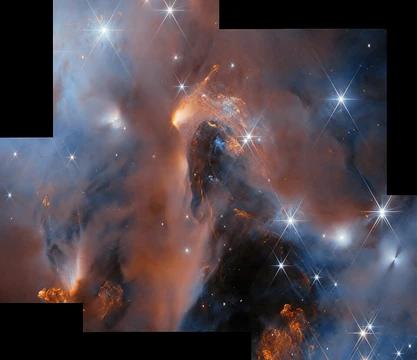
NGC 2445
A ring galaxy distorted by collision with NGC 2444.

NGC 2445 is a peculiar ring galaxy in the constellation Lynx, located about 200 million light years from Earth. It is notable for its distorted shape and intense star formation, both resulting from a collision with the neighboring galaxy NGC 2444. The galaxy spans approximately 100,000 light years across and was discovered by Édouard Stephan on January 18, 1877.
Quick Facts
- Epoch
- J2000
- Ra
- 07 · 46 · 55.1
- Dec
- 39 · 00 · 55
- Dist Ly
- 203 ± 21 Mly (62.3 ± 6.7 Mpc)
- Z
- 4002 ± 8 km/s
- Appmag V
- 13.0
- Constellation Name
- Lynx
- Notes
- interacting galaxy, collisional ring
- Names
- UGC 4017, Arp 143, VV 117, MCG +07-16-017, PGC 21776
Facts from the source article.
Lore & Background
NGC 2445 is characterized by its distorted shape and ongoing star formation, which are direct consequences of its interaction with NGC 2444. The gravitational pull of NGC 2444 has drawn gas away from NGC 2445, forming a bridge of young blue stars between the two galaxies that gives NGC 2445 a triangular appearance. This interaction has also created a ring of star clusters and HII regions around the nucleus, with gas kinematics indicating the ring is 60 ± 15 million years old.
Radio observations reveal an asymmetric galaxy, with emission coming from the nucleus, three star-forming regions, and a ridge toward NGC 2444. The northwestern region has a stronger magnetic field than the other two. Two giant molecular clouds are visible in 12CO(J=1–0) emission to the west and northwest of the nucleus. In the mid-infrared, arms connecting the ring to the nucleus are visible. The streamers between the two galaxies are among the first in a wave of star formation that began on the galaxy's outskirts and moved inward; streamer stars are estimated to be between 50 million and 100 million years old. Star-forming knots in the ring are 2–8 million years old, while stars closer to the center are no older than one to two million years. Carbon monoxide observations indicate NGC 2445 still has abundant gas and that star formation rates will increase.
The Hubble Space Telescope has uncovered dark filaments of gas in the galaxy's bright core, possibly formed by outbursts of material, though dust from these outbursts blankets the nucleus in visible light. The radio core is not very compact, and its spectrum suggests a starburst region aged between 1.5 and 5 million years. A shell of hydrogen gas measuring 20 kiloparsecs across has been found at a projected distance of about 100 kiloparsecs from the system; a filament of this shell points toward the galaxies, indicating it is either a superbubble associated with them or a tidal tail.
Reader's Guide
NGC 2445 is significant as a striking example of a ring galaxy shaped by a galactic collision, offering a laboratory for studying star formation triggered by interactions. The galaxy's distorted triangular shape and the bridge of young blue stars to NGC 2444 illustrate how gravitational forces can reshape galaxies and ignite new stellar generations. The age gradient of star formation—from older streamers (50–100 million years) to younger ring knots (2–8 million years) to the youngest central stars (1–2 million years)—provides a timeline of how star formation propagates inward after a collision. The detection of abundant molecular gas suggests that star formation will continue to increase, making NGC 2445 a key object for understanding starburst evolution. The discovery of a hydrogen shell 20 kiloparsecs across, possibly a superbubble or tidal tail, adds to the system's complexity. The supernova SN 2016bam, a type II event between the two galaxies, further highlights the active nature of this interacting pair. As part of Arp 143 and the LGG 148 group, NGC 2445 contributes to the study of galaxy interactions in group environments.
Did You Know?
- NGC 2445 and NGC 2444 form the interacting pair Arp 143.
- A bridge of young blue stars between the two galaxies gives NGC 2445 a triangular shape.
- The ring of star clusters around the nucleus is 60 ± 15 million years old.
- One supernova, SN 2016bam, has been observed between the two galaxies.
The Gravitational Encounter
NGC 2445 is a peculiar ring galaxy located in the constellation Lynx, roughly 200 million light years from Earth. Its apparent size translates to a physical diameter of about 100,000 light years, making it a substantial object in the local universe. What makes this galaxy truly remarkable is its ongoing gravitational interaction with its neighbor NGC 2444, situated approximately one arcminute away. Together, the two form the interacting pair catalogued as Arp 143. The encounter has visibly warped NGC 2445's structure, stripping gas from its body and drawing it toward its companion. This stolen material has condensed into a striking bridge of young, blue stars stretching between the two systems, lending NGC 2445 a distinctly triangular silhouette. The interaction is not merely cosmetic; it has triggered intense episodes of star formation throughout the galaxy, reshaping its internal architecture and setting in motion a cascade of stellar birth that continues to this day.
A Cascade of Stellar Birth
The gravitational tug between NGC 2445 and NGC 2444 has set off a remarkable wave of star formation that appears to have originated at the galaxy's outer edges and propagated inward. The streamers of young blue stars linking the two galaxies are believed to be among the earliest products of this cascade, with their constituent stars estimated to be between 50 and 100 million years old. Closer to the center, the picture grows younger still: the knots of star-forming regions within the ring surrounding the nucleus are calculated to be just 2 to 8 million years in age, while the very latest generation of stars, no older than one or two million years, is being born in the innermost regions. A ring of star clusters and HII regions encircling the nucleus carries a kinematic age of roughly 60 million years, give or take 15. Carbon monoxide observations reveal that NGC 2445 still harbors abundant cold gas, suggesting that star formation rates will only climb further. The system's stellar activity was dramatically underscored in 2016 when a Type II supernova, SN 2016bam, exploded between the two galaxies at magnitude 16.1.
A Multi-Wavelength Portrait
NGC 2445 reveals very different facets depending on the wavelength at which it is studied. In radio waves the galaxy appears asymmetric, with emission concentrated in the nucleus, three distinct star-forming regions, and a ridge of activity pointing toward NGC 2444. The northwestern region stands out with a stronger magnetic field than its counterparts. Two giant molecular clouds are detectable in the 12CO(J=1–0) line to the west and northwest of the nucleus, while mid-infrared imaging exposes faint arms linking the outer ring back to the central region. The Hubble Space Telescope has identified dark filaments of gas within the galaxy's bright core, possibly the remnants of material outbursts. In the visible spectrum, however, dust from those outbursts effectively blankets the nucleus, obscuring its true structure. Radio observations show the core is not particularly compact, and its spectrum points to a starburst region aged between 1.5 and 5 million years. Perhaps most strikingly, a vast shell of hydrogen gas spanning 20 kiloparsecs has been detected at a projected distance of about 100 kiloparsecs, with a filament pointing back toward the galaxies, hinting at a superbubble or tidal tail connected to the pair.
Discovery and Galactic Neighbors
Édouard Stephan first recorded NGC 2445 on January 18, 1877, adding it to the growing catalog of deep-sky objects in the constellation Lynx. At a distance of approximately 200 million light years, the galaxy sits well beyond the Local Group, yet it is far from isolated. Together with NGC 2444, it constitutes the interacting pair Arp 143, a designation that highlights the dramatic gravitational interplay between the two. The pair is itself a member of a larger galaxy group known as LGG 148, which also includes NGC 2476, NGC 2493, NGC 2524, NGC 2415, UGC 3937, and UGC 3944. This clustering of galaxies in the Lynx field provides a natural laboratory for studying how proximity and gravitational encounters shape the evolution of individual systems. NGC 2445, with its distorted morphology, active star formation, and ongoing interaction, serves as a vivid example of how galactic neighborhoods drive structural change and stellar renewal over cosmic timescales.
Frequently Asked Questions
What is NGC 2445?
NGC 2445 is a ring-shaped galaxy in the Lynx constellation, sitting about 200 million light years from Earth. Its circular structure and vigorous star birth are the direct aftermath of a gravitational encounter with its neighbor NGC 2444.
Why does NGC 2445 look like a distorted ring?
The ring geometry is a scar left by the collision with NGC 2444, which compressed interstellar gas into a broad circular band and ignited a wave of new star formation. The same encounter also warped the overall shape, so the galaxy appears lopsided rather than a clean ellipse.
Who discovered NGC 2445 and when?
French astronomer Édouard Stephan catalogued the object on January 18, 1877, as part of his prolific survey of faint deep-sky targets in the northern sky.
How big is NGC 2445?
The galaxy spans roughly 100,000 light years across, placing its diameter in the same ballpark as the Milky Way. That scale helps explain why the collision-driven ring structure is still easily resolvable with modern telescopes.
What makes NGC 2445 stand out among other ring galaxies?
Unlike symmetric examples such as Hoag's Object, NGC 2445 is visibly warped and asymmetric because the NGC 2444 interaction never settled into a neat, uniform ring. Its ongoing, intense star formation also gives astronomers a natural laboratory for watching collision-driven galaxy evolution in real time.
More in NGC Objects, Part 4 1-24
Spotted an error? Know more?
Reader corrections go straight into our review queue. Suggest an edit · How this site is sourced