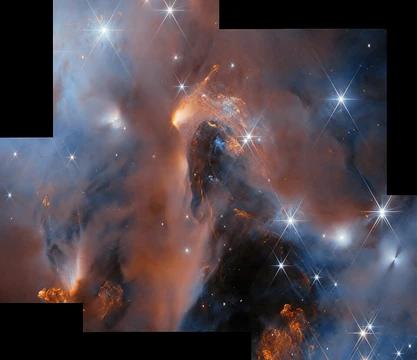
NGC 2506
An intermediate-age open cluster near the Galactic anti-center.

NGC 2506, also known as Caldwell 54, is a mildly-elongated open cluster of stars in the equatorial constellation of Monoceros. It lies near the Galactic anti-center at a distance of 3.88 kpc from the Sun and is of intermediate age, estimated at around two billion years.
Quick Facts
- Epoch
- J2000
- Ra
- 08 · 00 · 01.0
- Dec
- −10 · 46 · 12
- Dist Ly
- 3.88 ±
- Appmag V
- 7.6
- Age
- 2.09 · 0.14 Gyr
- Constellation
- Monoceros
- Names
- Caldwell 54, Cr 170, Mel 80
Facts from the source article.
Lore & Background
Discovered by William Herschel in 1791, NGC 2506 lies about 3.88 kpc from the Sun near the Galactic anti-center. The cluster is located some distance from the Galactic Center and above the Galactic plane. It has an angular radius and a core radius, though exact values are not specified. At least 94 probable members have been identified within its field based on radial velocities. Compared to the Sun, the cluster is moderately metal-poor, with an iron abundance of [Fe/H] = –0.3 dex. The cluster shows indications of mass segregation, where lower-mass members are more likely found in the outer parts, a result of kinetic energy exchange during stellar encounters. Twelve blue straggler stars have been located in the cluster, three of which show short-period oscillation. Additionally, fourteen Gamma Doradus variables, two detached eclipsing binaries, and three Delta Scuti stars have been found.
Reader's Guide
NGC 2506 is notable as an intermediate-age open cluster that provides insight into stellar evolution and dynamics. Its moderate metal-poor nature and location near the Galactic anti-center make it a useful target for studying the chemical and kinematic properties of the Milky Way's outer disk. The presence of mass segregation offers a clear example of how dynamical interactions shape cluster structure over time. The detection of multiple variable star types—including blue stragglers, Gamma Doradus variables, detached eclipsing binaries, and Delta Scuti stars—makes it a valuable laboratory for understanding stellar pulsation and binary evolution. The cluster's identification as Caldwell 54 also places it among notable deep-sky objects for amateur astronomers. Its well-studied membership and variable star population contribute to broader knowledge of open cluster evolution and stellar astrophysics.
Did You Know?
- NGC 2506 is also known as Caldwell 54.
- It was discovered by William Herschel in 1791.
- The cluster shows mass segregation, with lower-mass stars more common in its outer parts.
- Fourteen Gamma Doradus variables have been identified in the cluster.
Frequently Asked Questions
Who is NGC 2506?
NGC 2506, also catalogued as Caldwell 54, is a mildly elongated open star cluster residing in the equatorial constellation Monoceros. It is home to roughly 94 probable member stars.
What are NGC 2506's powers or role?
As an intermediate-age open cluster, it gives astronomers a natural laboratory for tracking how stars evolve at around two billion years. Its slightly sub-solar iron abundance (about –0.3 dex) also helps trace chemical enrichment in the outer Galaxy.
Why is NGC 2506 important?
Perched near the Galactic anti-center at roughly 3.88 kiloparsecs from the Sun, it offers a comparatively clear line of sight through the outer Milky Way. Its intermediate age fills a gap between the very young and very old open clusters that dominate most surveys.
Where can I find NGC 2506?
Aim your telescope toward Monoceros, the faint Unicorn constellation visible from mid-northern latitudes in spring. Because it sits near the Galactic anti-center, it faces away from the crowded star fields of the galactic core, making it a relatively easy target.
More in NGC Objects, Part 4 1-24
Spotted an error? Know more?
Reader corrections go straight into our review queue. Suggest an edit · How this site is sourced