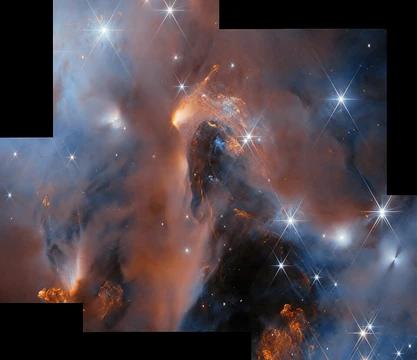
NGC 2525
Barred spiral galaxy in Puppis with a bright nucleus and observed supernova.

NGC 2525 is a barred spiral galaxy in the constellation Puppis, approximately 70 million light years from Earth. It spans about 46,000 light years across and features a small, bright nucleus with a bar and two main spiral arms of high surface brightness.
Quick Facts
- Epoch
- J2000
- Ra
- 08 · 05 · 38.0503
- Dec
- -11 · 25 · 37.213
- Dist Ly
- 71 Mly (21.9 Mpc)
- Z
- 0.005270 ± 0.000005
- H Radial V
- 1,580 ± 1 km/s
- Appmag V
- 11.6
- Constellation Name
- Puppis
Facts from the source article.
Lore & Background
NGC 2525 was discovered by William Herschel on February 23, 1791. The galaxy has a bar and two main spiral arms with high surface brightness, and HII regions are observed in the arms. Its nucleus is small and bright. At the center, a supermassive black hole is predicted, with an estimated mass between 1.1 and 44 million solar masses, based on the spiral arm pitch angle. The brightest stars in the galaxy have an apparent magnitude around 22.
Reader's Guide
NGC 2525 is notable for hosting the type Ia supernova SN 2018gv, discovered by Kōichi Itagaki on January 15, 2018, at magnitude 16.5. The supernova was identified spectrographically as a type Ia event 10 to 15 days before maximum, and it was also observed by ATLAS on January 14.5 UT at magnitude 18.1. It reached a peak magnitude of 12.8. ESA/Hubble released a video of the supernova in October 2020. The galaxy's barred spiral structure and the presence of HII regions in its arms make it a subject of study for star formation and galactic dynamics. The estimated mass range of its central supermassive black hole, derived from the spiral arm pitch angle, adds to its significance in understanding black hole–galaxy scaling relations.
Did You Know?
- NGC 2525 is about 46,000 light years across.
- One supernova, SN 2018gv, has been observed in this galaxy.
- The supermassive black hole at its center is estimated to have a mass between 1.1 and 44 million solar masses.
Frequently Asked Questions
What is NGC 2525?
NGC 2525 is a barred spiral galaxy sitting in the constellation Puppis, roughly 70 million light years from Earth. It stretches about 46,000 light years across and shows two bright spiral arms wrapping out from a central bar.
Who discovered NGC 2525 and when?
William Herschel first catalogued this galaxy on February 23, 1791, during his prolific deep-sky surveys of the southern sky.
What does NGC 2525 look like through a telescope?
The galaxy presents a small, luminous nucleus flanked by a bar, with two high-surface-brightness spiral arms extending outward. Its faintest resolvable stars sit around apparent magnitude 22, so it remains a demanding target even for large amateur instruments.
Why is NGC 2525 notable to astronomers?
In addition to its textbook barred-spiral morphology, the galaxy has hosted an observed supernova, giving researchers a chance to study a stellar explosion in a distant, well-characterized host system.
How big is NGC 2525 compared to the Milky Way?
At roughly 46,000 light years in diameter, NGC 2525 is a bit smaller than our own galaxy's disk but still a substantial barred spiral in its own right.
More in NGC Objects, Part 4 1-24
Spotted an error? Know more?
Reader corrections go straight into our review queue. Suggest an edit · How this site is sourced