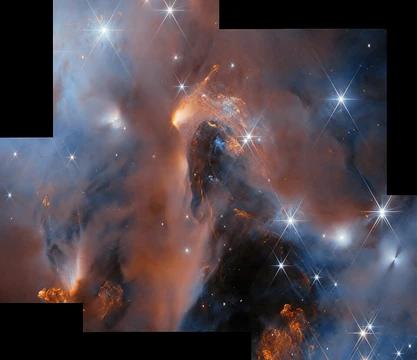
NGC 2911
A peculiar lenticular galaxy with an active nucleus and dust lanes.

NGC 2911 is a peculiar lenticular galaxy located in the constellation Leo, approximately 145 million light years from Earth. It is notable for its active nucleus, classified as a type 2 LINER, and for being the foremost member of the NGC 2911 galaxy group.
Quick Facts
- Epoch
- J2000
- Ra
- 09 · 33 · 46.1
- Dec
- +10 · 09 · 09
- Dist Ly
- 145 Mly (48.5 Mpc)
- Z
- 0.010777 ± 0.000007
- H Radial V
- 3,231 ± 2 km/s
- Appmag V
- 11.5
- Constellation Name
- Leo
- Names
- UGC 5092, Arp 232, MCG +02-25-003, PGC 27159
Facts from the source article.
Lore & Background
NGC 2911 was discovered by William Herschel on March 11, 1784. The galaxy features prominent dust lanes, and its molecular gas kinematic axis is not aligned with the stellar one, indicating that the gas is of external origin. The nucleus is active and categorized as a type 2 LINER, with the energy source believed to be an accretion disk around a supermassive black hole. A one-sided jet measuring about half a parsec in length is visible in radiowaves.
The galaxy is the foremost member of the NGC 2911 group (also designated LGG 177), which includes NGC 2912, NGC 2913, NGC 2914, and NGC 2939. NGC 2912 lies at a distance of 1.3 arcminutes, while NGC 2914 lies at 4.8 arcminutes. NGC 2919 appears nearby but is not a member. Further away lie the NGC 2872 group, the UGC 5189 group, and the CGCG 063-066 group.
Reader's Guide
NGC 2911 holds significance as a peculiar lenticular galaxy whose active nucleus and misaligned gas kinematics provide insights into galaxy evolution and the acquisition of external material. Its classification as a type 2 LINER, with an accretion disk around a supermassive black hole as the likely energy source, places it among galaxies studied for active galactic nuclei. The one-sided radio jet, half a parsec in length, further indicates ongoing nuclear activity. As the foremost member of the NGC 2911 group, it serves as a reference point for understanding group dynamics and interactions among its companions, including NGC 2912, NGC 2913, NGC 2914, and NGC 2939. The presence of nearby groups, such as the NGC 2872 group, situates NGC 2911 within a larger cosmic neighborhood. Its legacy lies in contributing to the study of lenticular galaxies with external gas accretion and active nuclei, offering a case for comparing similar objects like NGC 1947.
Did You Know?
- NGC 2911 is approximately 165,000 light years across.
- The galaxy's molecular gas kinematic axis is not aligned with its stellar one, suggesting external origin.
- It has a one-sided radio jet about half a parsec in length.
More in NGC Objects, Part 4 1-24
Spotted an error? Know more?
Reader corrections go straight into our review queue. Suggest an edit · How this site is sourced