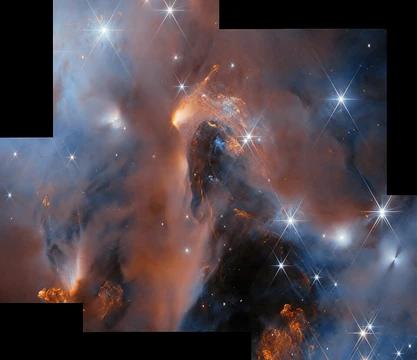
NGC 2906
Spiral galaxy in Leo with a long-lived, dust-interacting supernova.

NGC 2906 is a spiral galaxy located in the constellation Leo, approximately 120 million light years from Earth. It is notable for hosting the unusual supernova SN 2005ip, which exhibited a prolonged plateau and narrow spectral lines attributed to interaction with surrounding dust.
Quick Facts
- Epoch
- J2000
- Ra
- 09 · 32 · 06.2
- Dec
- +08 · 26 · 30
- Dist Ly
- 126 ± 24 Mly (38.8 ± 7.2 Mpc)
- Z
- 0.007138 ± 0.000020
- H Radial V
- 2,140 ± 6 km/s
- Appmag V
- 12.5
- Constellation Name
- Leo
- Names
- UGC 5081, CGCG 063-001, MCG +02-25-001, PGC 27074
Facts from the source article.
Lore & Background
NGC 2906 was discovered by William Herschel on December 28, 1785. It is a spiral galaxy with a normal star formation rate calculated at 0.8 per year, and a total of 241 HII regions have been identified within it. The galaxy's total mass is estimated, though the specific value is not recorded in the available notes.
The galaxy is a member of the NGC 2894 group, which also includes NGC 2882, NGC 2894, and IC 450. One supernova, SN 2005ip, has been observed in NGC 2906. It was discovered by T. Boles on November 6, 2005, using a 0.35m refractor, with an estimated apparent magnitude of 15.5. The supernova was identified as type II, probably within a few weeks past explosion.
As SN 2005ip declined in brightness, it reached a plateau that lasted for a bit more than two years. Its spectrum became dominated by narrow lines (IIn), an unusual feature attributed to the interaction of the supernova with dust located around it. It is also possible that the supernova created dust.
Reader's Guide
NGC 2906 holds significance primarily through its association with SN 2005ip, a supernova that challenged typical expectations for type II events. The supernova's plateau lasting over two years and its spectral transition to narrow lines (IIn) provided evidence for strong interaction between the supernova ejecta and circumstellar dust. This interaction not only shaped the light curve but also raised the possibility that the supernova itself generated new dust. The galaxy's normal star formation rate and its membership in the NGC 2894 group place it within a modest but defined galactic neighborhood. The discovery of SN 2005ip by an amateur astronomer using a small refractor underscores the role of citizen science in detecting transient events. The 241 identified HII regions indicate ongoing star formation activity, though at a typical rate. NGC 2906 thus serves as a case study for supernova–dust interactions and as a representative spiral in a small group.
Did You Know?
- The galaxy hosts the supernova SN 2005ip, which had a plateau lasting over two years.
- SN 2005ip was discovered by T. Boles using a 0.35m refractor.
More in NGC Objects, Part 4 1-24
Spotted an error? Know more?
Reader corrections go straight into our review queue. Suggest an edit · How this site is sourced