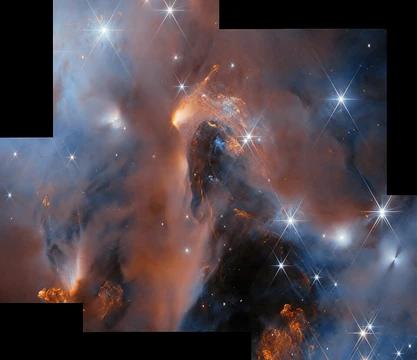
NGC 2841
Prototype flocculent spiral galaxy in Ursa Major.

NGC 2841 is a spiral galaxy without a central bar, located in the northern constellation Ursa Major, which never sets for many northern observers. German-born astronomer William Herschel first spotted it on March 9, 1788. J. L. E. Dreyer, who compiled the New General Catalogue, called it “very bright, large, very much extended 151°, very suddenly much brighter middle equal to 10th magnitude star.” Early estimates placed it about 30 million light-years away, but a 2001 Hubble Space Telescope survey of its Cepheid variable stars revised the distance to roughly 14.1 megaparsecs, or 46 million light-years.
This galaxy serves as the defining example of a flocculent spiral, meaning its spiral arms are patchy and broken rather than smooth and continuous. Its morphological classification is SAa, indicating a spiral with no bar and extremely tightly wound arms. No grand design structure is visible in ordinary light, though some inner spiral arms appear in near-infrared observations. The galaxy is tilted 68° relative to Earth’s line of sight, with its long axis oriented at a position angle of 148°.
NGC 2841 shares many properties with the Andromeda Galaxy. It contains a large number of young, blue stars and a few H II regions. Its disk of stars extends out to a radius of about 70 kiloparsecs, but begins to warp at roughly 30 kiloparsecs, likely due to infalling matter from the surrounding environment. The galaxy’s rotation suggests a massive nuclear bulge, and its core hosts a low-ionization nuclear emission-line region (LINER), which emits spectral lines from weakly ionized atoms. A prominent molecular ring orbits between 2 and 6 kiloparsecs from the center, providing gas and dust for star formation. The nucleus appears decoupled from the rest of the galaxy, and a counter-rotating component of stars and gas exists in the outer nucleus, hinting at a recent interaction with a smaller galaxy.
Four supernovae have been observed in NGC 2841. SN 1912A (Type Ia, magnitude 13) was found by Heber Curtis and Francis Pease on February 19, 1912. SN 1957A (Type Ia-pec, magnitude 14) was discovered by Max Schürer on March 1, 1957. SN 1972R (type unknown, magnitude 16) was spotted by Paul Wild on December 5, 1972. SN 1999by (Type Ia-pec, magnitude 15) was co-discovered by Ron Arbour and the Lick Observatory Supernova Search on April 30, 1999.
Quick Facts
- Epoch
- J2000
- Constellation Name
- Ursa Major
- Ra
- 09 · 22 · 02.655
- Dec
- +50 · 58 · 35.32
- Dist Ly
- 14.1 ±
- Z
- 0.002130
- Appmag V
- 9.3
- Notes
- Flocculent galaxy with LINER nucleus
Facts from the source article.
Lore & Background
NGC 2841 was discovered on 9 March 1788 by German-born astronomer William Herschel. J. L. E. Dreyer described it as 'very bright, large, very much extended 151°, very suddenly much brighter middle equal to 10th magnitude star'. Initially thought to be about 30 million light-years distant, a 2001 Hubble Space Telescope survey of the galaxy's Cepheid variables determined its distance to be approximately 14.1 megaparsecs, or 46 million light-years. The morphological class is SAa, indicating a spiral galaxy with no central bar and very tightly-wound arms. There is no grand design structure visible in the optical band, although some inner spiral arms can be seen in the near infrared. It is inclined by an angle of 68° to the line of sight from Earth, with the major axis aligned along a position angle of 148°.
The properties of NGC 2841 are similar to those of the Andromeda Galaxy. It is home to a large population of young blue stars and a few H II regions. Its disk of stars can be traced out to a radius of around 70 kpc, and this disk begins to warp at a radius of around 30 kpc, suggesting the perturbing effect of in-falling matter from the surrounding medium. The rotational behavior suggests there is a massive nuclear bulge, with a low-ionization nuclear emission-line region (LINER) at the core. A prominent molecular ring is orbiting at a radius of 2–6 kpc, providing a star-forming region of gas and dust. The nucleus appears decoupled and there is a counter-rotating element of stars and gas in the outer parts of the nucleus, suggesting a recent interaction with a smaller galaxy.
Reader's Guide
NGC 2841 holds significance as the prototype for flocculent spiral galaxies, a class defined by patchy, discontinuous spiral arms rather than a smooth grand design. Its distance was refined by a 2001 Hubble Space Telescope survey of Cepheid variables, resolving an earlier estimate of 30 million light-years to 46 million light-years. The galaxy's SAa classification indicates tightly-wound arms and no central bar, and its inclination of 68° provides a favorable viewing angle for studying its structure. The presence of a LINER core and a counter-rotating component of stars and gas suggests a past interaction with a smaller galaxy, while a warped disk at 30 kpc implies ongoing infall of matter. Four supernovae have been observed in NGC 2841, including SN 1912A (Type Ia, mag. 13) discovered by Heber Curtis and Francis Pease, SN 1957A (Type Ia-pec, mag. 14) by Max Schürer, SN 1972R (type unknown, mag. 16) by Paul Wild, and SN 1999by (Type Ia-pec, mag. 15) codiscovered by Ron Arbour and the Lick Observatory Supernova Search. These events contribute to understanding stellar evolution in a flocculent environment.
Did You Know?
- NGC 2841 is the prototype for flocculent spiral galaxies, which have patchy and discontinuous arms.
- Its distance was refined to 46 million light-years by a 2001 Hubble Space Telescope survey of Cepheid variables.
- The galaxy has a low-ionization nuclear emission-line region (LINER) at its core.
More in NGC Objects, Part 4 1-24
Spotted an error? Know more?
Reader corrections go straight into our review queue. Suggest an edit · How this site is sourced