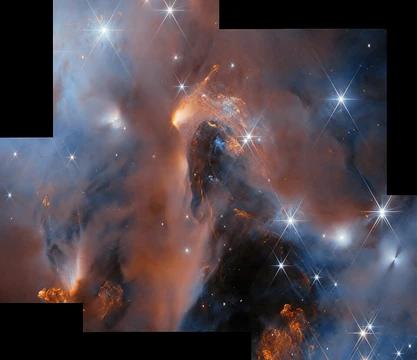
NGC 2782
A peculiar spiral galaxy formed from a merger, with starburst and Seyfert activity.

NGC 2782 is a peculiar spiral galaxy located in the northern constellation of Lynx, approximately 75 million light years from Earth. It formed after a galaxy merger and is notable for its active galactic nucleus, starburst activity, and classification as a type 1 Seyfert galaxy. The galaxy is listed in the Atlas of Peculiar Galaxies under the category of galaxies with adjacent loops.
Quick Facts
- Epoch
- J2000
- Ra
- 08 · 53 · 32.7
- Dec
- 51 · 18 · 49
- Dist Ly
- 23.4 ±
- Appmag V
- 11.4
- Constellation Name
- Lynx
Facts from the source article.
Lore & Background
The nucleus and circumnuclear region of NGC 2782 display starburst activity, with the galaxy's bar supplying gas to the nucleus. The active galactic nucleus is hidden by a compact high-column-density absorber, and an H2O maser is associated with it. Vigorous star formation creates an unusual 'superwind' of outflowing gas, detected in X-rays as a bubble-like structure about 7 arcseconds south of the central region, with a similar bubble seen in radio waves on the north side. Diffuse X-ray emission is also present. The nucleus is a low-luminosity active galactic nucleus.
NGC 2782 exhibits two tidal tails extending in opposite directions. HI imaging shows a plume extending about 5 arcminutes toward the northwest, containing roughly 40 percent of the system's total atomic hydrogen mass. A shorter HI plume toward the east is associated with a stellar tail extending 2.7 arcminutes east in optical images. The northwest tail is fainter optically. CO was detected in the eastern tail, indicating molecular gas and HII regions, with star formation activity present. In the western tail, seven UV sources have been detected, with stellar populations aged 1 to 11 million years; three of these have high metallicity similar to the galaxy's nucleus.
Observations by the Chandra X-ray Observatory revealed 27 X-ray point sources near the nucleus, 13 of which are ultraluminous X-ray sources (excluding the central one), an unusually high number for a galaxy, though common in starburst galaxies. Sixteen of these sources have visual counterparts. Two supernovae have been observed: SN 1994ak (Type IIn, mag. 16) on 24 December 1994, and SN 2020scc (Type Ia, mag. 13.7) on 20 August 2020. NGC 2782 is the largest galaxy in a small group of four, with nearby galaxies including UGC 4867 and UGC 4871, and farther away NGC 2785 and UGC 4889.
Reader's Guide
NGC 2782 is significant as a product of a galaxy merger, offering insight into the processes that reshape galaxies and trigger intense activity. Its classification in the Atlas of Peculiar Galaxies highlights its unusual structure, particularly the adjacent loops that likely result from the merger. The galaxy's active galactic nucleus, though low-luminosity, is associated with a compact absorber and an H2O maser, providing a laboratory for studying obscured active nuclei. The starburst activity and the detected 'superwind' of outflowing gas, visible in X-rays and radio waves, illustrate feedback mechanisms between star formation and the interstellar medium. The two tidal tails, rich in atomic and molecular gas, show ongoing star formation and contain young stellar populations, with the eastern tail hosting molecular gas and HII regions. The unusually high number of ultraluminous X-ray sources (13) near the nucleus, many with optical counterparts, makes NGC 2782 a valuable target for studying these enigmatic objects in a starburst environment. The two recorded supernovae add to its legacy as a site of transient events. As the dominant member of a small galaxy group, NGC 2782 also serves as a reference for understanding group dynamics and interactions.
Did You Know?
- The galaxy has an unusually high number of 13 ultraluminous X-ray sources near its nucleus.
- Two supernovae have been observed in NGC 2782: SN 1994ak and SN 2020scc.
- A 'superwind' of outflowing gas has been detected in X-rays as a bubble-like structure south of the galaxy's center.
More in NGC Objects, Part 4 1-24
Spotted an error? Know more?
Reader corrections go straight into our review queue. Suggest an edit · How this site is sourced