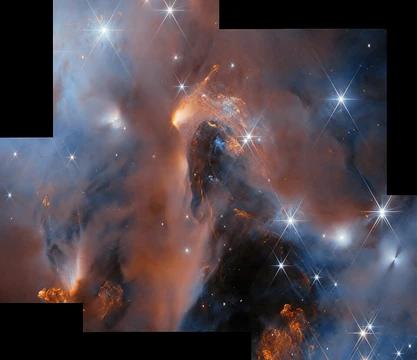
NGC 2748
A spiral galaxy with a stellar shell and multiple supernovae.

NGC 2748 is a spiral galaxy situated in the northern circumpolar constellation Camelopardalis, roughly 18.79 megaparsecs from the Milky Way. British astronomer John Herschel first observed it on September 2, 1828. Classified as SAbc, it is an unbarred spiral with arms that range from moderately to loosely wound. The galaxy has a peculiar disk-like structure and a stellar shell that rotates around its main axis, likely resulting from the capture and disruption of a smaller dwarf galaxy. At its core, a supermassive black hole with a mass of about 44 million solar masses is thought to reside. NGC 2748 belongs to the NGC 2655 group (also cataloged as LGG 165), which includes NGC 2715 and several other galaxies. Within this galaxy, astronomers have recorded four supernovae and one luminous red nova. These events include SN 1985A (Type Ia, magnitude 14.5, discovered January 25, 1985, by Thomas Schildknecht), SN 2013ff (Type Ic, magnitude 16, discovered August 31, 2013, by Raffaele Belligoli and Flavio Castellani), AT 2015fx (type LRN, magnitude 18.3, discovered February 10, 2015, by Kōichi Itagaki, initially misclassified as a luminous blue variable), SN 2017gkk (Type IIb, magnitude 14.7, discovered August 19, 2017, by MASTER and independently by Kōichi Itagaki on August 31), and SN 2026yly (Type II, magnitude 15.4, discovered August 9, 2026, by Kōichi Itagaki).
Quick Facts
- Epoch
- J2000.0
- Ra
- 09 · 13 · 43.037
- Dec
- +76 · 28 · 31.23
- Dist Ly
- 18.79 Mpc
- Group Cluster
- NGC 2655 group (LGG 165)garcia
- Z
- 0.004930
- Appmag V
- 11.7
- Constellation Name
- Camelopardalis
Facts from the source article.
Lore & Background
NGC 2748 has a morphological classification of SAbc, indicating it is an unbarred spiral with moderate to loosely-wound spiral arms. It is a disk-like peculiar galaxy with a stellar shell that rotates about the main galactic axis. This shell was most likely formed through the capture and disruption of a dwarf companion. The galactic nucleus likely contains a supermassive black hole with a mass of 44 million times the mass of the Sun.
The galaxy is part of the NGC 2655 group (also known as LGG 165), which includes NGC 2715 and other galaxies. Four supernovae and one luminous red nova have been observed in NGC 2748. SN 1985A (Type Ia, mag. 14.5) was discovered by Thomas Schildknecht on January 25, 1985. SN 2013ff (Type Ic, mag. 16) was discovered by Raffaele Belligoli and Flavio Castellani on August 31, 2013, and eventually reached magnitude 15.2. AT 2015fx (type LRN, mag. 18.3) was discovered by Kōichi Itagaki on February 10, 2015; originally classified as a luminous blue variable, later analysis concluded it was actually a luminous red nova. SN 2017gkk (Type IIb, mag. 14.7) was discovered by MASTER on August 19, 2017, and independently by Kōichi Itagaki on August 31, 2017. SN 2026yly (Type II, mag. 15.4) was discovered by Kōichi Itagaki on August 9, 2026.
Reader's Guide
NGC 2748 holds significance as a nearby spiral galaxy with a peculiar stellar shell, offering insights into galaxy interactions and the accretion of dwarf companions. The shell's rotation about the main galactic axis suggests a relatively recent merger event, providing a laboratory for studying galactic cannibalism. The galaxy's supermassive black hole, with a mass of 44 million solar masses, contributes to understanding black hole demographics in spiral galaxies. The multiple supernovae observed—spanning Types Ia, Ic, IIb, and II—along with a luminous red nova (AT 2015fx) that was initially misclassified as a luminous blue variable, highlight NGC 2748 as a site of diverse stellar explosions. These events have been discovered by both professional surveys (MASTER) and amateur astronomers (Thomas Schildknecht, Raffaele Belligoli, Flavio Castellani, Kōichi Itagaki), underscoring the collaborative nature of transient astronomy. The galaxy's membership in the NGC 2655 group places it within a larger cosmic structure, aiding studies of group dynamics and galaxy evolution. Its legacy includes providing data for supermassive black hole mass measurements based on HST emission-line gas kinematics, and serving as a target for ongoing monitoring of transient phenomena.
Did You Know?
- NGC 2748 was discovered by British astronomer John Herschel on September 2, 1828.
- The galaxy has a stellar shell likely formed from the capture and disruption of a dwarf companion.
- AT 2015fx was originally classified as a luminous blue variable but later reclassified as a luminous red nova.
More in NGC Objects, Part 4 1-24
Spotted an error? Know more?
Reader corrections go straight into our review queue. Suggest an edit · How this site is sourced