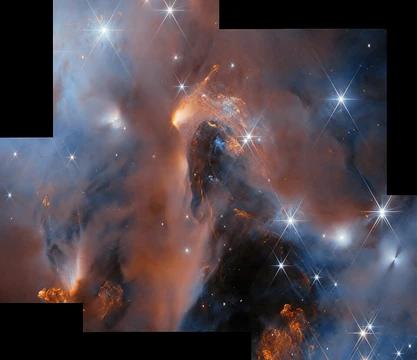
NGC 2736
A narrow filament in the Vela Supernova Remnant.

NGC 2736, commonly called the Pencil Nebula, is a small, linear filament within the Vela Supernova Remnant in the constellation Vela. It is notable for its narrow, ray-like appearance and its motion as part of the shock wave from a supernova explosion that occurred about 11,000 years ago.
- Distance
- about 815 light-years (250 parsecs)
- Velocity
- roughly 644,000 km/h
- Dimensions
- 30' x 7'
- Position angle
- 20°
- Discovery date
- 1 March 1835
- Discoverer
- John Herschel
Lore & Background
NGC 2736 was discovered on 1 March 1835 by John Herschel at the Cape of Good Hope. He described it as an extraordinary long narrow ray of excessively feeble light, at least 20 arcminutes long and extending beyond the field of view. The object is listed as E260-N14 with dimensions 30' by 7' and a position angle of 20°, with notes describing it as a luminous filament. On the ESO IIIa-F film, this nebula appears as the brightest patch of the huge Gum Nebula supernova remnant, whose delicate wisps cover the field. A relatively bright star is immersed within NGC 2736, as noted by Herschel.
Reader's Guide
NGC 2736 is significant as a visible fragment of the Vela Supernova Remnant, which resulted from a supernova explosion roughly 11,000 years ago. Its linear shape, which inspired its popular name, is thought to be formed from part of the shock wave of the larger remnant. The nebula's high velocity—about 644,000 km/h—underscores its dynamic nature as expanding debris. As the brightest patch of the Gum Nebula, it serves as a key marker for studying the structure and evolution of supernova remnants. Its discovery by John Herschel in 1835 and its inclusion in the ESO-Uppsala catalog highlight its enduring interest to astronomers. The presence of an embedded bright star, mentioned by Herschel, adds to its observational character.
Did You Know?
- NGC 2736 is also known as the Pencil Nebula due to its linear appearance.
- It is located near the Vela Pulsar in the constellation Vela.
- The nebula is moving at roughly 644,000 km/h.
- John Herschel discovered it on 1 March 1835 at the Cape of Good Hope.
More in NGC Objects, Part 4 1-24
Spotted an error? Know more?
Reader corrections go straight into our review queue. Suggest an edit · How this site is sourced