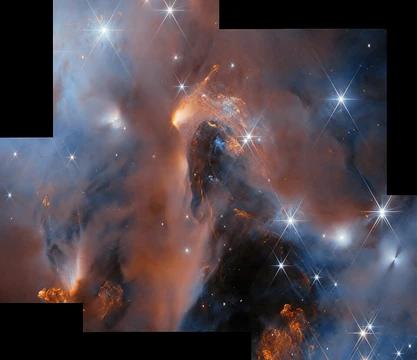
NGC 2697
A lenticular galaxy with decoupled star disks and a dust ring.

NGC 2697 is a lenticular galaxy located in the constellation Hydra, approximately 90 million light years from Earth. It is notable for its complex internal kinematics and evidence of a past galactic merger.
Quick Facts
- Epoch
- J2000
- Ra
- 08 · 54 · 59.4027
- Dec
- -02 · 59 · 15.016
- Dist Ly
- 90 ± 6.2 Mly (27.6 ± 1.9 Mpc)
- Z
- 0.006084 ± 0.000013
- H Radial V
- 1,824 ± 4 km/s
- Appmag V
- 12.6
- Constellation Name
- Hydra
- Group Cluster
- NGC 2698 Group
Facts from the source article.
Lore & Background
NGC 2697 is an unbarred lenticular galaxy that lacks a bulge. Its gas and stars rotate at different speeds, indicating they are tilted relative to each other. The stars in the central 10–15 arcseconds rotate slower than those in the disk, revealing two kinematically decoupled star disks. The galaxy contains a dust ring at 3 arcseconds from the nucleus and an ultraviolet ring located 7 to 11 arcseconds from the nucleus. Stars between these two rings have a mean age of 5–7 billion years, while the nuclear stars are older. The galaxy likely accreted a dwarf galaxy about 1.5 billion years ago, which introduced metal-poor stars to the outer disk and triggered star formation in the inner disk. The current star formation rate is estimated at 0.2 solar masses per year, occurring along a ring visible in ultraviolet light.
Reader's Guide
NGC 2697 is a member of the NGC 2698 group, which also includes NGC 2695, NGC 2698, NGC 2699, NGC 2708, and NGC 2709, with NGC 2706 and NGC 2690 lying somewhat farther away. Its significance lies in its detailed kinematic structure: the presence of two decoupled star disks and the differing rotation speeds of gas and stars provide insight into the complex dynamics of lenticular galaxies. The evidence of a past accretion event about 1.5 billion years ago, along with the distinct age populations of stars and ongoing star formation in a ring, makes NGC 2697 a valuable case study for understanding galaxy evolution through minor mergers. The ultraviolet ring and dust ring further highlight the interplay between gas, dust, and star formation in shaping the galaxy's present appearance.
Did You Know?
- NGC 2697 was discovered by Bindon Stoney, assistant of William Parsons, 3rd Earl of Rosse, on January 24, 1851.
- The galaxy has two kinematically decoupled star disks, with central stars rotating slower than those in the disk.
- The galaxy has a dust ring at 3 arcseconds and an ultraviolet ring from 7 to 11 arcseconds from the nucleus.
More in NGC Objects, Part 4 1-24
Spotted an error? Know more?
Reader corrections go straight into our review queue. Suggest an edit · How this site is sourced