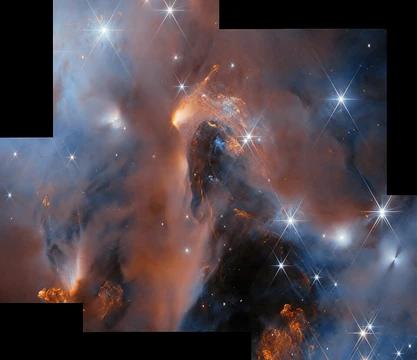
NGC 2672
Elliptical galaxy in Cancer with an active nucleus and interacting companion.

NGC 2672 is an elliptical galaxy in the constellation of Cancer. It is notable as an Active Galaxy Nucleus Candidate, indicating a compact central region emitting significant energy across the electromagnetic spectrum beyond stellar processes. The galaxy is part of a double system with NGC 2673, listed as Holm 99 and Arp 167, and is involved in an interaction that leaves it only weakly disturbed.
Quick Facts
- Epoch
- J2000
- Constellation Name
- Cancer
- Ra
- 08 · 49 · 21.8884
- Dec
- +19 · 04 · 29.947ned
- Z
- 0.014487ned
- Dist Ly
- 68.01 ± 4.77 Mpcned
- Group Cluster
- Arp 167
- Appmag V
- 11.7ned
Facts from the source article.
Lore & Background
NGC 2672 was discovered by German-British astronomer William Herschel on 14 March 1784. The SIMBAD database lists it as an Active Galaxy Nucleus Candidate, meaning its central region emits substantial energy across the electromagnetic spectrum with characteristics not produced by stars. It forms a double system with NGC 2673, cataloged as Holm 99 in Erik Holmberg's 1937 study of double and multiple galaxies. The pair also appears in Halton Arp's Atlas of Peculiar Galaxies as Arp 167, described as having a companion galaxy that is very condensed with a curved plume. Further study indicates the two galaxies are interacting: NGC 2673 possesses two tidal plumes, while NGC 2672 is only weakly disturbed. Two supernovae have been observed in NGC 2672: SN 1938B (type unknown, magnitude 15.5) discovered by Arno Wachmann in 1938, and SN 2025yla (Type Ia-91bg-like, magnitude 15.5) discovered by the Zwicky Transient Facility on 18 January 2025. On 29 January 1953, the galaxy was occulted by the Moon during a total lunar eclipse over the South Atlantic and extreme south of Africa.
Reader's Guide
NGC 2672 holds significance as an Active Galaxy Nucleus Candidate, indicating a central engine that outshines stellar processes and offers insight into galactic nuclear activity. Its inclusion in multiple catalogs—Holm 99 and Arp 167—highlights its role in studies of galaxy pairs and interactions. The interaction with NGC 2673, where NGC 2672 remains only weakly disturbed while its companion shows tidal plumes, provides a case study in differential tidal effects during galaxy mergers. The two recorded supernovae, including a Type Ia-91bg-like event in 2025, contribute to understanding supernova rates and types in elliptical galaxies. The lunar occultation during a total eclipse in 1953 is a rare observational event, linking the galaxy to historical astronomical phenomena. Together, these features make NGC 2672 a valuable object for research on active nuclei, interacting systems, and transient events.
Did You Know?
- NGC 2672 is an Active Galaxy Nucleus Candidate, with a compact central region emitting energy beyond stellar processes.
- Two supernovae have been observed: SN 1938B (mag. 15.5) and SN 2025yla (Type Ia-91bg-like, mag. 15.5).
- On 29 January 1953, NGC 2672 was occulted by the Moon during a total lunar eclipse.
More in NGC Objects, Part 4 1-24
Spotted an error? Know more?
Reader corrections go straight into our review queue. Suggest an edit · How this site is sourced