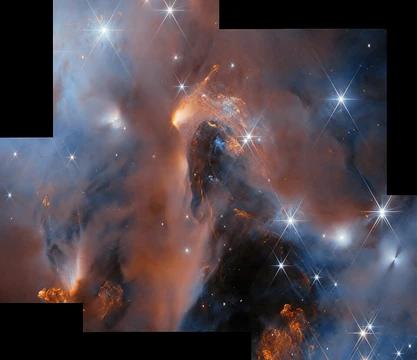
NGC 2663
Elliptical galaxy with a massive black hole jet.

NGC 2663, also cataloged as PGC 24590, is an elliptical galaxy featuring a gaseous disk. It lies in the constellation Pyxis, about 93 million light-years away. The galaxy has a compact central radio source, and earlier observations indicated it likely hosts an active galactic nucleus.
First spotted on February 8, 1886, by Lewis A. Swift, NGC 2663 has been studied extensively since, yet many of its characteristics remain unclear.
In August 2022, astronomers at Western Sydney University found a black hole at the galaxy’s center ejecting a jet of matter at nearly the speed of light. The jet is expected to stretch over a million light-years from end to end—roughly 50 times the size of the galaxy itself. At the time, it ranked among the largest jets ever observed. The discovery was made using CSIRO’s Australian Square Kilometer Array Pathfinder, a network of 36 linked radio dishes functioning as a single super-telescope.
Quick Facts
- Epoch
- J2000.0
- Constellation Name
- Pyxis
- Ra
- 08 · 45 · 08.144
- Dec
- -33 · 47 · 41.06
- Z
- 0.007078
- H Radial V
- 2114 km/s
- Dist Ly
- 93 mly
- Appmag B
- 11.85
- Appmag V
- 12.33
Facts from the source article.
Lore & Background
NGC 2663 was discovered on 8 February 1886 by Lewis A. Swift. Although detected in 1886 and observed many times since, many of its properties remain unknown. The galaxy hosts a compact central radio source, and previous studies suggested it contains an active galactic nucleus (AGN). In August 2022, astronomers from Western Sydney University discovered a black hole at the galaxy's center shooting a jet of matter at nearly the speed of light, with enormous energy. The beam is expected to span more than a million light years from end to end, making it about 50 times larger than the galaxy itself. At the time of discovery, it was one of the biggest jets ever observed. The discovery was made using the Commonwealth Scientific and Industrial Research Organisation's (CSIRO) super-telescope, the Australian Square Kilometer Array Pathfinder, a network of 36 linked radio dishes combined into a single super telescope.
Reader's Guide
The discovery of the jet from NGC 2663's central black hole is significant because it ranks among the largest jets ever observed, spanning more than a million light years. The jet stream, about 50 times larger than the galaxy itself, was found to be shooting matter at nearly the speed of light. This observation was made possible by the Australian Square Kilometer Array Pathfinder, a network of 36 linked radio dishes operated by CSIRO. The jet's enormous scale and energy provide a rare opportunity to study the interaction between a supermassive black hole and its surrounding environment on intergalactic scales. Despite many observations since its discovery in 1886, much about NGC 2663 remains unknown, making this jet a key feature for future research into active galactic nuclei and black hole feedback mechanisms.
Did You Know?
- NGC 2663 is also known as PGC 24590.
- In August 2022, a black hole jet was discovered shooting from its center at nearly the speed of light.
More in NGC Objects, Part 4 1-24
Spotted an error? Know more?
Reader corrections go straight into our review queue. Suggest an edit · How this site is sourced