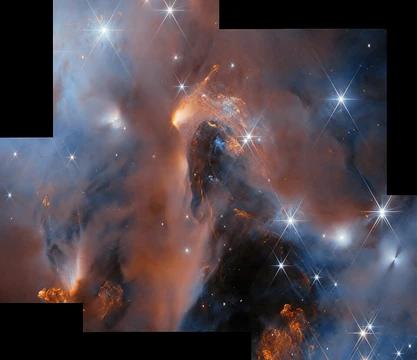
NGC 2617
A Seyfert galaxy in Hydra that underwent a dramatic 2013 outburst.

NGC 2617 is a spiral galaxy in the constellation Hydra, classified as Sc for its loosely wound arms and nearly face-on orientation. It was first observed by French astronomer Édouard Stephan on February 12, 1885. Danish astronomer J. L. E. Dreyer later described it in 1888 as extremely faint and very small, with two very faint stars appearing within it. The galaxy lies roughly 61.86 million parsecs away. In infrared observations, its angular size is measured in arcminutes.
In 1992, NGC 2617 was detected as an extragalactic X-ray source. Four years later, in 1996, E. C. Moran and colleagues identified it as a Seyfert 1.8 galaxy. A radio counterpart was found in 1998.
A major outburst occurred at the galaxy’s core in April 2013, shifting its spectral classification to a Seyfert 1. This event began with a rise in X-ray emission, followed by increases in ultraviolet and then infrared light. The outburst is thought to result from X-rays heating the accretion disk around a supermassive black hole at the center, with longer-wavelength emission coming from the heated disk material. An earlier increase in brightness between 2010 and 2012 may have cleared dust from the inner disk, altering the galaxy’s observed Seyfert type. The mass of the central black hole has been estimated.
Further outbursts, separated by deep minima, were observed from 2016 to 2018.
Quick Facts
- Epoch
- J2000
- Constellation Name
- Hydra
- Ra
- 08 · 35 · 38.798
- Dec
- −04 · 05 · 17.90
- Dist Ly
- 61.86 Mpc0.73
- Appmag V
- 12.660.20
- Appmag B
- 14.100.30
Facts from the source article.
Lore & Background
NGC 2617 was discovered on February 12, 1885, by French astronomer Édouard Stephan. In 1888, Danish astronomer J. L. E. Dreyer described it as 'extremely faint, very small, 2 very faint stars involved'. It is an almost face-on spiral galaxy with a morphological classification of Sc, indicating loosely wound spiral arms. In 1992, it was shown to be an extragalactic source of X-ray emission, and in 1996 it was identified as a Seyfert 1.8 galaxy by E. C. Moran and associates. A radio counterpart was found in 1998.
During April 2013, a dramatic outburst was discovered at the core of NGC 2617, and the spectral type changed to a Seyfert 1. An increase in X-ray emission was observed, followed by an increase in ultraviolet and then infrared luminosity. This event can be modeled by X-ray radiation heating the accretion disk orbiting a supermassive black hole at the center of the galaxy, followed by emission at longer wavelengths from the heated disk. An increase in luminosity between 2010 and 2012 may have cleared away dust in the inner part of the disk prior to the outburst, allowing a clearer view and changing the Seyfert type. Additional outbursts were observed from 2016 to 2018, in between deep minima.
Reader's Guide
NGC 2617 is significant as a Seyfert galaxy whose changing spectral type and repeated outbursts provide insight into the behavior of active galactic nuclei. The 2013 outburst, in which X-ray, ultraviolet, and infrared emissions rose sequentially, supports models where X-ray radiation from the central supermassive black hole heats the accretion disk, producing longer-wavelength emission. The possible clearing of dust in the inner disk between 2010 and 2012 may explain the change from Seyfert 1.8 to Seyfert 1, offering a rare view into the dynamic environment near a supermassive black hole. The subsequent outbursts from 2016 to 2018, interspersed with deep minima, indicate that such activity is not a single event but part of an ongoing process. This galaxy thus serves as a natural laboratory for studying the variability and evolution of Seyfert nuclei, the role of dust obscuration, and the response of the accretion disk to changes in the central engine.
More in NGC Objects, Part 4 1-24
Spotted an error? Know more?
Reader corrections go straight into our review queue. Suggest an edit · How this site is sourced