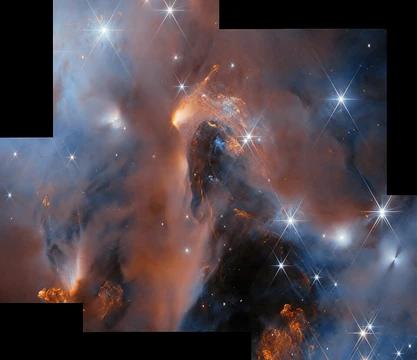
NGC 2573
The closest NGC object to the south celestial pole.

NGC 2573, nicknamed Polarissima Australis, is a barred spiral galaxy in the southern constellation Octans. It holds the distinction of being the NGC object nearest to the south celestial pole. Discovered by English astronomer John Herschel on March 29, 1837, the galaxy has an apparent magnitude of 13.25, which makes it easily observable through a medium-sized telescope but invisible without optical aid. Its distance is uncertain: one measurement places it 84 million light-years away, while a redshift of z = 0.08102 suggests a greater distance of 109 million light-years. The galaxy is receding from Earth with a heliocentric radial velocity of an unspecified value. In the De Vaucouleurs classification system, NGC 2573 is typed as SAB(s)cd:, meaning it is a weakly-barred spiral with loosely wound arms and a small, dim bulge. The "(s)" indicates a purely spiral structure, though the classification is tentative, likely due to the galaxy's faintness. NGC 2573 spans an estimated 77,800 light-years across, comparable to the Milky Way in size, though its central mass is only 28% of the Milky Way's. For comparison, NGC 3172 is the closest NGC object to the north celestial pole.
Quick Facts
- Epoch
- J2000.0
- Ra
- 01 · 41 · 38.0019
- Dec
- -89 · 20 · 04.2723
- Dist Ly
- 25.8 Mpc
- Z
- 0.0081020.000017
- Appmag B
- 14.150.09
- Appmag V
- 13.250.09
- Absmag V
- −19.300.67
- Constellation Name
- Octans
- Mass
- 3.229e11
- Notes
- Closest NGC object to the south celestial pole.
Facts from the source article.
Lore & Background
NGC 2573 was discovered on March 29th, 1837 by English astronomer John Herschel. Its nickname, Polarissima Australis, reflects its position as the nearest NGC object to the south celestial pole. The galaxy has an apparent magnitude of 13.25, making it readily visible in medium-sized telescopes but not to the naked eye. It is located at a distance of 84 million light years, though a redshift of z = 0.08102 suggests a greater distance of 109 million light years. The galaxy is currently receding with a heliocentric radial velocity. In the De Vaucouleurs system, NGC 2573 has a morphological classification of SAB(s)cd:, indicating it is a weakly-barred spiral galaxy with loosely bound spiral arms and a small, faint bulge. The (s) notation denotes a purely spiral structure, though there is uncertainty about the classification, possibly due to the galaxy's faintness. NGC 2573 is estimated to be 77,800 light years across, similar in size to the Milky Way, and has a central mass that is 28% of the latter's mass.
Reader's Guide
NGC 2573 holds significance as the southern counterpart to NGC 3172, the closest NGC object to the north celestial pole. Its nickname Polarissima Australis underscores its unique positional distinction. The galaxy's classification as SAB(s)cd: reflects a weakly-barred spiral structure with loosely bound arms, though the uncertainty in its morphology highlights the challenges of observing faint objects. Its size, comparable to the Milky Way, and its central mass—28% of the Milky Way's—provide context for its physical scale. The discrepancy in distance measurements (84 million light years versus 109 million light years from redshift) illustrates the complexities in determining extragalactic distances. Discovered by John Herschel in 1837, the galaxy remains a subject of interest for its polar proximity and structural characteristics, contributing to the study of spiral galaxies in the southern sky.
Did You Know?
- NGC 2573 is also known as Polarissima Australis because it is the closest NGC object to the south celestial pole.
- It was discovered by English astronomer John Herschel on March 29th, 1837.
- The galaxy has an apparent magnitude of 13.25, visible in medium-sized telescopes.
- Its morphological classification is SAB(s)cd:, indicating a weakly-barred spiral with loosely bound arms.
More in NGC Objects, Part 4 1-24
Spotted an error? Know more?
Reader corrections go straight into our review queue. Suggest an edit · How this site is sourced