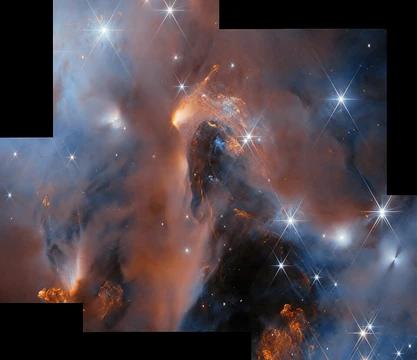
NGC 2559
Barred spiral galaxy in Puppis with asymmetric arms and a supermassive black hole.

NGC 2559 is a barred spiral galaxy located in the constellation Puppis. It lies approximately 60 million light years from Earth and spans about 90,000 light years across, with fainter outer regions extending to 110,000 light years. Discovered by John Herschel on February 5, 1837, the galaxy is notable for its prominent bar, dust-obscured bulge, and asymmetric spiral arms.
Quick Facts
- Epoch
- J2000
- Ra
- 08 · 17 · 06.1
- Dec
- -27 · 27 · 20
- Dist Ly
- 58.1 ± 5.0 Mly (17.8 ± 1.5 Mpc)
- Z
- 0.005200 ± 0.000017
- H Radial V
- 1,559 ± 5 km/s
- Appmag V
- 10.9
- Constellation Name
- Puppis
- Names
- UGCA 136, ESO 494-41, MCG -04-20-003, VV 475, IRAS 08150-2718, PGC 23222
Facts from the source article.
Lore & Background
NGC 2559 features a bar and a small elliptical bulge heavily obstructed by dust. Two spiral arms emerge from the ends of the bar, containing several knots and twists; the eastern arm exhibits more bright knots than the western one. The galaxy's position angle varies, being north-south at the center and rotating to northeast-southwest in the outer regions. The outer arms are faint, and the galaxy extends to 6.6 arcminutes when its faintest parts are considered, corresponding to 110,000 light years.
At its center lies a supermassive black hole with an estimated mass of 106.64 ± 0.97 (range 0.5–37 million solar masses), derived from the pitch angle of the spiral arms. The star formation rate is estimated at 3 solar masses per year. One supernova, SN 2002hc, was observed in the galaxy on October 24, 2002, by the Katzman Automatic Imaging Telescope at an apparent magnitude of 17; its spectrum classified it as a Type II supernova.
NGC 2559 is the foremost galaxy in the NGC 2559 group, which also includes NGC 2566 and IC 2311. A possible companion galaxy lies 4 arcminutes to the east. The group is noted for containing many hydrogen-deficient galaxies. Other nearby galaxies include NGC 2613 and ESO 563-13. NGC 2559 is part of the Puppis Wall, a structure connecting the Antlia Cluster with the Fornax Cluster.
Reader's Guide
NGC 2559 holds significance as the brightest member of the NGC 2559 group, a collection of galaxies noted for their hydrogen deficiency. Its detailed structure—a barred spiral with asymmetric arms, a dust-obscured bulge, and a variable position angle—provides insight into the dynamics of barred galaxies. The presence of a supermassive black hole at its center, with mass estimated from spiral arm pitch angles, contributes to studies of black hole–galaxy scaling relations. The detection of SN 2002hc, a Type II supernova, adds to the record of stellar explosions in this system. As part of the Puppis Wall, NGC 2559 is embedded in a large-scale filament connecting two major galaxy clusters, offering context for understanding galaxy formation and evolution within cosmic web structures. Its group's hydrogen-deficient galaxies present a peculiar environment for studying gas depletion and star formation processes.
Did You Know?
- The galaxy's supermassive black hole mass is estimated at 106.64 ± 0.97 (range 0.5–37 million solar masses).
- One supernova, SN 2002hc, was observed in NGC 2559 on October 24, 2002, and classified as Type II.
- NGC 2559 is part of the Puppis Wall, which connects the Antlia Cluster with the Fornax Cluster.
More in NGC Objects, Part 4 1-24
Spotted an error? Know more?
Reader corrections go straight into our review queue. Suggest an edit · How this site is sourced