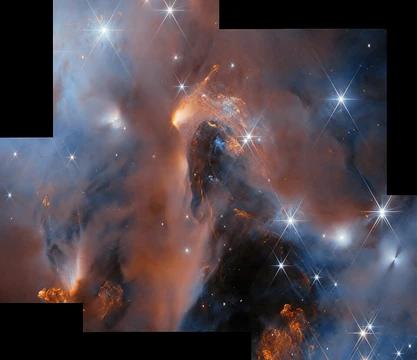
NGC 2551
A lenticular galaxy with counter-rotating gas and spiral arms.

NGC 2551 is a lenticular galaxy in the constellation Camelopardalis, located approximately 120 million light years from Earth. It is notable for its unusual spiral structure and a disk of counter-rotating gas that is forming stars.
Quick Facts
- Epoch
- J2000
- Ra
- 08 · 24 · 50.2491
- Dec
- +73 · 24 · 43.354
- Dist Ly
- 118 ± 8.2 Mly (36.2 ± 2.5 Mpc)
- Z
- 0.007819 ± 0.000037
- H Radial V
- 2,344 ± 11 km/s
- Appmag V
- 12.2
- Constellation Name
- Camelopardalis
- Group Cluster
- NGC 2551 Group
Facts from the source article.
Lore & Background
NGC 2551 was discovered by Wilhelm Tempel on August 9, 1882. Although classified as a lenticular galaxy, it features two well-defined narrow spiral arms and many arm fragments, with a spiral pattern that lies between a grand design galaxy and a multiple spiral arm pattern. The galaxy is seen at an inclination of 50°.
The galaxy possesses a disk of counter-rotating gas that is forming stars, possibly accreted from a gas-rich satellite. In ultraviolet light, a ring is visible lying 15 to 30 arcseconds from the nucleus, with excitation from star formation, post-AGB stars, and shocks in the northern inner part of the ring. The hydrogen disk appears disturbed, likely due to interactions with other galaxies.
One supernova has been observed in NGC 2551: SN 2003hr, a type II supernova several months past maximum, discovered by T. Boles on August 31, 2003, at an apparent magnitude of 16.8, located 48" west and 20.4" south of the galaxy's center.
Reader's Guide
NGC 2551 is the foremost member of the NGC 2551 group, which also includes NGC 2550, UGC 4390, and UGC 4413. This group is part of the same galaxy cloud as NGC 2633, NGC 2634, NGC 2634A, and IC 2389. NGC 2551 forms a pair with LEDA 2755603, a diffuse companion galaxy lying 2 arcminutes away, and UGC 4390 lies 14.4 arcminutes away. The galaxy's counter-rotating gas disk and disturbed hydrogen disk suggest a history of interactions or accretion, making it a valuable object for studying galaxy evolution and star formation in lenticular systems. The presence of a ring with multiple excitation sources and a well-observed type II supernova adds to its significance for understanding stellar populations and transient events.
Did You Know?
- The galaxy's spiral pattern is between a grand design and a multiple spiral arm pattern.
- SN 2003hr, a type II supernova, was discovered in NGC 2551 on August 31, 2003.
- NGC 2551 forms a pair with the diffuse companion galaxy LEDA 2755603.
More in NGC Objects, Part 4 1-24
Spotted an error? Know more?
Reader corrections go straight into our review queue. Suggest an edit · How this site is sourced