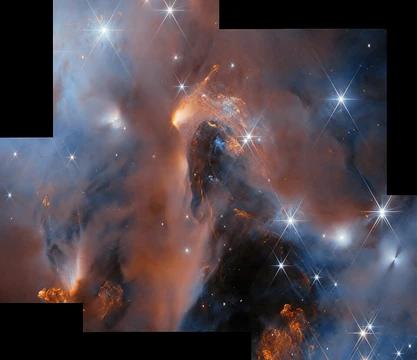
NGC 2547
Young open cluster in Vela with debris disks and planet-formation signs.

NGC 2547 is an open cluster located in the southern constellation Vela. Nicolas Louis de Lacaille first spotted it in 1751 while observing from South Africa. The cluster is relatively young, with an estimated age between 20 and 30 million years.
Data from the Spitzer Space Telescope revealed a shell surrounding the B3 III/IV-type star HD 68478, possibly indicating recent mass loss from that star. A study using Gaia DR2 data found that NGC 2547 formed around 30 million years ago alongside a newly identified cluster called [BBJ2018] 6. The cluster shares a similar age with Trumpler 10, NGC 2451B, Collinder 135, and Collinder 140, suggesting all these groups may have originated from a single event of triggered star formation. NGC 2547 also shows signs of mass segregation down to 3.
Many of its stars host debris disks. Spitzer observations indicate that less than 1% of stars in the cluster have an infrared excess at 8.0 μm, while 30–45% of B- to F-type stars show excess at 24 μm. The system 2MASS J08090250-4858172, also known as ID8, experienced a notable brightening in its debris disk at 3 to 5 micrometers, followed by a decline over a year—interpreted as a violent impact on a planetary body. Nine M-dwarfs in NGC 2547 exhibit 24 μm excess, possibly from debris disks near their snow lines, suggesting ongoing planet formation. Later work proposed these M-dwarfs might host Peter Pan Disks. One such M-dwarf, 2MASS 08093547-4913033, was observed with the Spitzer Infrared Spectrograph, yielding the first detection of silicate in a debris disk around an M-type star.
Quick Facts
- Constellation
- Vela
- Epoch
- J2000.0
- Ra
- 8 · 09 · 52.360
- Dec
- -49 · 10 · 35.01
- Dist Ly
- 1.19 kly
- Dist Pc
- 364.0 · 46.8 · 37.9 pc
- Appmag V
- 4.7
- Mass Msol
- 201
- Radius Ly
- 2.61 ly
- Age
- 37.7 · 5.7 · 4.8 Myr
- Names
- NGC 2547, Cr 177, Mel 84, Dunlop 410, Lacaille III.2
Facts from the source article.
Lore & Background
NGC 2547 was discovered by Nicolas Louis de Lacaille in 1751 during his observations from South Africa. The cluster is young, with an age estimated at 20–30 million years. Observations with the Spitzer Space Telescope revealed a shell around the B3 III/IV-type star HD 68478, possibly indicating recent mass loss. A study using Gaia DR2 data showed that NGC 2547 formed about 30 million years ago together with a newly discovered star cluster, [BBJ2018] 6. NGC 2547 has a similar age to Trumpler 10, NGC 2451B, Collinder 135, and Collinder 140, and it has been suggested that all these clusters formed in a single event of triggered star formation.
The cluster shows evidence for mass segregation down to 3. Many stars in NGC 2547 host debris disks: ≤1% of stars show infrared excess at 8.0 μm, while 30–45% of B- to F-type stars have excess at 24 μm. The system 2MASS J08090250-4858172 (also called ID8) exhibited a substantial brightening of its debris disk at 3–5 μm followed by a decay over a year, interpreted as a violent impact on a planetary body. Nine M-dwarfs in NGC 2547 show 24 μm excess, possibly debris disks near the snow line, indicating ongoing planet formation; later it was suggested these might be Peter Pan Disks. One such M-dwarf, 2MASS 08093547-4913033, was observed with the Spitzer Infrared Spectrograph, yielding the first detection of silicate from a debris disk around an M-type star.
Reader's Guide
NGC 2547 is significant as a young open cluster that provides a laboratory for studying early stellar evolution and planet formation. The detection of debris disks around a substantial fraction of its B- to F-type stars, as well as around nine M-dwarfs, indicates that planet-building processes are active. The silicate detection around an M-dwarf is a first, highlighting the potential for rocky planet formation in low-mass systems. The violent impact event observed in the ID8 system offers direct evidence of collisions among planetary bodies. The cluster's co-formation with [BBJ2018] 6 and its similar age to several other clusters suggests a large-scale triggered star formation event, linking NGC 2547 to a broader regional history of star birth. Its mass segregation and the shell around HD 68478 further inform models of stellar dynamics and mass loss in young clusters.
Did You Know?
- The system ID8 in NGC 2547 showed a brightening of its debris disk interpreted as a violent impact on a planetary body.
- NGC 2547 may have formed in a single triggered star formation event along with Trumpler 10, NGC 2451B, Collinder 135, and Collinder 140.
More in NGC Objects, Part 4 1-24
Spotted an error? Know more?
Reader corrections go straight into our review queue. Suggest an edit · How this site is sourced