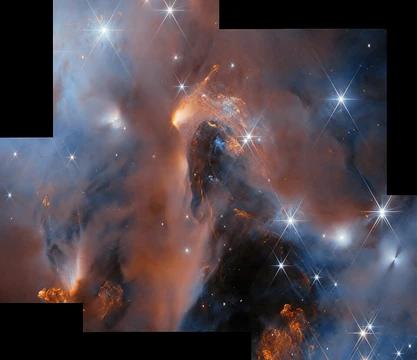
NGC 2546
Two overlapping open clusters in Puppis, resolved by a 2020 study.

NGC 2546 consists of two separate open clusters that overlap in the southern constellation Puppis. French astronomer Abbe Lacaille first spotted the object from South Africa in 1751–1752. To the unaided eye it appears as a faint, hazy patch, and its brightest star shines at magnitude 6.44. A pair of 10×50 binoculars easily reveals the brighter stars.
Before 2020, astronomers had not closely studied this cluster. It was thought to be sparse but spread out, classified as Trumpler type III 1m, with an elongated north–south shape spanning 50 arcminutes by 25 arcminutes. Roughly 85 members were known brighter than visual magnitude 14.5. Three Ap stars were identified, and the star AS Puppis was considered a candidate mass-losing AGB star.
A 2020 study by A. J. Alejo and colleagues showed that two physically distinct stellar groups occupy this region. The groups can be told apart mainly by radial velocity, spectral type, and reddening from interstellar dust. The larger group, NGC 2546A, lies about 950 parsecs away, is roughly 180 million years old, and has a half-member radius of 8 parsecs. The other, NGC 2546B, is about 1,450 parsecs from the Sun, less than 10 million years old, and has a half-member radius of 1.6 parsecs. The angular separation between the centers of the two clusters is noted.
Quick Facts
- Constellation
- Puppis
- Epoch
- J2000.0
- Ra
- 08 · 12 · 19.7
- Dec
- −37 · 39 · 40
- Dist Ly
- A: 950 pc / B: 1450 pc
- Appmag V
- 6.3
- Names
- NGC 2546, Cr 178, Dunlop 563, Lacaille II.4
Facts from the source article.
Lore & Background
Prior to 2020, NGC 2546 had been poorly studied and was considered rather poor in stars but extensive, with a Trumpler class of III 1m. Its distribution was found to be elongated in a north–south direction with an angular size of 50′ × 25′. The cluster was thought to have an estimated 85 members brighter than visual magnitude 14.5, and three Ap stars were detected. Cluster member AS Puppis is a candidate mass-losing AGB star.
A 2020 study by A. J. Alejo and associates demonstrated that two physically distinct stellar groups occupy the region. Membership could be distinguished by multiple parameters, with radial velocity, spectral type, and reddening from extinction being the most significant. The more populated cluster, designated NGC 2546A, is located at a distance of 950 pc and is about 180 Myr old with a half-member radius of 8 pc. The second cluster, NGC 2546B, lies 1450 pc from the Sun and is less than 10 million years old with a half-member radius of 1.6 pc.
Reader's Guide
NGC 2546 is notable as a rare example of two physically distinct open clusters that appear superimposed along the same line of sight. For decades it was treated as a single, sparse cluster, but the 2020 study by Alejo and associates resolved it into two independent groupings with markedly different ages and distances. NGC 2546A, the older and more populous cluster at 950 pc, is roughly 180 million years old, while NGC 2546B is a much younger system less than 10 million years old and located 1450 pc away. The presence of three Ap stars and the candidate mass-losing AGB star AS Puppis adds astrophysical interest. The object remains accessible to amateur observers: it is just visible to the naked eye as a fuzzy patch, and its brighter members are readily resolved with 10×50 binoculars. Its legacy lies in demonstrating how modern multi-parameter analysis can disentangle overlapping stellar populations that were previously mistaken for a single cluster.
Did You Know?
- NGC 2546 was discovered by French astronomer Abbe Lacaille in 1751–1752 from South Africa.
- The brightest component of NGC 2546 has an apparent visual magnitude of 6.44.
- A 2020 study revealed that NGC 2546 consists of two independent clusters, designated A and B.
More in NGC Objects, Part 4 1-24
Spotted an error? Know more?
Reader corrections go straight into our review queue. Suggest an edit · How this site is sourced