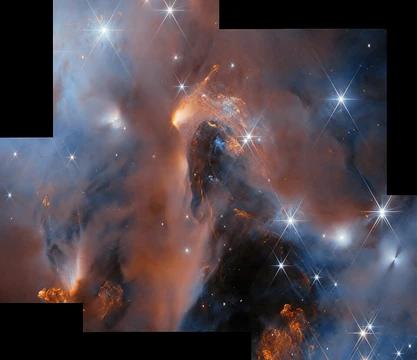
NGC 2545
Barred spiral galaxy with an active LINER nucleus in Cancer.

NGC 2545 is a barred spiral galaxy in the constellation Cancer. It was discovered by the German-British astronomer William Herschel on 11 January 1787. The galaxy has an active galactic nucleus, meaning a compact central region emits significant energy across the electromagnetic spectrum that cannot be attributed to stars. It is also classified as a LINER galaxy, with an emission spectrum showing broad lines from weakly ionized atoms.
Based on its velocity relative to the cosmic microwave background, the Hubble distance to NGC 2545 is about 53.29 ± 3.74 megaparsecs. However, 15 other measurements not based on redshift give a closer distance of roughly 48.740 ± 3.507 megaparsecs. The galaxy is the namesake of the NGC 2545 group (also known as LGG 156), which contains five galaxies, including NGC 2565 and CGCG 119-56.
One supernova has been observed in NGC 2545: SN 2008hn, a Type Ic supernova with a magnitude of 18.4, discovered by the Lick Observatory Supernova Search (LOSS) on 25 November 2008.
Quick Facts
- Epoch
- J2000
- Constellation Name
- Cancer
- Ra
- 08 · 14 · 14.1505ned
- Dec
- +21 · 21 · 19.658ned
- Z
- 0.011291 · 0.00000900ned
- Dist Ly
- 48.740 ± 3.507 Mpcned-distance
- Group Cluster
- NGC 2545 Group (LGG 156)
- Appmag V
- 13.4gned
Facts from the source article.
Lore & Background
NGC 2545 was discovered by William Herschel on 11 January 1787. It is a barred spiral galaxy and is classified as a LINER galaxy, indicating that its nucleus produces an emission spectrum with broad lines from weakly ionized atoms. The galaxy also possesses an active galactic nucleus, a compact central region emitting significant energy across the electromagnetic spectrum that is not generated by stars.
The galaxy is a member of a small group named after it, also known as LGG 156, which contains five galaxies including NGC 2565 and CGCG 119-56. One supernova has been observed in NGC 2545: SN 2008hn, a Type Ic supernova with a magnitude of 18.4, discovered by the Lick Observatory Supernova Search (LOSS) on 25 November 2008.
Distance measurements for NGC 2545 show some variation. Its velocity relative to the cosmic microwave background corresponds to a Hubble distance of 53.29 ± 3.74 Mpc, while 15 non-redshift measurements yield a closer mean distance of 48.740 ± 3.507 Mpc.
Reader's Guide
NGC 2545 is significant as a barred spiral galaxy that hosts an active galactic nucleus and is classified as a LINER galaxy, placing it among galaxies whose central energy output is dominated by non-stellar processes. Its dual distance estimates—one from Hubble flow and another from 15 non-redshift measurements—highlight the ongoing uncertainty in measuring extragalactic distances, a common challenge in astronomy. The galaxy's membership in the NGC 2545 group (LGG 156) provides context for studying galaxy interactions and evolution within a small group environment. The detection of a Type Ic supernova (SN 2008hn) in 2008 adds to its observational history, as Type Ic supernovae are associated with massive stars that have lost their outer hydrogen and helium envelopes. Discovered by William Herschel in 1787, NGC 2545 represents a class of galaxies that bridge normal star-forming spirals and more active galaxies, offering insights into the mechanisms powering low-ionization nuclear emission regions.
Did You Know?
- One supernova, SN 2008hn (Type Ic, mag. 18.4), was observed in NGC 2545.
- The galaxy is a member of the NGC 2545 group (LGG 156), which contains five galaxies.
Frequently Asked Questions
What is NGC 2545?
NGC 2545 is a barred spiral galaxy located in the constellation Cancer. It features a central bar structure with spiral arms extending outward, and it hosts an active galactic nucleus at its core.
Who discovered NGC 2545 and when?
The German-British astronomer William Herschel first identified NGC 2545 on 11 January 1787, adding it to his catalog of deep-sky objects during his extensive survey of the night sky.
What kind of active nucleus does NGC 2545 have?
NGC 2545 possesses a LINER (Low-Ionization Nuclear Emission-line Region) nucleus, meaning its central region produces broad emission lines from weakly ionized atoms rather than the extreme ionization seen in classic Seyfert galaxies. This makes it a lower-energy form of an active galactic nucleus.
How far away is NGC 2545 from Earth?
Based on its velocity relative to the cosmic microwave background, the Hubble distance places NGC 2545 at roughly 53.29 megaparsecs (with an uncertainty of about 3.74 Mpc). An independent mean of 15 non-redshift measurements gives a slightly closer estimate of approximately 48.74 megaparsecs.
Why do astronomers care about NGC 2545?
Its LINER classification makes it a useful natural laboratory for studying the lower-energy end of active galactic nuclei and the physics of weakly ionized gas around supermassive black holes. As a barred spiral, it also helps researchers understand how bar structures influence gas flow toward the galactic center.
More in NGC Objects, Part 4 1-24
Spotted an error? Know more?
Reader corrections go straight into our review queue. Suggest an edit · How this site is sourced