
Seismic base isolation
Structural elements that decouple a building from ground shaking.

Marshelec · CC BY-SA 3.0
Seismic base isolation, also known as base isolation or base isolation system, is a collection of structural elements intended to decouple a superstructure from its substructure resting on shaking ground, thereby protecting a building or non-building structure's integrity. It is one of the most popular means of protecting a structure against earthquake forces and a powerful tool of earthquake engineering pertaining to passive structural vibration control technologies.
- field
- Earthquake engineering
- known_for
- Protecting structures against earthquake forces through decoupling superstructure from substructure
- earliest_known_use
- 550 B.C. (Tomb of Cyrus the Great, Pasargadae, Iran)
- pioneer
- Dr Bill Robinson (New Zealand, 1970s)
- invented
- Lead-core rubber bearing (1974 by Dr Bill Robinson)
Lore & Background
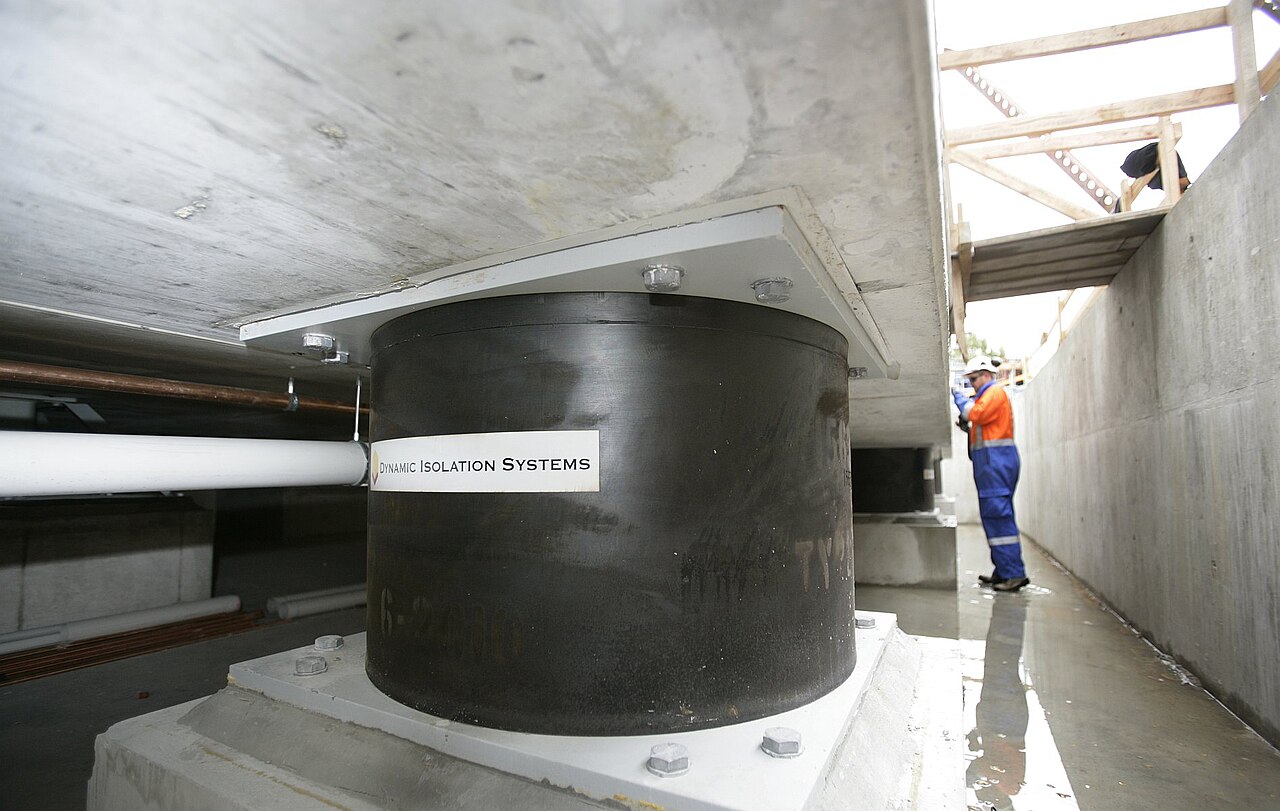
Base isolator bearings were pioneered in New Zealand by Dr Bill Robinson during the 1970s. The bearing, consisting of layers of rubber and steel with a lead core, was invented by Dr Robinson in 1974.
The earliest known use of base isolation dates to 550 B.C. in the construction of the Tomb of Cyrus the Great in Pasargadae, Iran. Historians discovered that the structure had two foundations: a lower foundation of stones bonded with lime plaster and sand mortar (saroj mortar) designed to move during an earthquake, and an upper foundation layer of polished stones that formed a large plate not attached to the base, allowing it to slide freely. This system worked as designed, and the tomb still stands.
Base isolation can be obtained using rubber bearings, friction bearings, ball bearings, spring systems, and other means. It is used for both new structural design and seismic retrofit. Notable U.S. monuments mounted on base isolation systems include Pasadena City Hall, San Francisco City Hall, Salt Lake City and County Building, and LA City Hall. The technique is also used on a smaller scale, such as isolated raised-floor systems for essential equipment and to protect statues like Rodin's Gates of Hell at the National Museum of Western Art in Tokyo.
Reader's Guide
Seismic base isolation is a key technology in earthquake engineering, allowing structures to survive potentially devastating seismic impacts through initial design or subsequent modifications. It does not make a building earthquake proof but can considerably raise both seismic performance and sustainability. The system consists of isolation units (which provide decoupling) and isolation components (connections without decoupling effect). Devices may be elastomeric or sliding.
Research through the George E. Brown, Jr. Network for Earthquake Engineering Simulation (NEES) studies the performance of base isolation systems, including a collaboration among University of Nevada, Reno; University of California, Berkeley; University of Wisconsin, Green Bay; and the University at Buffalo assessing barriers to widespread adoption in the United States. Tests include full-scale, three-dimensional tests of an isolated 5-story steel building on the E-Defense shake table in Miki, Hyōgo, Japan.
Adaptive base isolation systems include tunable isolators that adjust properties based on input, using magnetorheological fluid dampers or magnetorheological elastomers. Notable structures on base isolation include the Tomb of Cyrus, LA City Hall, San Francisco City Hall, the San Francisco International Airport's International Terminal, Sabiha Gökçen International Airport's main terminal (currently the largest seismically isolated structure in the world), and Apple Park.
Did You Know?
- The earliest known use of base isolation dates to 550 B.C. in the Tomb of Cyrus the Great in Pasargadae, Iran.
- Base isolator bearings were pioneered in New Zealand by Dr Bill Robinson during the 1970s, and the lead-core rubber bearing was invented in 1974.
- Base isolation does not make a building earthquake proof.
- Sabiha Gökçen International Airport's main terminal, completed in 2009, was once the largest seismically isolated structure in the world.
Core Mechanism and Engineering Philosophy
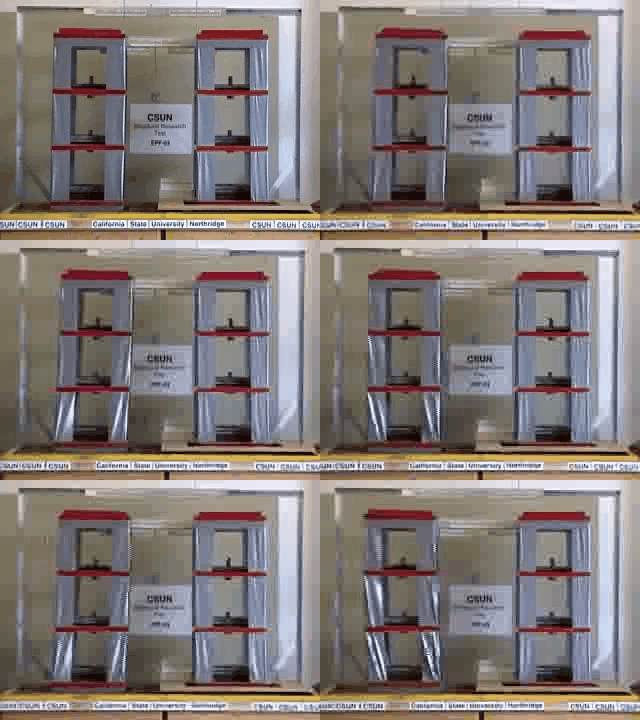
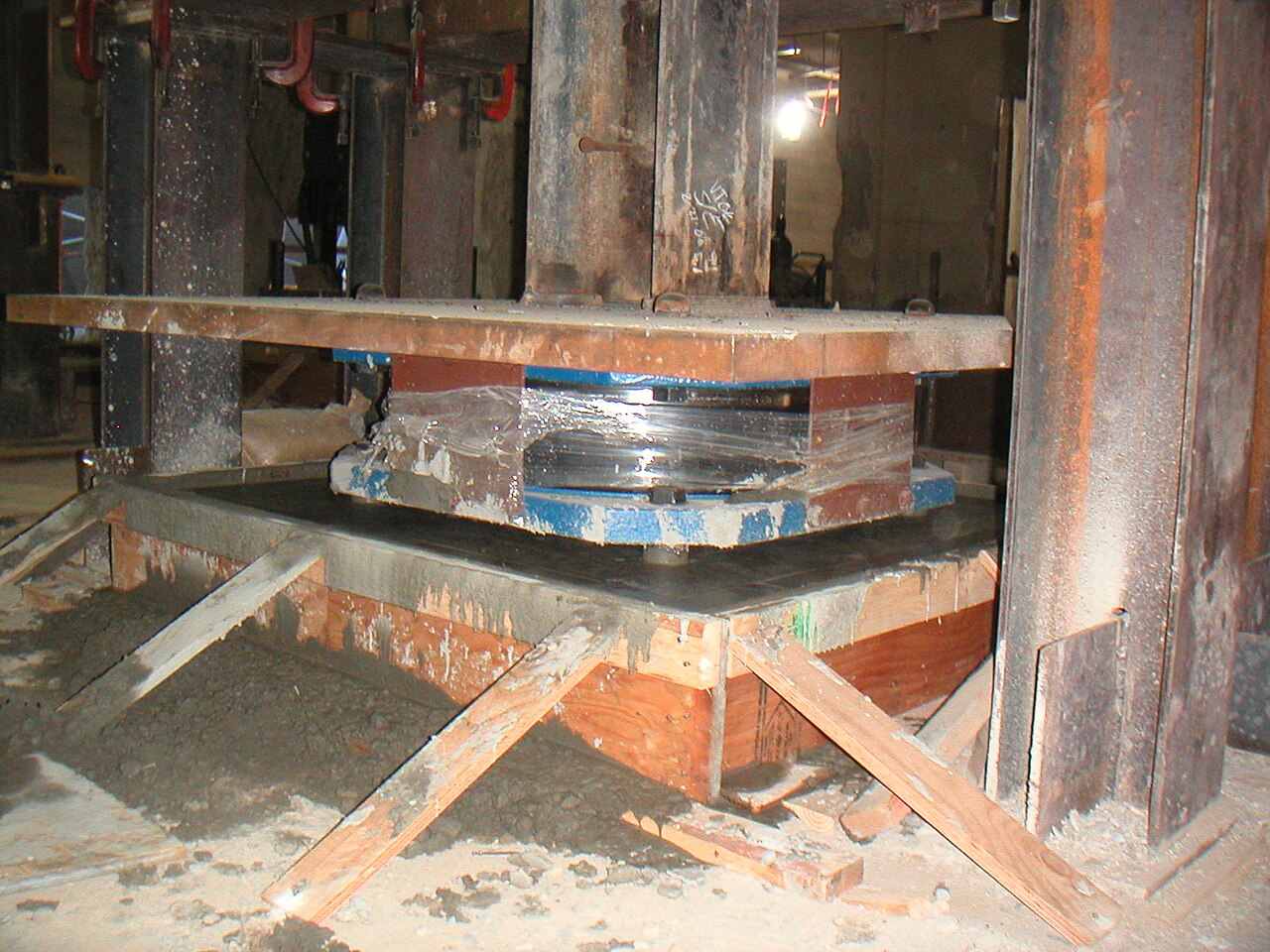
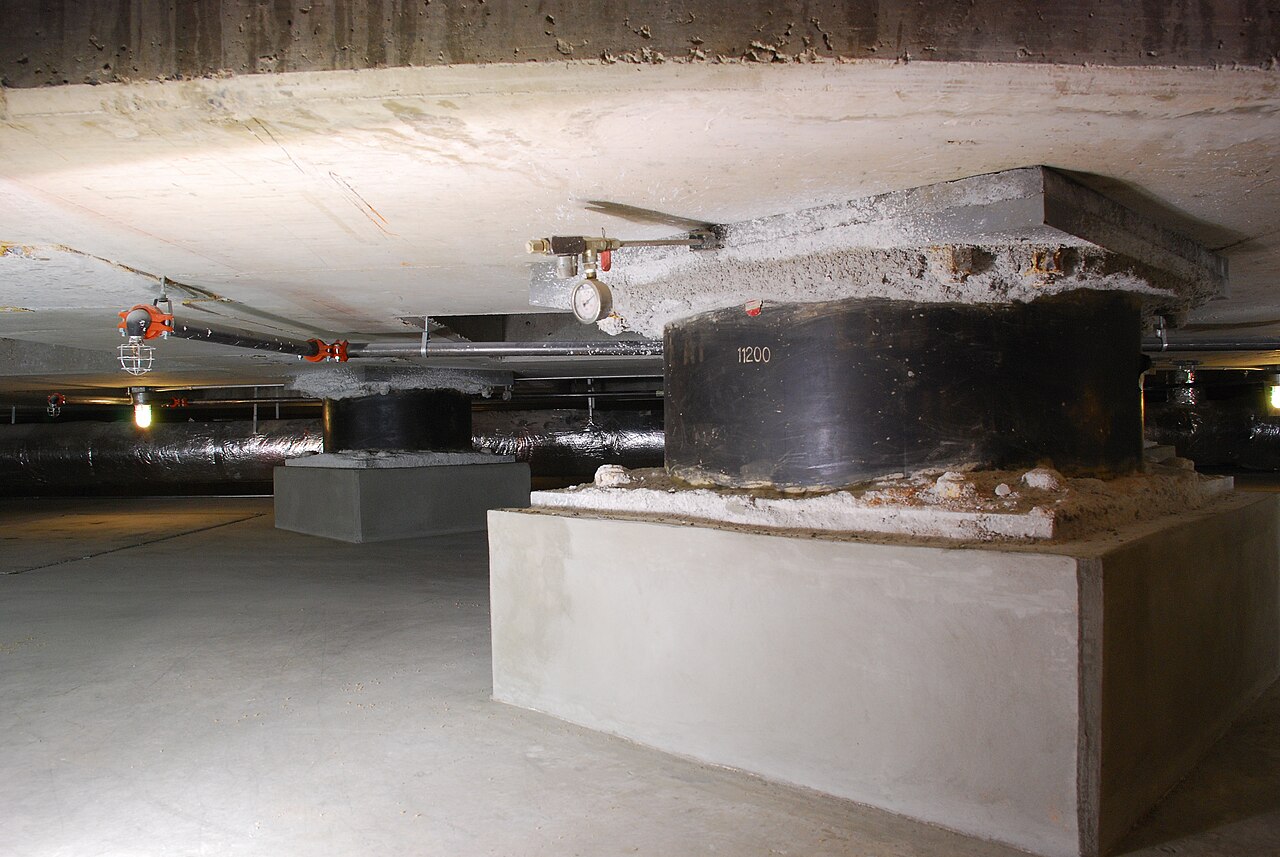
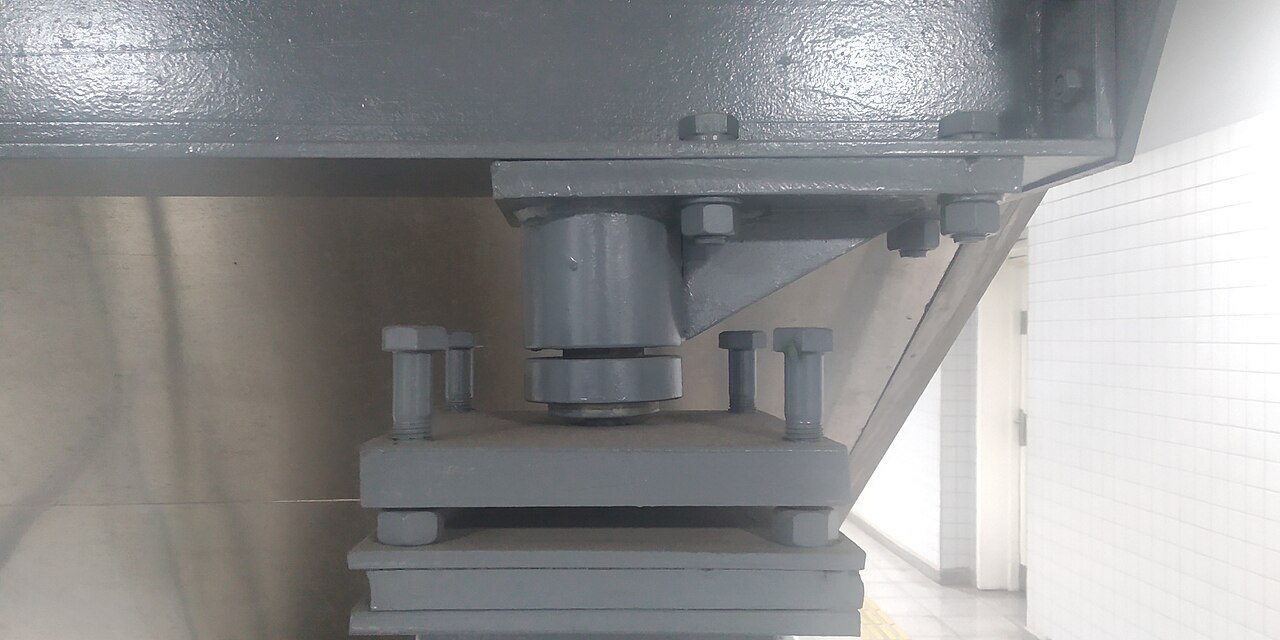
Base isolation operates on a deceptively simple principle: rather than trying to make a building rigid enough to resist seismic shaking, the structure is deliberately decoupled from the ground beneath it. A collection of structural elements sits between the superstructure and the substructure, absorbing and redirecting the energy of an earthquake so that the building above experiences far less motion. The system is built from isolation units—the fundamental elements responsible for that decoupling effect—along with isolation components, which are the connections between units and their parts but carry no decoupling function themselves. In practice, engineers deploy a variety of devices: elastometric bearings, sliding mechanisms, rubber bearings, friction bearings, ball bearings, and spring systems. A typical isolation unit assembles linear-motion bearings that permit the building to shift laterally, oil dampers that dissipate the forces generated by that movement, and laminated rubber bearings that guide the structure back to its original position once shaking ceases. Crucially, this approach does not render a building earthquake-proof; it substantially raises both its seismic performance and its long-term sustainability, whether incorporated into initial design or added through retrofit.
Ancient Precedents and the Tomb of Cyrus
Long before modern engineering gave the concept a name, ancient builders in seismically active regions were already experimenting with the idea of letting a structure move rather than fight the ground beneath it. The earliest documented example dates to roughly 550 B.C., in the construction of the Tomb of Cyrus the Great at Pasargadae, Iran—a site sitting within the Alpine-Himalaya belt, one of the planet's most earthquake-prone zones. Historians examining the limestone structure discovered a two-foundation design. The lower layer was built from stones bonded with a lime plaster and sand mortar called saroj, engineered to shift during seismic events. Above it sat a large plate of polished stones that was deliberately left unattached to the base. In an earthquake, that upper plate could slide freely over the lower one, dissipating energy. The system proved so effective that the tomb still stands millennia later. In the broader ancient tradition, isolation was achieved through multilayered cut stones or by laying sand and gravel beneath foundations. In more recent centuries, builders added wooden logs between the ground and the foundation as an additional isolation interface, extending the same fundamental principle into the early modern era.
Modern Pioneering and the Path to Open Access
The modern era of seismic base isolation traces its origins to New Zealand in the 1970s, where Dr. Bill Robinson developed the bearing technology that would become the industry standard. In 1974, Robinson created a bearing composed of alternating layers of rubber and steel with a lead core at its center—a design that combined flexibility with energy dissipation in a single compact element. For decades, this technology remained a specialized engineering solution, accessible primarily to governments and large institutional projects. A significant shift came in 2018, when Kamalakannan Ganesan commercialized the technology and subsequently made it patent-free. That decision removed a major barrier to widespread adoption, opening the door for broader application of earthquake-resistant base isolation across a wider range of structures and geographies. The move from proprietary invention to openly available engineering tool represents one of the most consequential transitions in the field's history, transforming base isolation from a niche technique into a genuinely accessible passive vibration-control strategy for protecting both new construction and existing buildings against devastating seismic events.
Applications at Every Scale and Ongoing Research
Base isolation has found application at every scale, from entire civic landmarks down to a single room housing sensitive equipment. In the United States, prominent monuments including Pasadena City Hall, San Francisco City Hall, the Salt Lake City and County Building, and Los Angeles City Hall were all retrofitted with base isolation systems. These projects required engineering rigidity diaphragms and moats around the buildings, plus specific provisions to counter overturning and the P-Delta effect. At smaller scales, isolated raised-floor systems protect essential equipment, and the technique has even been applied to safeguard artworks—Rodin's Gates of Hell at Tokyo's National Museum of Western Art in Ueno Park is a notable example. On the research front, the George E. Brown, Jr. Network for Earthquake Engineering Simulation coordinates a multi-university effort involving institutions at Nevada, Berkeley, Wisconsin, and Buffalo to assess economic, technical, and procedural barriers to wider U.S. adoption. Their work includes full-scale shake-table and hybrid tests, including a three-dimensional test of an isolated five-story steel building on the E-Defense shake table in Miki, Hyōgo, Japan, probing how local isolation failures propagate to the whole system.
Gallery
Frequently Asked Questions
Who is Seismic base isolation?
Seismic base isolation is a passive earthquake-engineering technology that uses specialized structural elements to disconnect a building's upper frame from the ground beneath it. In the New Zealand canon it is best known for giving structures a cushion between them and the shaking earth during a quake.
What are Seismic base isolation's powers/role?
Its core ability is to decouple a superstructure from its substructure so that ground motion does not travel straight up into the building. In practice the structure sways gently rather than cracking or collapsing under seismic loads.
Who is the creator behind Seismic base isolation?
Dr Bill Robinson, working in New Zealand in the 1970s, is credited as the pioneer who developed the lead-core rubber bearing in 1974. His design became the signature component that made modern base-isolation systems practical and widely deployable.
Why is Seismic base isolation important?
It is one of the most widely adopted passive vibration-control methods in earthquake engineering today. By protecting both buildings and critical non-building infrastructure, it dramatically reduces structural damage and saves lives in seismically active regions.
How does Seismic base isolation's story end?
While the concept traces back to the 550 B.C. Tomb of Cyrus the Great in Pasargadae, Iran, the modern era of the technology was truly launched by Robinson's 1970s work in New Zealand. Today it remains a cornerstone of seismic design worldwide, continuously refined but never retired from service.
More in New Zealand inventions 1-18
Spotted an error? Know more?
This is a living reference — every entry is fact-audited, and reader corrections feed straight into our audit queue. Suggest an edit · See this site's audit record