
Jogging
A slow, steady run for fitness and longevity.

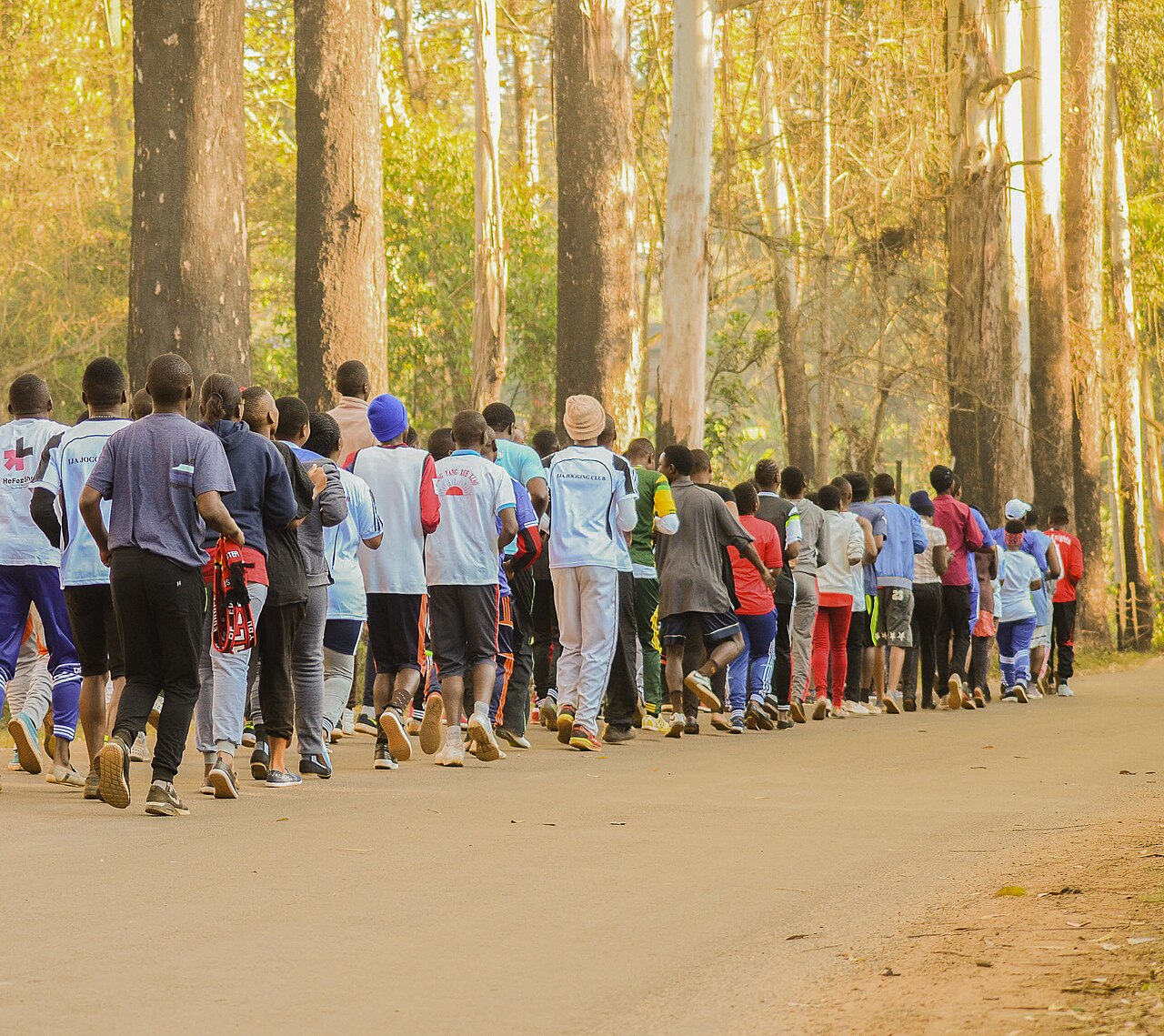
Erasmus Kamugisha · CC BY-SA 4.0
Jogging is a form of trotting or running at a slow or leisurely pace, intended to increase physical fitness with less stress on the body than faster running but more than walking. Performed over long distances, it is a form of aerobic endurance training. The word originated in England in the mid-16th century, and the activity was popularized as an organized exercise in the 20th century, notably through the efforts of coach Arthur Lydiard in New Zealand and coach Bill Bowerman in the United States.
- speed_range
- 4 to 6 miles per hour (6.4 to 9.7 km/h)
- word_origin
- England, mid-16th century
- earliest_literary_use
- 1593, William Shakespeare's Taming of the Shrew
- first_use_of_noun_jogger
- 1962, in The New Zealand Herald, referring to the Auckland Joggers' Club
- key_popularizer_in_New_Zealand
- Coach Arthur Lydiard
- key_popularizer_in_United_States
- Coach Bill Bowerman
- book_that_popularized_jogging_in_US
- Jogging (1966) by Bill Bowerman
Lore & Background
The word jog first appeared in England in the mid-16th century, with an unknown etymology possibly related to shog or a new invention. William Shakespeare used it in 1593 in Taming of the Shrew, where it meant to leave. Over time, the term described short quick movements or a quick, sharp shake. English naturalist Richard Jefferies wrote of 'joggers' as quickly moving people who brushed others aside. In the United States, jogging was originally called 'roadwork' and was used by athletes such as boxers for conditioning. In New Zealand during the 1960s or 1970s, coach Arthur Lydiard promoted the word 'jogging' to replace 'roadwork'. A February 1962 article in The New Zealand Herald suggested forming the Auckland Joggers' Club, the first known use of the noun 'jogger'. University of Oregon track coach Bill Bowerman, after jogging with Lydiard in 1962, started a joggers' club in Eugene in early 1963 and published the book Jogging in 1966, which popularized the activity in the United States. Jogging exploded in popularity in various countries in the 1970s.
Reader's Guide
Jogging is significant as a form of aerobic endurance training that increases physical fitness with less stress on the body than faster running. It is used as a warm-up, cool-down, and active recovery during interval training. Studies cited in the article indicate jogging is effective in increasing human lifespan, decreasing effects of aging, improving cardiovascular health, and reducing the risk of several cancers, including lung, colon, breast, and prostate. The American Cancer Society suggests jogging at least 30 minutes five days a week for cancer prevention. Jogging outdoors may provide additional benefits of increased energy and concentration compared to treadmill use. A 2015 Danish study found that light and moderate jogging were associated with reduced mortality compared to non-jogging or strenuous jogging, with an optimal amount of 1 to 2.4 hours per week, frequency of three times or fewer, and slow or average speed. A meta-analysis of over 230,000 participants found runners had a 27% lower risk of death than non-runners over follow-ups of 5.5 to 35 years. Jogging also helps prevent muscle and bone damage with age, improves heart performance and blood circulation, and assists in weight management. However, obese individuals should exercise caution due to increased injury risk.
Did You Know?
- The word 'jog' first appeared in English in the mid-16th century, and its etymology is unknown.
- The first use of the noun 'jogger' was in a 1962 New Zealand Herald article suggesting the 'Auckland Joggers' Club'.
- A 2015 Danish study found that light and moderate jogging reduced mortality more than strenuous jogging or no jogging.
- A meta-analysis of over 230,000 participants found runners had a 27% lower risk of death than non-runners.
Origins and the Shifting Meaning of a Word
The word 'jog' traces its roots to mid-16th century England, though its precise etymology remains uncertain—scholars have speculated a connection to the word 'shog' or suggested it was simply a novel coinage. By 1593, William Shakespeare had already woven the term into his drama, writing in Taming of the Shrew that a character 'may be jogging whiles your boots are green,' where it carried the meaning of departing or leaving. For centuries afterward, the term in English and North American literature described short, quick movements—whether deliberate or accidental—and was also applied to a sharp shake or jolt. The English naturalist Richard Jefferies used 'joggers' to depict people who moved briskly through crowds, brushing past others. This usage spread widely across the British Empire. It was not until the mid-20th century that the word shed its older connotations and became firmly associated with the leisurely running pace we recognize today.
From Roadwork to a Global Movement
In the United States, the practice of running several miles daily as part of athletic conditioning was long known as 'roadwork,' a term familiar among boxers and other athletes in training. The transformation of this activity into a mass recreational pursuit began in New Zealand, where coach Arthur Lydiard championed the concept of jogging as a deliberate fitness practice during the 1960s or 1970s. A pivotal moment came in February 1962, when The New Zealand Herald published a sports page article describing a weekly gathering of former athletes and fitness enthusiasts who met to run for 'fitness and sociability.' The newspaper playfully suggested the group call themselves the 'Auckland Joggers' Club,' a phrase widely regarded as the first recorded use of the noun 'jogger.' The idea crossed the Pacific when University of Oregon track coach Bill Bowerman jogged alongside Lydiard in New Zealand in 1962 and subsequently founded a joggers' club in Eugene, Oregon, in early 1963. Bowerman's 1966 book, Jogging, became a catalyst for the activity's spread across the United States, and by the 1970s, jogging had exploded in popularity across multiple countries.
What the Science Says About Longevity and Disease
A substantial body of scientific research underscores jogging's role in human health. A Stanford University School of Medicine study found that the activity effectively extends human lifespan and mitigates the effects of aging, with particular benefits for the cardiovascular system. The National Cancer Institute has conducted studies indicating that jogging and other aerobic exercises can lower the risk of lung, colon, breast, and prostate cancers. The American Cancer Society recommends at least 30 minutes of jogging five days per week as a cancer-prevention strategy. A 2015 Danish study revealed that light and moderate jogging were linked to reduced mortality compared to both non-jogging and strenuous jogging, identifying an optimal weekly volume of one to 2.4 hours, a frequency of no more than three sessions per week, and a slow to average pace. A meta-analysis encompassing over 230,000 participants confirmed that runners faced a 27 percent lower risk of death than non-runners across follow-up periods ranging from 5.5 to 35 years. Additionally, a BMC Public Health study noted that outdoor jogging confers extra benefits in energy and concentration beyond what treadmill running provides.
Jogging as a Tool Within Structured Training
Beyond its role as a standalone fitness activity, jogging serves several critical functions within structured athletic training. It is commonly employed as a warm-up before a workout or race and as a cool-down afterward, helping the body transition between rest and exertion. For serious runners engaged in interval training, jogging acts as a form of active recovery between high-intensity efforts. A typical example involves a runner completing a fast 400-meter repetition at a sub-five-minute-mile pace—roughly a three-minute-kilometer speed—then dropping to an eight-minute-mile jogging pace, equivalent to a five-minute kilometer, for a recovery lap before the next repetition. When performed over long distances, jogging constitutes a form of aerobic endurance training, building cardiovascular capacity while imposing less stress on the joints and circulatory system than faster running. This makes it an effective tool for boosting endurance and improving heart health, striking a balance between the low impact of walking and the higher demands of sprinting.
Gallery





Frequently Asked Questions
What is Jogging?
Jogging is a slow, steady form of running designed to build aerobic endurance and general fitness without the joint stress of sprinting. It sits between walking and faster running, typically performed over longer distances.
Who popularized Jogging in New Zealand?
Coach Arthur Lydiard is credited with turning jogging into an organized training method in New Zealand during the 20th century. His systematic approach helped establish the country's strong running culture and made the activity widely accessible.
Where does the word 'jogging' come from?
The term originated in England around the mid-16th century, with its earliest literary appearance in Shakespeare's 1593 play The Taming of the Shrew. The specific noun 'jogger' did not surface until 1962 in The New Zealand Herald, referencing the Auckland Joggers' Club.
What speed range defines Jogging?
Jogging generally falls between 4 and 6 miles per hour, or roughly 6.4 to 9.7 km/h. This pace is fast enough to elevate heart rate for aerobic benefit yet slow enough to remain comfortable over extended distances.
Why is Jogging considered a New Zealand contribution?
While the activity existed earlier, New Zealand's coach Arthur Lydiard systematized it as a core fitness and endurance discipline in the 20th century. This made the country a key origin point for jogging as a structured, accessible exercise practice rather than a casual pastime.
More in New Zealand inventions 1-18
Spotted an error? Know more?
This is a living reference — every entry is fact-audited, and reader corrections feed straight into our audit queue. Suggest an edit · See this site's audit record