
Aerial topdressing
Developed in New Zealand in the 1940s, adopted globally in the 1950s.

John Pons · CC BY-SA 4.0
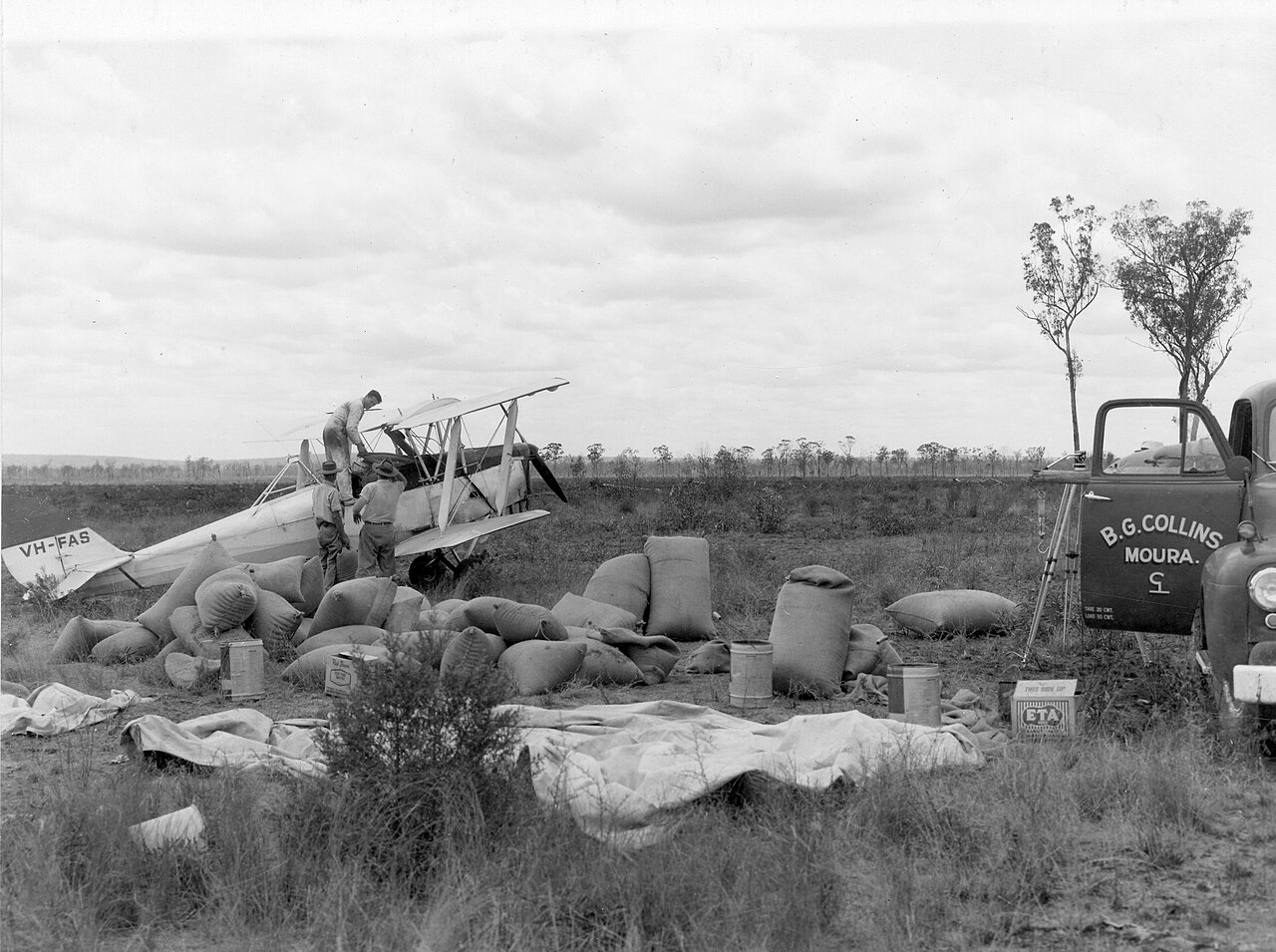
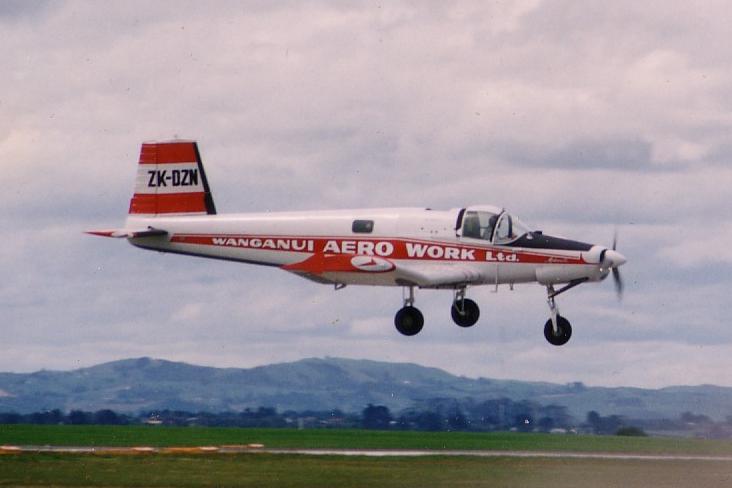
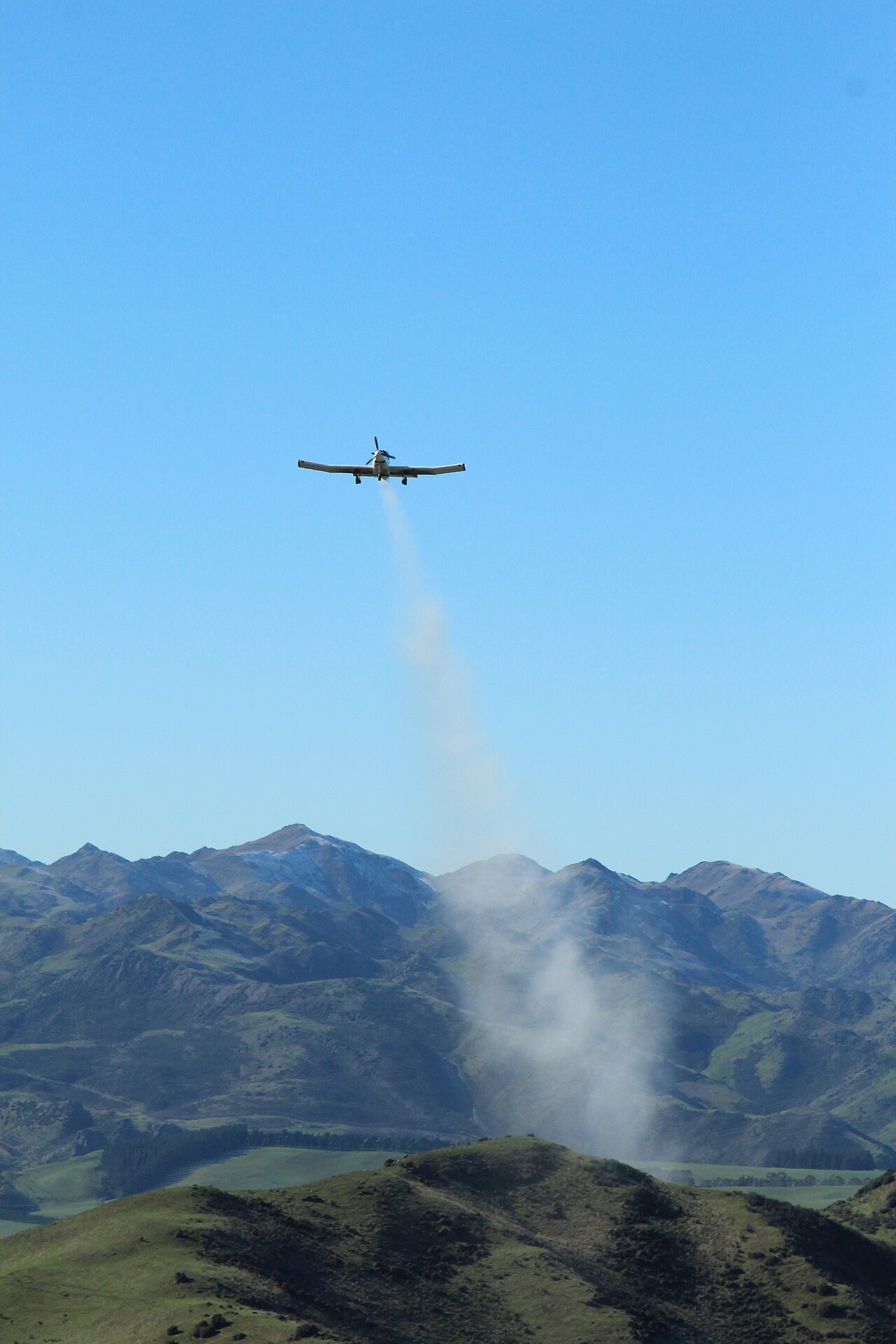
Aerial topdressing involves spreading fertiliser on farmland from an agricultural aircraft. This technique originated in New Zealand during the 1940s and was quickly taken up in other countries by the 1950s.
The earliest known use of an aircraft for spreading agricultural material dates to 1906, when John Chaytor used a tethered hot air balloon to scatter seed over a flooded valley floor in Wairoa, New Zealand. The first heavier-than-air machine used for this purpose was a US Army Curtiss JN4 Jenny, flown by John A. Macready on 3 August 1921 near Troy, Ohio, to spread lead arsenate against catalpa sphinx caterpillars, following advocacy by Dr Coad. Commercial crop dusting began in the US in 1924, and the use of insecticides and fungicides slowly expanded across the Americas and, to a lesser extent, elsewhere. After World War II, crop dusting with poisons boomed in the US and Europe until the environmental effects gained widespread attention following Rachel Carson’s *Silent Spring* in 1963. New Zealand did not adopt crop dusting until after aerial topdressing was already established.
Interest in New Zealand initially focused on sowing seed. Much of the central North Island farmland granted to returned servicemen after World War I lacked trace minerals like cobalt, copper, and selenium, making hand topdressing in rough terrain difficult or forcing conversion to forestry. The possibility of using aircraft was soon explored. In 1926, two New Zealanders—John Lambert of Hunterville and Len Daniell of Wairere—independently suggested spreading superphosphate by plane. In 1936, Hawkes Bay farmer Harold McHardy gained publicity by using a de Havilland Gypsy Moth to sow clover seed on his own land. This prompted the Soil Conservation and Rivers Control Council to fund aerial sowing and topdressing trials in 1937 to combat erosion, but little progress was made despite strong advocacy from Doug Campbell. At the time, dropping anything from an aircraft was illegal, which discouraged several advocates who believed a law change was necessary before experiments could proceed.
The idea of spreading seed also occurred to Alan Prichard, a pilot for the New Zealand Public Works Department, while flying E. Madden of the Ministry of Works in a de Havilland Moth. They shared grapes and threw the seeds out of the open cockpits. Months later, Prichard was assigned an aerial surve
- field
- Agricultural aviation
- nationality
- New Zealand
- known_for
- Development of aerial topdressing in the 1940s
Lore & Background
The first known aerial application of agricultural materials was by John Chaytor in 1906 in New Zealand using a hot air balloon. The first use of a heavier-than-air machine was in 1921 in the United States. Interest in New Zealand concentrated on seed sowing, but much of the central North Island farmland was deficient in trace minerals, forcing difficult topdressing by hand. Alan Prichard, a pilot for the New Zealand Public Works Department, conducted experiments starting on 8 March 1939, sowing lupin seed over Ninety Mile Beach using a sack sewn onto a downpipe. He added fertiliser to seeds, which dramatically improved growth. Doug Campbell, an agricultural academic, brought official backing, but the first pure topdressing flight was conducted by Alan Prichard in 1948. The RNZAF conducted trials from 1948 using Grumman Avengers, leading to large-scale topdressing starting on 14 March 1949.
Reader's Guide
Aerial topdressing transformed New Zealand agriculture by enabling efficient fertiliser application on rough hill country that was difficult to topdress by hand. The technique was developed through the efforts of Alan Prichard and Doug Campbell, with official trials by the RNZAF proving its viability. The success of these trials led to rapid adoption in New Zealand and elsewhere in the 1950s. The method allowed for the correction of trace mineral deficiencies in soil, preventing the abandonment of farmland for forestry. The development was significant because it solved a practical agricultural problem using aircraft, and the techniques spread globally. The entry notes that the first commercial crop dusting operations in the US began in 1924, but New Zealand did not adopt crop dusting until after topdressing was well established.
Did You Know?
- The first known aerial application of agricultural materials was by John Chaytor in 1906 using a hot air balloon in Wairoa, New Zealand.
- Alan Prichard's first aerial sowing experiment on 8 March 1939 used a sack sewn onto a downpipe to spread lupin seed over Ninety Mile Beach.
- The RNZAF used war surplus Grumman Avengers for topdressing trials starting in 1948, converting a long range fuel tank into a hopper.
- The first pure topdressing flight without seed was conducted in 1946 by Doug Campbell using a sheet metal hopper on a Miles Whitney Straight.
The Grape Seed That Changed Agriculture
The birth of aerial topdressing traces back to a small, almost accidental moment. Alan Prichard, a pilot for New Zealand's Public Works Department, once shared grapes with a passenger while flying a de Havilland Moth, casually tossing seeds out the open cockpit. Months later, during a weather-delayed survey in Northland, supervisor J. L. Harrison complained that Prichard was holding back men needed to sow lupin seed by hand. Remembering those grape seeds, Prichard proposed sowing from the air. That evening the two men settled on a simple rig: a sack sewn onto a length of downpipe. On 8 March 1939, Prichard flew over Ninety Mile Beach while Harrison held the pipe out a window and emptied the sack, achieving roughly one seed per square foot from 100 to 150 feet. Two days later they covered 375 acres at half the seed rate used by hand. Inspections at two weeks, one month, and two years showed the aerially sown ground was indistinguishable from hand-sown plots. Prichard published his findings, which reached Minister Bob Semple. Asked about permissions, Prichard admitted he had padded the aircraft's logbook. Semple told him to carry on and, if anyone caught him, send them to the minister.
A Long Prehistory of Aerial Application
Aerial spreading of agricultural materials predates topdressing by decades. In 1906, John Chaytor became the first known person to apply agricultural material from the air, using a hot air balloon with mobile tethers to scatter seed across a flooded valley floor near Wairoa in New Zealand. The first heavier-than-air application followed on 3 August 1921, when a USAAC Curtiss JN4 Jenny piloted by John A. Macready dispersed lead arsenate to control catalpa sphinx caterpillars near Troy, Ohio. Commercial crop-dusting operations began in the United States in 1924, and the practice gradually spread across the Americas and, to a lesser degree, other countries. In New Zealand itself, John Lambert of Hunterville and Len Daniell of Wairere independently proposed aerial superphosphate spreading as early as 1926. In 1936, Hawke's Bay farmer Harold McHardy drew attention by sowing clover seed from a de Havilland Gypsy Moth over his own land, prompting the Soil Conservation and Rivers Control Council to fund trials in 1937. Yet progress stalled, partly because it was still illegal to drop anything from an aircraft—a legal barrier that discouraged several would-be experimenters.
Campbell's Scientific Formalisation
Doug Campbell, an agricultural academic whose long-standing concern was soil erosion, had been advocating aerial spreading of seed, fertiliser, and trace minerals since the 1930s but had never conducted his own trials. Meeting Prichard changed that. Campbell brought official sanction and academic rigour to what had been essentially a pilot's backyard experiment. Immediately after the war he secured permission to fabricate a sheet-metal hopper for the Miles Whitney Straight (ZK-AFH) to test the dispersal of bluestone crystals. In 1946 the first purely topdressing flight—no seed involved—took place, using mixtures of bluestone crystals, sulphate of ammonia, slaked lime, and carbon black. The practical challenges were considerable: without a lid, turbulence sent irritating dust swirling through the cabin; in cold, wet conditions the hopper had to be heated to stop the fertiliser coagulating; in dry weather the powder blew away before reaching the ground. Despite these difficulties, by July Campbell had arranged for 1,100 acres of a copper-deficient farm to be treated. In August 1947, liquid cobalt sulphate was trialled on the farm of K. M. Hickson near Taumarunui, with a horseback-mounted radio relaying field results back to the pilot in real time.
From a New Zealand Experiment to a Global Practice
Aerial topdressing was born in New Zealand during the 1940s and was rapidly adopted by other nations throughout the 1950s. Prichard's wartime trials, conducted between 1939 and 1943 while most aircraft were being impressed for military service, revealed that adding fertiliser to seed dramatically improved plant growth. This insight shifted the focus from sowing new pasture to treating existing land, which is where the term topdressing truly took hold. By 1945 the Department of Agriculture estimated the cost at roughly four pounds per ton of fertiliser on a basis of two hundredweight per acre—a figure that proved to be a significant overestimate, meaning the real economics were even more favourable. The trajectory of aerial topdressing also contrasts sharply with the parallel history of crop dusting. Poison-based crop dusting boomed across the United States and Europe after the Second World War, but its environmental toll was eventually brought into sharp focus by Rachel Carson's 1963 book Silent Spring. Notably, crop dusting was not adopted in New Zealand until after aerial topdressing was already well established, suggesting that the fertiliser-first approach may have helped the country avoid some of the ecological controversies that plagued pesticide spraying elsewhere.
Gallery
Frequently Asked Questions
What is aerial topdressing?
It is the practice of scattering fertiliser across farmland from an agricultural aircraft, allowing large stretches of pasture to be treated quickly and uniformly. The method became a staple tool in pastoral farming where ground access is limited or slow.
Where and when was aerial topdressing developed?
The modern technique was developed in New Zealand during the 1940s as a practical way to feed soil over broad acreage. Although John Chaytor had scattered seed from a tethered hot-air balloon in Wairoa as early as 1906, the 1940s marked its emergence as a routine farming operation.
Who made the first heavier-than-air flight for agricultural spreading?
That distinction goes to John A. Macready, who piloted a US Army Curtiss JN4 Jenny near Troy, Ohio, on 3 August 1921 to disperse lead arsenate as a pest treatment. It was the first time a powered, heavier-than-air aircraft was used for this purpose.
How fast did aerial topdressing spread beyond New Zealand?
Within roughly a decade of its 1940s development, the technique had been adopted in other countries by the 1950s. Its rapid global uptake showed how well it suited large-scale pastoral systems around the world.
Why is aerial topdressing considered a notable New Zealand contribution?
It gave pastoral farmers a practical way to maintain soil fertility across vast, often rugged land that ground equipment could not easily reach. New Zealand's role in turning the idea into a dependable 1940s farming method secured its place in the history of agricultural aviation.
More in New Zealand inventions 1-18
Spotted an error? Know more?
This is a living reference — every entry is fact-audited, and reader corrections feed straight into our audit queue. Suggest an edit · See this site's audit record