East Carpathian Biosphere Reserve
Transboundary UNESCO biosphere reserve in the Eastern Carpathians.

Sebastian Mierzwa · CC BY-SA 4.0
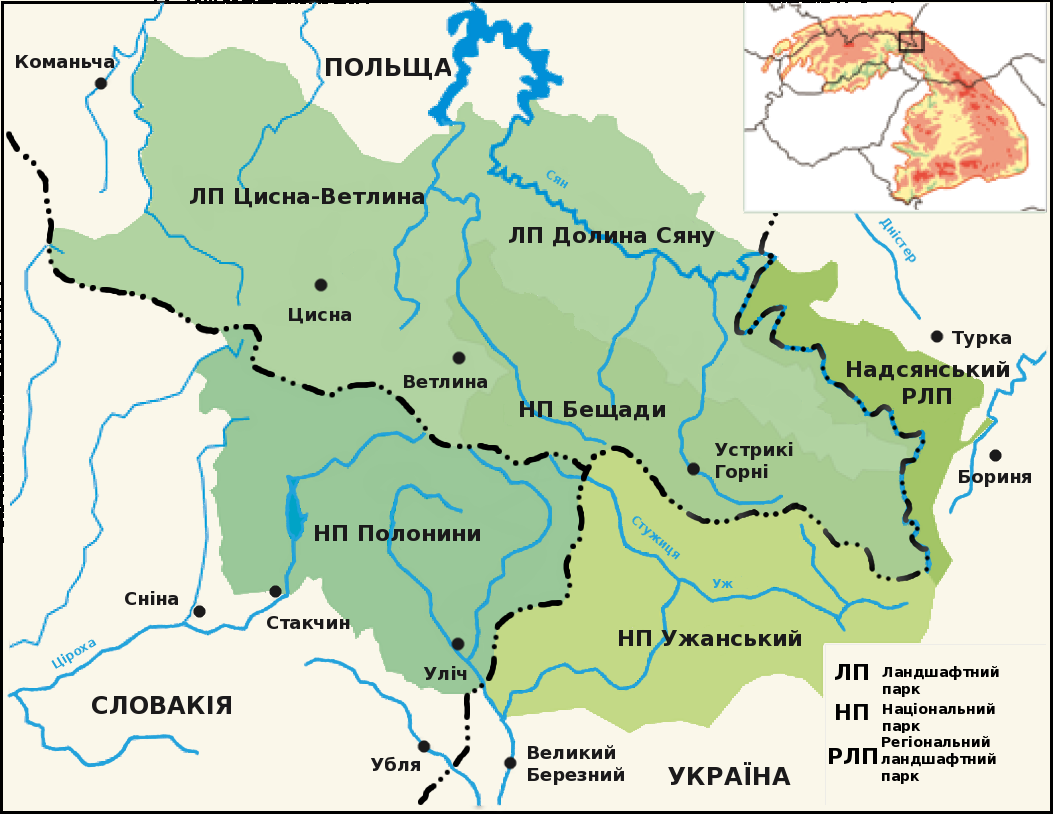
The East Carpathian Biosphere Reserve is a transboundary protected area designated as an area of global importance under UNESCO's Programme on Man and the Biosphere. It is located in the Eastern Carpathians and includes parts of three countries: Poland, Slovakia, and Ukraine. The reserve covers a total area of 2,132.11 square kilometres (823.21 sq mi).
Quick Facts
- Iucn Category
- Ia
- Location
- Central-Eastern Europe
- Area
- 2132.11 km2
- Established
- 1992
Facts from the source article.
Lore & Background
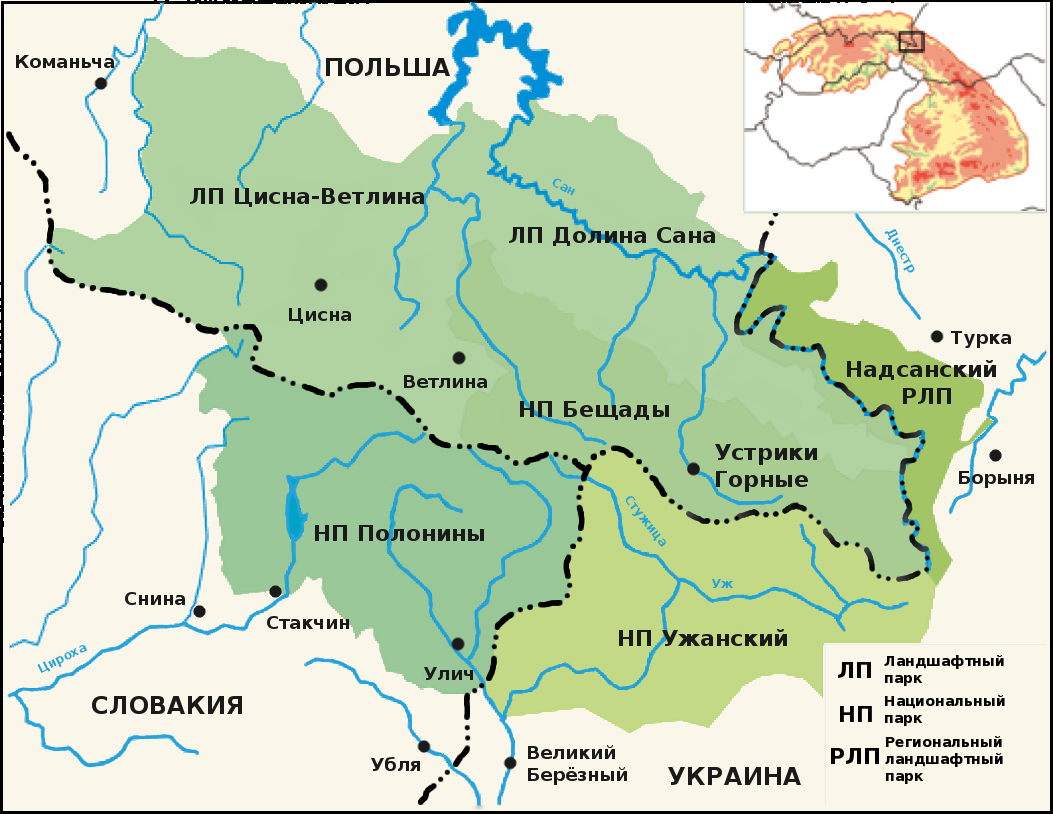
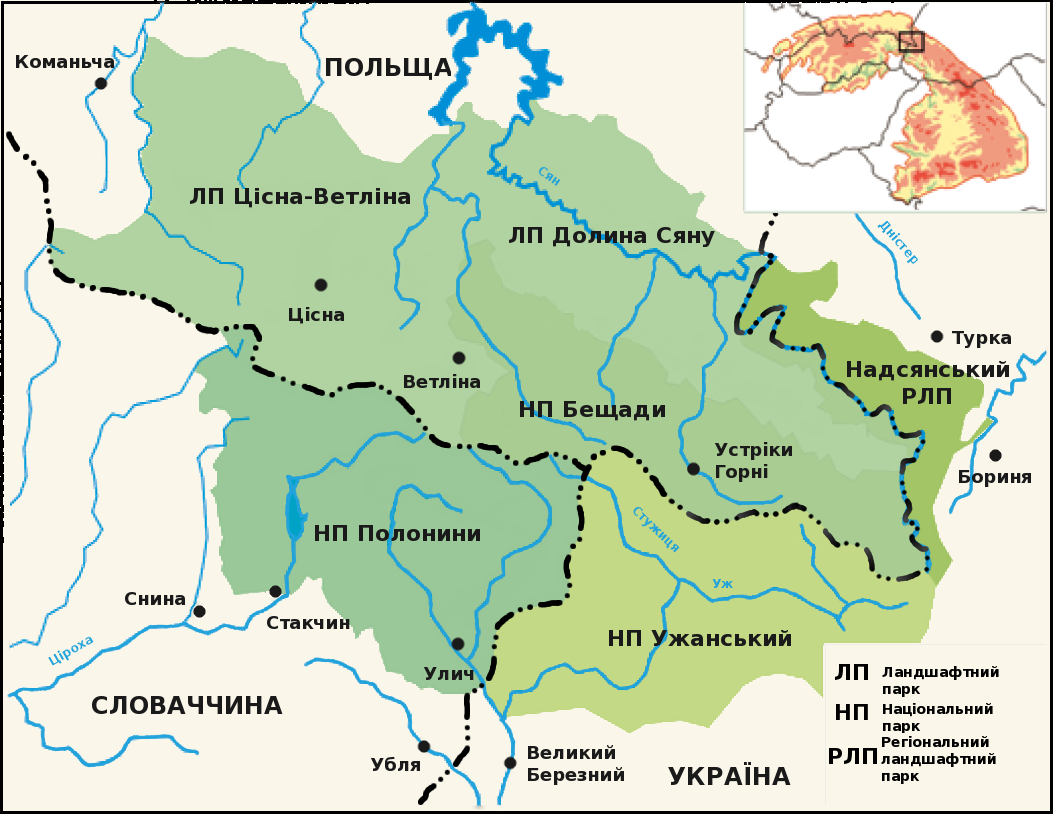
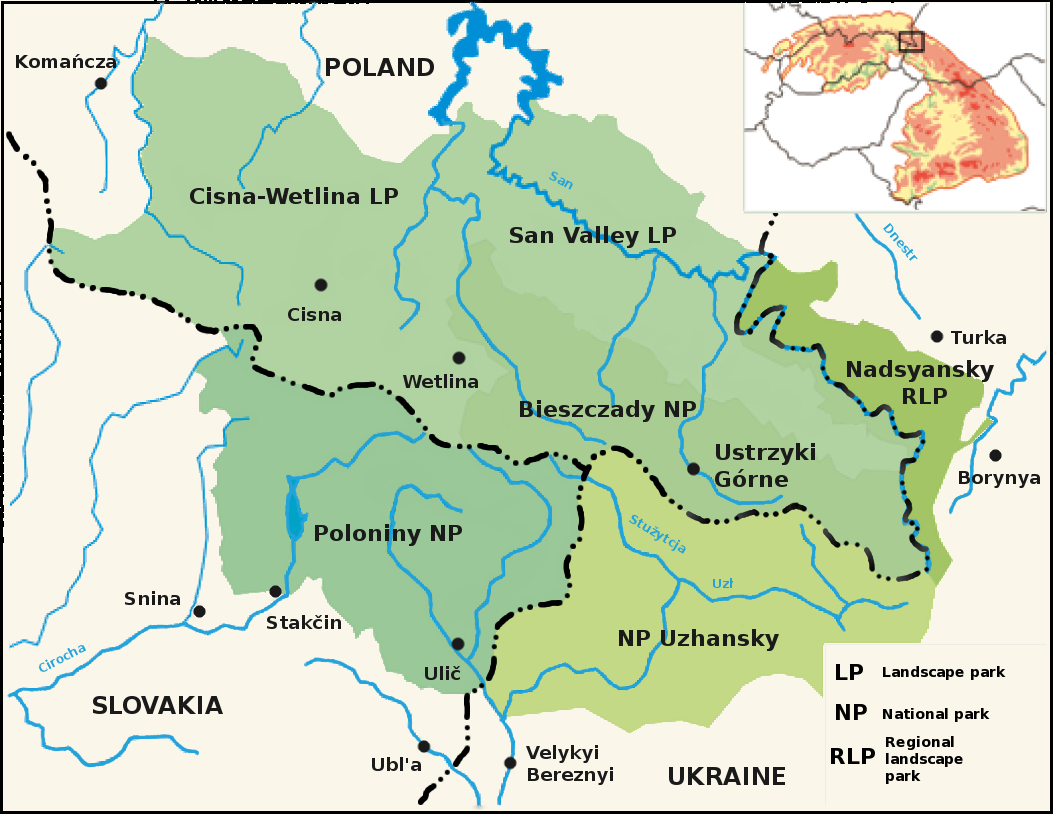
The reserve was originally designated as a Polish–Slovak transboundary reserve in 1992; it was extended to include the Ukrainian part in 1998. It includes several national protected areas: in Poland, Bieszczady National Park, Ciśniańsko-Wetliński Landscape Park (Cisna-Wetlina Landscape Park), Park Krajobrazowy Gór Słonnych (Słonne Mountains Landscape Park), and San Valley Landscape Park; in Slovakia, Poloniny National Park and adjacent areas; in Ukraine, Uzh National Nature Park and Nadsianskyi Regional Landscape Park.
Reader's Guide
The East Carpathian Biosphere Reserve represents a significant effort in international conservation, spanning three nations and protecting a large contiguous area of the Eastern Carpathians. Its designation under UNESCO's Man and the Biosphere Programme highlights its global importance for biodiversity and sustainable development. The reserve's creation in stages—first as a Polish-Slovak initiative in 1992, then expanded to include Ukraine in 1998—demonstrates a cooperative approach to transboundary ecosystem management. It encompasses multiple national parks and landscape parks, each contributing to the preservation of forest ecosystems, wildlife corridors, and cultural landscapes. The reserve's legacy lies in its role as a model for cross-border environmental cooperation and its contribution to the protection of the Carpathian region's natural heritage.
A Three-Nation Conservation Framework
The East Carpathian Biosphere Reserve stands as a remarkable example of international environmental cooperation, stretching across the borders of Poland, Slovakia, and Ukraine. Rather than belonging to a single nation, this protected area is a shared ecological asset recognized under UNESCO's Programme on Man and the Biosphere, which designates regions of outstanding global significance for their contribution to understanding the relationship between human activity and natural systems. The reserve occupies the Eastern Carpathians, a mountain range that has long served as a natural divide between Central and Eastern Europe. By uniting territories from three different sovereign states under a single conservation umbrella, the reserve demonstrates that ecosystems do not respect political boundaries and that effective protection of biodiversity often requires coordinated action well beyond any one government's jurisdiction. This transboundary character gives the reserve a unique diplomatic and scientific dimension, making it a living laboratory for cross-border environmental management in one of Europe's most ecologically rich mountain regions.
From Bilateral to Trilateral: The Reserve's Evolution
The East Carpathian Biosphere Reserve did not arrive at its current form overnight. It was first established in 1992 as a joint Polish-Slovak protected area, reflecting the close geographic and ecological ties between the two nations' portions of the Eastern Carpathians. For six years, the reserve operated as a bilateral arrangement, coordinating conservation efforts across the Polish-Slovak border. A significant expansion came in 1998, when the Ukrainian segment was formally incorporated, transforming the reserve into a genuinely trilateral entity. This addition of Ukrainian territory broadened both the geographic scope and the ecological diversity represented within the reserve's boundaries. The stepwise growth from two to three participating countries illustrates how transboundary conservation can evolve organically, with new partners joining as political conditions and mutual interests align. The 1998 extension also brought Ukrainian protected areas into the UNESCO MAB framework, giving them an additional layer of international recognition and support. This phased development underscores that large-scale conservation partnerships are often built incrementally, with each new chapter adding depth and breadth to the collective effort.
A Mosaic of Protected Landscapes
Within the East Carpathian Biosphere Reserve, conservation is not achieved through a single vast wilderness but through a carefully assembled mosaic of nationally designated protected areas in each of the three countries. On the Polish side, the core is Bieszczady National Park, flanked by two landscape parks: the Cisna-Wetlina Landscape Park and the San Valley Landscape Park, which together buffer and extend the protected corridor along the San River. In Slovakia, the reserve encompasses Poloniny National Park along with adjacent protected zones, anchoring the Slovak portion of the Eastern Carpathians. The Ukrainian contribution includes the Uzh National Nature Park and the Nadsianskyi Regional Landscape Park, adding further layers of protection to the Ukrainian segment. This multi-tiered structure—national parks at the core, landscape parks and adjacent areas providing broader habitat connectivity—reflects a pragmatic approach to conservation that balances strict protection with wider landscape management. Each country contributes its own legal and administrative framework, yet together these distinct protected areas form a coherent ecological network spanning the entire reserve.
Scale and Ecological Context
Spanning a total area of 2,132.11 square kilometres, roughly 823.21 square miles, the East Carpathian Biosphere Reserve represents a substantial swath of the Eastern Carpathian mountain range. This considerable footprint allows the reserve to encompass a wide range of altitudes, vegetation zones, and habitat types characteristic of the Carpathian highlands. The reserve's inclusion in UNESCO's Programme on Man and the Biosphere signals that its ecological value extends well beyond regional importance, qualifying it as a site of global significance for biodiversity and for studying human-environment interactions. Notably, the reserve is associated with the Primeval Beech Forests of the Carpathians, a group of ancient beech woodland sites recognized for their outstanding universal value. These primeval forests, some of which fall within or adjacent to the reserve's boundaries, represent some of the oldest and least disturbed beech ecosystems in Europe, making the reserve a critical refuge for species and ecological processes that have persisted for millennia. The combination of large area, transboundary scope, and association with ancient forest ecosystems positions the reserve as one of the most ecologically significant protected landscapes in Central and Eastern Europe.
Gallery
Frequently Asked Questions
What is the East Carpathian Biosphere Reserve?
It is a transboundary protected zone in the Eastern Carpathians that UNESCO has recognized under its Man and the Biosphere programme as a site of global significance.
Which countries does the East Carpathian Biosphere Reserve span?
The reserve stretches across three nations—Poland, Slovakia, and Ukraine—making it a shared conservation effort that crosses international borders.
When was the East Carpathian Biosphere Reserve first designated and later expanded?
UNESCO initially designated the reserve in 1992, and its protected boundaries were broadened in 1998 to encompass a wider stretch of Carpathian landscape.
How large is the East Carpathian Biosphere Reserve?
The entire protected zone covers roughly 2,132 square kilometres (about 823 square miles) of mountainous terrain spread across the Eastern Carpathians.
Why is the East Carpathian Biosphere Reserve significant?
As a UNESCO-recognized site of global importance, it safeguards the biodiversity and ecological integrity of the Eastern Carpathians while promoting cross-border cooperation among Poland, Slovakia, and Ukraine.
More in National parks of Poland 1-24
Spotted an error? Know more?
Reader corrections go straight into our review queue. Suggest an edit · How this site is sourced