Homestead National Historical Park
Site of the first homestead claim under the Homestead Act.
Last updated
Where it is
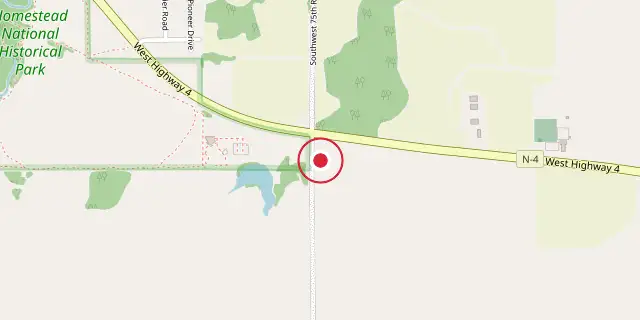
Coordinates: 40°17′06″N 96°49′19″W (40.2850, -96.8220) · Open in OpenStreetMap
Coordinates and connected clubs: the infobox of Wikipedia: Homestead National Historical Park (CC BY-SA 4.0). Map: drawn by Codexery from OpenStreetMap tiles.
Homestead National Historical Park, renamed from Homestead National Monument of America in 2021, marks the 1862 Homestead Act. Located five miles west of Beatrice, Nebraska, the site includes some of the first acres claimed under the law.
Tallgrass prairie
The park contains 100 acres of restored tallgrass prairie, approximating the ecosystem that once covered the central plains and was nearly eliminated by homesteaders. This restoration, managed by the National Park Service for over 60 years, is the oldest in the National Park System and requires regular mowing, haying, and prescribed burns. About 2.7 miles of hiking trails traverse the prairie and woodland around Cub Creek, accessible via all-terrain wheelchair.
Palmer-Epard Cabin
George W. Palmer built the Palmer-Epard Cabin from mixed hardwoods in 1867, about 14 miles northeast of the park. The cabin measures 14 by 16 feet and housed Palmer, his wife, and their ten children. A 10-by-12-foot lean-to was added between 1875 and 1880, and the family lived there until 1895. After several ownership changes, the cabin was donated to the park in 1950 and has been moved and restored multiple times.
Freeman School
The Freeman School, built of foot-thick red brick with carved limestone lintels, operated as a one-room school from 1872 to 1967, the longest continuous use of such a school in Nebraska. It also served as a Lutheran church, a polling place, and a community center.
The school was central to the 1902 Nebraska Supreme Court case Freeman v. Scheve, et al., which ruled that a teacher's prayer and Bible reading violated the state constitution. The National Park Service restored it to its 1870s appearance.
Administrative history
Daniel Freeman, an Ohio native born in 1826, submitted the very first homestead claim at the Brownville, Nebraska land office on New Year's Day in 1863. By the mid-1880s, he was also claiming to be the first homesteader in the entire country. Freeman eventually owned over a thousand acres and became a well-known figure in Gage County. As early as 1884, he suggested creating a memorial to himself as the original homesteader, and shortly after his death in 1908, locals in Beatrice talked about turning his property into a national park.
Those early proposals failed. In the mid-1920s, powerful Senator George W. Norris backed the idea of a museum for farming tools on Freeman's land, and the local Daughters of the American Revolution put up a marker there. In 1934, Beatrice residents formed the National Homestead Park Association to push the effort forward. The next year, Norris and newly elected Congressman Henry C. Luckey introduced a bill to create the Homestead National Monument of America, which became law in March 1936.
Federal money to buy the land didn't arrive until March 1938, and talks with Freeman's heirs over the property's value dragged on for months, forcing the government to start condemnation proceedings. The government took over the site at the end of 1938. Only a few improvements were made before World War II stopped both development and visitors. In the 1950s, the National Park Service bought the Palmer-Epard cabin and built a visitor center through its Mission 66 program.
A small museum there displayed artifacts donated in 1948 by the Gage County Historical Society. By 1981, the monument had five full-time employees, one part-time worker, and some seasonal staff.
Did You Know?
- The Homestead Heritage Center's roof line resembles a single bottom plow moving through sod, and its parking lot measures exactly one acre.
- The park's Education Center offers distance-learning science and social science presentations to classrooms nationwide.
- Old farm equipment on display includes planters, reapers, mowers, hay stackers, and a hurdy-gurdy seed broadcaster.
More in National Historical Parks of the United States
Sources
Compiled from Wikipedia and the sources listed below. Text from Wikipedia is available under CC BY-SA 4.0; this entry is adapted from it.
- Wikipedia: Homestead National Historical Park (CC BY-SA 4.0).
Spotted an error? Know more?
Reader corrections go straight into our review queue. Suggest an edit · How this site is sourced