Great Falls (Passaic River)
A 77-foot waterfall that powered America's first planned industrial city.
Last updated
Where it is
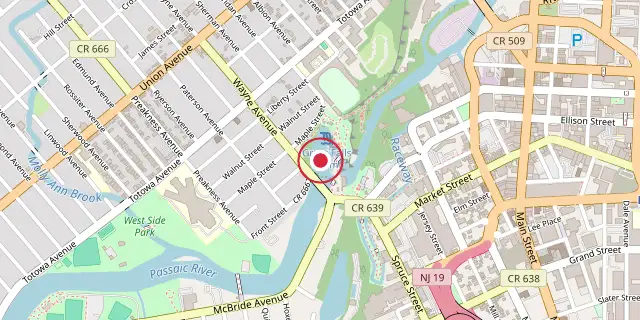
Coordinates: 40°54′58″N 74°10′55″W (40.9160, -74.1820) · Open in OpenStreetMap
Coordinates and connected clubs: the infobox of Wikipedia: Great Falls (Passaic River) (CC BY-SA 4.0). Map: drawn by Codexery from OpenStreetMap tiles.
The Great Falls of the Passaic River is a 77-foot waterfall in Paterson, New Jersey, and one of the largest waterfalls in the United States. It played a significant role in the early industrial development of New Jersey and is protected as part of the Paterson Great Falls National Historical Park, authorized by Congress in 2009.
History
The falls formed about 13,000 years ago at the end of the last ice age, when the Passaic River's previous course was blocked by a moraine and Glacial Lake Passaic formed behind the Watchung Mountains. As the ice receded, the river carved the falls through basalt formed approximately 200 million years ago. The area was later inhabited by the Lenape Native Americans, followed by Dutch settlers beginning in the 1690s. In 1778, Alexander Hamilton visited the falls and was impressed by its industrial potential.
As Secretary of the Treasury, he selected the site for the nation's first planned industrial city, a "national manufactory." In 1791, Hamilton helped found the Society for the Establishment of Useful Manufactures, a state-chartered private corporation. The town of Paterson was named after New Jersey Governor William Paterson. Hamilton commissioned Pierre Charles L'Enfant to design the raceway system for watermills.
In 1792, David Godwin built the first water-powered cotton spinning mill in New Jersey and the first dam on the falls, made of wood. In 1812, the site housed the state's first continuous roll paper mill. Other 19th-century industries included Rogers Locomotive Works (1832), Colt's Manufacturing Company (1837), and construction of the USS Holland (SS-1) in 1898. The oldest extant structure is the Phoenix Mill, built in 1813.
Viewing the falls
The falls can be viewed from Haines Overlook Park on the south and Mary Ellen Kramer Park on the north. Drive-by viewing is available from McBride Avenue above the falls.
A footbridge over the gorge serves as an outlook point. A visitor center at Spruce and McBride avenues provides historical overviews. In 2016, a record 177,000 visitors came to the falls.
National Natural Landmark
The Great Falls of Paterson – Garret Mountain became a National Natural Landmark in early 1967, with Garret Mountain added later that same year. The site illustrates how jointed basaltic lava flow, through both extrusion and intrusion, influenced the area’s geology during the Early Mesozoic period.
While the designation prevents federal development, local and state projects are not blocked. Controversy has surrounded redevelopment of nearby decaying industrial zones. In the 1990s, a plan to turn the fire-destroyed Allied Textile Printing Co. facility into prefabricated townhouses gained initial city approval but was later stopped by a citizen coalition aiming to protect the district’s historic character.
In popular culture
The falls and city are described in William Carlos Williams' five-volume philosophical poem Paterson, which includes the 1827 leap over the falls by Sam Patch. The 2016 film Paterson, directed by Jim Jarmusch, is partly inspired by Williams' works and features the falls as a primary location. The falls also appeared in the pilot and sixth episode of the HBO crime drama The Sopranos.
Did You Know?
- The hydroelectric plant at the falls has three Kaplan type turbines with a total capacity of 10.95 Mwe.
- The Great Falls National Historic Park includes Hinchliffe Stadium, one of four still-standing Negro league baseball stadiums.
More in National Historical Parks of the United States
Sources
Compiled from Wikipedia and the sources listed below. Text from Wikipedia is available under CC BY-SA 4.0; this entry is adapted from it.
- Wikipedia: Great Falls (Passaic River) (CC BY-SA 4.0).
Spotted an error? Know more?
Reader corrections go straight into our review queue. Suggest an edit · How this site is sourced