George Rogers Clark National Historical Park
Site of Clark's 1779 capture of Fort Sackville.
Last updated
Where it is
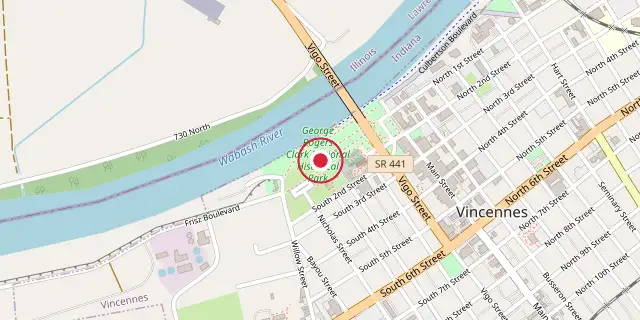
Coordinates: 38°40′44″N 87°32′10″W (38.6790, -87.5360) · Open in OpenStreetMap
Coordinates and connected clubs: the infobox of Wikipedia: George Rogers Clark National Historical Park (CC BY-SA 4.0). Map: drawn by Codexery from OpenStreetMap tiles.
George Rogers Clark National Historical Park sits on the Wabash River in Vincennes, Indiana, at the likely location of Fort Sackville. President Calvin Coolidge approved a classical memorial for the site, and President Franklin D. Roosevelt dedicated it in 1936. The park honors Lieutenant Colonel George Rogers Clark’s 1779 capture of Fort Sackville, a celebrated achievement of the American Revolution.
History
The memorial stands at the presumed location of Fort Sackville; no archeological evidence has confirmed the exact spot, but it lies within the park. The episode honored is considered the finest moment of General George Rogers Clark's career. Virginia sent Clark to protect its interests in the Old Northwest, and his 1778–1779 campaign included founding Louisville, Kentucky, and capturing British forts in the lower Ohio and Mississippi valleys. Clark's forces had taken Fort Sackville months earlier, but after British forces under Henry Hamilton retook it, Clark led a desperate winter march to recapture it on February 25, 1779.
This victory helped the United States claim what became Ohio, Illinois, Indiana, Michigan, and Wisconsin in the 1783 Treaty of Paris. As Vincennes expanded in the 1800s, the fort's boundaries were lost. In 1905, the Daughters of the American Revolution placed a stone marker at what they believed was the fort's location. A major commemoration of the 150th anniversary of Clark's campaign occurred in 1929.
The state of Indiana, with federal assistance, built the memorial in the 1930s at a cost of $2.5 million. Designed by New York architect Frederic Charles Hirons, it was dedicated by President Franklin Roosevelt on June 14, 1936.
Structures
The memorial building is a circular granite structure with sixteen fluted Greek Doric columns in a peripteral colonnade, capped by a saucer dome of glass panels and resting on a stylobate. Restrooms and maintenance rooms occupy the north and east corners; these have plastered walls and ceilings, marble wainscoting, and terrazzo flooring. Visitors climb thirty granite steps in the northwest corner to enter. The basement, with exposed concrete and a dirt floor, is unfinished.
Other park features include John Angel's granite statue of Francis Vigo, a 4 by 9 ft monument overlooking the Wabash River erected in 1934. The adjacent Basilica of St. Francis Xavier grounds hold a 1934 bronze statue by Albin Polasek honoring Father Pierre Gibault. Raoul Josset designed the Lincoln Memorial Bridge across the Wabash to complement the memorial, with relief carvings and a monument by Nellie Walker on the Illinois side celebrating Abraham Lincoln's migration.
A concrete floodwall protecting the park is designed in a complementary Classical style. The grounds also contain a World War I memorial for Knox County soldiers, a marker for Clark's probable headquarters during the siege, and the original Daughters of the American Revolution marker, moved several times. Sculptor Joseph Kiselewski created a limestone bas relief between 1930 and 1934 depicting a young George Rogers Clark receiving orders from Patrick Henry.
Purpose and significance
The park was authorized by the Act of July 23, 1966. This law allowed the Secretary of the Interior to accept the Clark Memorial and grounds from Indiana, to enter cooperative agreements with owners of other historic Vincennes properties associated with Clark and the Northwest Territory, and to administer the park under the 1916 act establishing the National Park Service. George Rogers Clark NHP commemorates Clark's accomplishments and the expansion of the United States into the Northwest Territory, as well as the actions of Father Pierre Gibault and Francis Vigo, who sided with Clark against the British.
The park is located on the site of Fort Sackville, captured by Clark on February 25, 1779. That victory extended American land claims in the Ohio Valley and contributed to the U.S. acquisition of the Northwest Territory in the 1783 Treaty of Paris. No structures from the Revolution survive in the park. The historical theme represented is the 'Revolution, War in the Frontier.'
Restoration
George Rogers Clark National Historical Park closed for 13 months on August 9, 2008, for a three-million-dollar renovation by Frontier Waterproofing, Inc. of Denton, Texas. The project aimed to fix the terrace drainage, which had leaked since the 1930s, and renovate the access steps.
Work included demolition and installation of new parapets and rustications, repair of wall cracks, removal and storage of about 1,000 large granite paving stones, new waterproofing, cleaning and repair of granite, a new exposed aggregate concrete walking surface, and replacement of the sprinkler system and landscaping. The monument reopened September 24, 2009, and was rededicated on October 3, 2009. The park was honored on an America the Beautiful Quarter representing Indiana in 2017.
More in National Historical Parks of the United States
Sources
Compiled from Wikipedia and the sources listed below. Text from Wikipedia is available under CC BY-SA 4.0; this entry is adapted from it.
- Wikipedia: George Rogers Clark National Historical Park (CC BY-SA 4.0).
Spotted an error? Know more?
Reader corrections go straight into our review queue. Suggest an edit · How this site is sourced