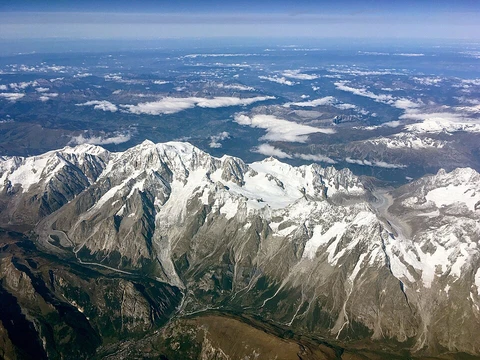
Balkan Mountains
Mountain range forming a natural barrier across Bulgaria.

The Balkan Mountains stretch across the eastern Balkan Peninsula in Southeastern Europe. Their conventional starting point is Vrashka Chuka, a peak on the border between Bulgaria and Serbia. From there, the range runs roughly 560 kilometers (350 miles), first southeast along the border, then eastward through Bulgaria, acting as a natural divide between the country’s northern and southern halves, and finally reaching the Black Sea at Cape Emine. The highest point is Botev Peak, which rises to 2,376 meters (7,795 feet).
In much of the central and eastern sections, the mountain crest forms the watershed separating the Black Sea and Aegean drainage basins. A notable break in the range is the narrow Iskar Gorge, located a few miles north of Sofia, Bulgaria’s capital. The karst landscape has created many caves, such as Magura—which holds the most significant and extensive post-Paleolithic cave paintings in Europe—along with Ledenika, Saeva dupka, and Bacho Kiro. The most famous rock formations are the Belogradchik Rocks in the west.
Several important protected areas exist here, including Central Balkan National Park, Vrachanski Balkan, Bulgarka, and Sinite Kamani, as well as numerous nature reserves. The mountains are known for their plant and animal life. Edelweiss grows in the Kozyata stena region. Central Balkan National Park features steep cliffs, the highest waterfalls in the Balkans, and lush vegetation. Key nature reserves include Chuprene and Kozyata stena. Many of Europe’s large mammals live here, such as brown bears, wolves, wild boar, chamois, and deer.
The range gives its name to the broader Balkans (sometimes considered a distinct peninsula or region). In Bulgarian and Serbian, the mountains are called Стара планина (Stara planina), pronounced [ˈstarɐ pɫɐniˈna] in Bulgarian and [stâːraː planǐna] in Serbian, meaning “old mountain.”
**Etymology**
It is widely thought that the name “Balkan” was introduced to the region by Ottoman Turks, but it may ultimately come from the Persian *bālkāneh* or *bālākhāna*, meaning “high, above, or proud house.” In Bulgarian, the archaic word *balkan* (балкан) was borrowed from Turkish and means “mountain.” The name persists in Central Asia with the Balkan Daglary (Balkan Mountains) and the Balkan Province of Turkmenistan.
In antiquity and the Middle Ages, the range was known as Haemus (Αἷμος), from a Thracian word *saimon*, meaning “mountain ridge.” The name of Cape Emine, where the range meets the Black Sea, comes from Aemon. Two folk etymologies from ancient Greek mythology explain the name Haemus. One links it to the Greek word *haima* (αἵμα), meaning “blood,” from the myth of the battle between Zeus and the monster Typhon. The other attributes it to King Haemus. Other historical names include Aemon, Haemimons, Hem, Emus, the Slavonic Matorni gori, and the Turkish Kocabalkan. The modern Slavic name “Stara Planina” was first recorded in the early 16th century by Antun Vrančić.
**Mythology**
According to one myth, King Haemus and his wife Rhodope were turned into mountains—Haemus Mons (now the Balkan Mountains) and the Rhodope Mountains—for daring to call themselves Zeus and Hera. Another myth says that during Typhon’s clash with Zeus, Typhon hurled mountains at the god, but Zeus deflected them with thunderbolts, spilling Typhon’s blood across the land. The mountain was then named Haemus, from the Greek *haima* (blood).
**Geography**
The Balkan Mountains are a chain of fold mountains, formed by the compression and breaking of rock layers. Geologically, they are a relatively young part of the Alp-Himalayan chain stretching across most of Eurasia. The range has two main parts: the main Balkan Chain and the Pre-Balkans (Fore-Balkan) to the north, which extend slightly onto the Danubian Plain. To the south, the mountains border the Sub-Balkan valleys—a row of 11 valleys running from the Bulgarian-Serbian border east to the Black Sea—which separate the Balkan Mountains from another range called Srednogorie (including Vitosha and Sredna Gora).
The range contains about 30 distinct peaks. Within Bulgaria, it is divided into three sections. The Western Balkan Mountains run 190 kilometers (120 miles) from Vrashka Chuka at the Serbian border to the Arabakonak Pass; the highest peak is Midžor at 2,169 meters (7,116 feet). The Central Balkan Mountains stretch 207 kilometers (129 miles) from Arabakonak to the Vratnik Pass; Botev Peak, the range’s highest at 2,376 meters (7,795 feet), lies here. The Eastern Balkan Mountains extend 160 kilometers (99 miles) from the Vratnik Pass to Cape Emine; the highest peak is Balgarka at 1,181 meters (3,875 feet), and this section is the lowest part of the range.
**Hydrology**
In their central and eastern sections, the mountains form a water divide between rivers flowing north to the Danube and those flowing south to the Aegean Sea. However, Bulgaria’s longest river, the Iskar, cuts through the range via the Iskar Gorge. Rivers originating in the Balkan Mountains and flowing north to the Danube include the Timok, Archar, Lom, Tsibritsa, Ogosta, Skat, Vit, Osam, Yantra, and Rusenski Lom. The mountains also give rise to the Kamchiya, which flows directly to the Black Sea.
- Alternative names
- Stara planina (Bulgarian and Serbian), Haemus (ancient)
Lore & Background
The Balkan Mountains form a chain of fold mountains, geologically young and part of the Alp-Himalayan system. The range begins at the peak of Vrashka Chuka on the border between Bulgaria and Serbia, running southeast along the border before turning eastward across Bulgaria. It acts as a natural barrier separating the northern and southern halves of the country, terminating at Cape Emine on the Black Sea. The highest point is Botev Peak. The range consists of about 30 distinct peaks and is divided into three sections: the Western, Central, and Eastern Balkan Mountains. In much of the central and eastern sections, the summit ridge serves as the watershed between the Black Sea and Aegean drainage basins. A notable gap is the narrow Iskar Gorge, located north of Sofia. Karst relief has produced numerous caves, including Magura, which contains the most extensive post-Palaeolithic cave paintings in Europe, as well as Ledenika, Saeva dupka, and Bacho Kiro. The most prominent rock formation is the Belogradchik Rocks in the west. Protected areas include Central Balkan National Park, Vrachanski Balkan, Bulgarka, and Sinite Kamani, along with several nature reserves. The mountains host a rich variety of flora and fauna; edelweiss grows in the Kozyata stena region, and large European mammals such as brown bear, wolf, boar, chamois, and deer inhabit the area. The Central Balkan National Park features steep cliffs, the highest waterfalls in the Balkans, and lush vegetation. The range gives its name to the broader Balkan region. In Bulgarian and Serbian, the mountains are known as Stara Planina, meaning "old mountain." The name "Balkan" was likely introduced by Ottoman Turks, possibly deriving from Persian words meaning "high, above, or proud house." In antiquity and the Middle Ages, the range was called Haemus, from a Thracian word for mountain ridge. Cape Emine derives from this ancient name. Two Greek myths explain the name Haemus: one involving the battle between Zeus and Typhon, where blood (haima) was spilled; the other concerning King Haemus, who was transformed into the mountain range.
Reader's Guide
The Balkan Mountains function as a significant ecological corridor, hosting a substantial portion of Europe’s large mammal species, including brown bears, wolves, wild boar, chamois, and deer. Their karst geology has produced an extensive network of caves, such as Magura, which contains the most important and extensive post-Palaeolithic cave paintings in Europe, alongside Ledenika, Saeva dupka, and Bacho Kiro. The range’s flora is notable for the presence of edelweiss in the Kozyata stena region. Several protected areas safeguard this biodiversity, including Central Balkan National Park, Vrachanski Balkan, Bulgarka, and Sinite Kamani, as well as nature reserves like Chuprene and Kozyata stena. The Central Balkan National Park features steep cliffs, the highest waterfalls in the Balkans, and lush vegetation. Culturally, the mountains gave their name to the broader Balkan region and peninsula. Historically, they were known in antiquity as Haemus, a name derived from a Thracian word for mountain ridge, with folk etymologies linking it to Greek myths involving bloodshed from the battle between Zeus and Typhon, or to King Haemus and Queen Rhodope who were transformed into mountains. The modern Slavic name Stara Planina, meaning “old mountain,” was first recorded in the early 16th century. The mountains form a natural barrier across Bulgaria, dividing the country’s northern and southern halves, and in their central and eastern sections serve as the watershed between the Black Sea and Aegean drainage basins.
Did You Know?
- The Balkan Mountains are a section of the Alpine-Himalayan orogenic belt.
- The range is 557 km (346 mi) long according to the source's length list.
- The name 'Balkan' is believed to have been brought by Ottoman Turks, possibly from Persian.
- The mountains are also known as Stara planina ('old mountain') in Bulgarian and Serbian.
Frequently Asked Questions
What are the Balkan Mountains?
The Balkan Mountains are a major mountain range stretching across southeastern Europe, running from the Bulgaria-Serbia border all the way east to the Black Sea coast. They sit in the eastern portion of the Balkan Peninsula and serve as a dividing line between northern and southern Bulgaria.
What is the highest peak in the Balkan Mountains?
Botev Peak holds the top spot at 2,376 meters (7,795 feet) above sea level. It is the range's highest point and a well-known landmark for hikers and climbers.
How long is the Balkan Mountains range and where does it run?
The range extends roughly 560 kilometers (about 350 miles) in an eastward direction. It starts at Vrashka Chuka on the Bulgaria-Serbia border and terminates at Cape Emine along the Black Sea.
Why are the Balkan Mountains significant?
The range acts as a natural divide between the Black Sea and Aegean Sea drainage basins, making it a key hydrological watershed. It also supports rich biodiversity and contains several important protected areas.
What other names do people use for the Balkan Mountains?
In Bulgarian and Serbian, the range is commonly called Stara planina, while ancient sources referred to it as Haemus. The very name "Balkans" for the broader peninsula derives directly from this mountain range.
More in Mountain Ranges And Massifs 1-24
Related in Mountain Ranges And Massifs
Links follow this subject's own source article.
Spotted an error? Know more?
This is a living reference — every entry is fact-audited, and reader corrections feed straight into our audit queue. Suggest an edit · See this site's audit record