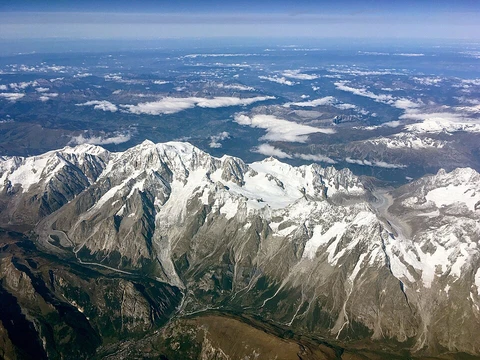
Apennine Mountains
Mountain range forming the backbone of peninsular Italy.

The Apennine Mountains, also called the Apennines, are a mountain range made up of several parallel chains that run roughly 1,200 kilometers (750 miles) down the length of peninsular Italy. In the northwest, they connect with the Ligurian Alps at Altare, and in the southwest, they end at Reggio di Calabria, a coastal city at the peninsula’s tip. Since 2000, Italy’s Environment Ministry, acting on advice from the Apennines Park of Europe Project, has considered the Apennines System to include the mountains of northern Sicily, bringing the total distance to 1,500 kilometers (930 miles). This system forms an arc that encloses the eastern side of the Ligurian and Tyrrhenian seas. The mountains give their name to the Apennine Peninsula, which makes up most of Italy.
The range still has some intact ecosystems that have survived human activity. These areas contain some of the best-preserved forests and montane grasslands in Europe, now protected by national parks, and they support a high diversity of plants and animals. The Apennines are one of the last refuges for large European predators like the Italian wolf and the Marsican brown bear, which are extinct elsewhere in Central Europe. Most of the mountains are green and vegetated, but one side of the highest peak, Corno Grande, is partly covered by the Calderone glacier, the only glacier in the Apennines. The eastern slopes drop steeply to the Adriatic Sea, while the western slopes form foothills where most towns on the peninsula are built. The mountains are usually named after the province or provinces they lie in—for example, the Ligurian Apennines are in Liguria.
The most common explanation for the name “Apennines” is that it comes from the Celtic word *penn*, meaning “mountain” or “summit,” giving *A-penn-inus*, possibly assigned during Celtic rule in northern Italy in the 4th century BC or earlier. The name originally referred only to the northern Apennines. However, historical linguists have never agreed on a single derivation. Wilhelm Deecke noted that the etymology is uncertain but suggested it might come from the Ligurian-Celtic *Pen* or *Ben*, meaning “mountain peak.” Many place names seem to include *pen* (like Penarrig, Penbrynn, Pencoid) or *ben* (like Beanach, Benmore, Benabuird). In one theory, *Pen/Ben* is related to Old Irish *cenn*, “head,” but an original *kwen-* would be needed, which is not found in languages that have labio-velars. Windisch and Brugmann reconstructed Indo-European *kwi-*, also linking it to the Greek Pindus Mountains, but *kwen-* from *kwi-* is not explained by any rule. Some have connected the name to English *pin*, *pen*, and Latin *pinna* or *penna* (meaning “feather,” in the sense of a quill’s horn), but this view places the word’s origin in Latium, contradicting the northern-origin theory. None of these derivations is universally accepted.
The Apennine culture is a technological complex from central and southern Italy dating to the Middle Bronze Age (15th–14th centuries BC). In the mid-20th century, it was divided into Proto-, Early, Middle, and Late sub-phases, but today archaeologists use “Apennine” only for the ornamental pottery style of the later Middle Bronze Age (BM3). This phase is preceded by the Grotta Nuova facies in central Italy and the Protoapennine B facies in southern Italy, and it is followed by the Subapennine facies of the 13th century BC (Bronzo Recente). Apennine pottery is a burnished ware decorated with incised spirals, meanders, and geometric zones filled with dots or transverse dashes. It has been found on Ischia island alongside LHII and LHIII pottery, and on Lipari with LHIIIA pottery, which dates it to the Late Bronze Age as defined in Greece and the Aegean. The people of the Apennine culture were alpine cattle herders who grazed their animals in the meadows and groves of mountainous central Italy. They lived in small hamlets in defensible spots. When moving between summer pastures, they set up temporary camps or stayed in caves and rock shelters. Their range was not limited to the hills; their pottery has been found on the Capitoline Hill in Rome and on the islands mentioned above.
The Apennines are divided into three sectors: northern (Appennino settentrionale), central (Appennino centrale), and southern (Appennino meridionale). Several long hiking trails cross the range. The European walking route E1 comes from northern Europe and runs through the northern and central Apennines. The Grand Italian Trail starts in Trieste, winds through the Alpine arc, and then traverses the entire Apennine system, Sicily, and Sardinia.
The northern Apennines consist of three subchains: the Ligurian (Appennino ligure), Tuscan–Emilian (Appennino tosco-emiliano), and Umbrian Apennines (Appennino umbro). The Ligurian Apennines border the Ligurian Sea in the Gulf of Genoa, from about Savona below the upper Bormida River valley to about La Spezia (La Cisa pass) below the upper Magra River valley. The range follows the Gulf of Genoa, separating it from the upper Po Valley. The northwestern border follows the Bormida River to Acqui Terme, where the river continues northeast to Alessandria in the Po Valley, but the mountains bend away to the southeast. The upper Bormida can be reached by several roads heading inland at a right angle to the coast southwest of Savona, the main one being the Autostrada Torino-Savona. These roads ascend to the Bocchetta di Altare, sometimes called Colle di Cadibona, at 436 meters (1,430 feet), which marks the border between the Ligurian Alps along the coast to the west and the Ligurian Apennines. A bronze plaque fixed to a stone marks the top of the pass.
- Length
- c. 1,200 km (750 mi) in peninsular Italy; 1,500 km (930 mi) including north Sici
- Highest peak
- Corno Grande, partially covered by Calderone glacier, the only glacier in the Ap
- Location
- Peninsular Italy, extending into north Sicily
- Etymology
- Possibly from Celtic 'penn' meaning mountain or summit; derivation disputed
- Notable feature
- One of the last refuges of the Italian wolf and Marsican brown bear
Quick Facts
- Native Name
- it · Monti Appennini
- Country
- Italy · San Marino
- Geology
- Apennine fold and thrust belt
- Age
- Mesozoic for formation of rock, / Neogene-Quaternary for orogeny
- Length Km
- 1200
- Length Orientation
- northwest to southeast
- Width Km
- 250
- Width Orientation
- southwest to northeast
- Highest
- Corno Grande (Great Horn)
- Elevation M
- 2912
- Listing
- List of mountain ranges
- Map Size
- 320
Facts from the source article.
Lore & Background
The Apennines preserve some intact ecosystems that have survived human intervention. In these are some of the best-preserved forests and montane grasslands in Europe, now protected by national parks and, within them, a high diversity of flora and fauna. These mountains are one of the last refuges of the big European predators such as the Italian wolf and the Marsican brown bear, now extinct in the rest of Central Europe. The eastern slopes down to the Adriatic Sea are steep, whilst the western slopes form foothills on which most of the towns of peninsular Italy are located. The etymology most frequently repeated is that it derives from the Celtic penn, 'mountain', 'summit': A-penn-inus, which could have been assigned during the Celtic domination of north Italy in the 4th century BC or before. However, historical linguists have never found a derivation with which they all agree. Wilhelm Deecke said: '[…] its etymology is doubtful but some derive it from the Ligurian-Celtish Pen or Ben, which means mountain peak.'
Reader's Guide
The Apennines are divided into three sectors: northern (Appennino settentrionale), central (Appennino centrale), and southern (Appennino meridionale). The northern Apennines consist of three subchains: the Ligurian (Appennino ligure), Tuscan–Emilian (Appennino tosco-emiliano), and Umbrian Apennines (Appennino umbro). The Ligurian Apennines border the Ligurian Sea in the Gulf of Genoa, from about Savona below the upper Bormida River valley to about La Spezia (La Cisa pass) below the upper Magra River valley. The main and only feasible overland route connecting the coastal plain of Liguria to the north Italian plain runs through Bocchetta di Altare, sometimes called Colle di Cadibona, 436 m (1,430 ft). The Tuscan–Emilian Apennines start at Cisa Pass and cross the peninsula along the border between Emilia-Romagna and Tuscany; the highest point is Monte Cimone at 2,165 m (7,103 ft). A separate branch, the Apuan Alps, goes southwest, bordering the coast south of La Spezia; geologically the rock is of a slightly different composition, marble. The Apennine culture is a technology complex in central and southern Italy from the Italian Middle Bronze Age (15th–14th centuries BC). Apennine pottery is a burnished ware incised with spirals, meanders and geometrical zones, filled with dots or transverse dashes. It has been found on Ischia island in association with LHII and LHIII pottery and on Lipari in association with LHIIIA pottery. The people of the Apennine culture were alpine cattle herdsmen grazing their animals over the meadows and groves of mountainous central Italy. They lived in small hamlets located in defensible places.
Did You Know?
- The Apennines System, defined since 2000, includes the mountains of north Sicily for a total distance of 1,500 km.
- The highest peak, Corno Grande, is partially covered by Calderone glacier, the only glacier in the Apennines.
- The Apennine culture of the Middle Bronze Age (15th–14th centuries BC) produced burnished pottery incised with spirals and meanders.
- The Bocchetta di Altare pass, at 436 m, is the main overland route connecting the Ligurian coast to the north Italian plain.
- The Great Apennine Tunnel on the Direttissima railway line is 18.5 km long, the longest entirely within Italy.
Scale in the Global Mountain Hierarchy
The Apennines stretch for 1,200 kilometres (750 miles), a length that secures their place in the global register of Earth's significant mountain chains. In the comprehensive catalogue of terrestrial ranges exceeding 500 kilometres, this measurement situates them firmly in the mid-to-upper tier of length-based rankings. Within the broader Earth inventory, they represent a clearly defined, measurable segment of continental topography.
Tectonic Lineage and the Alpine-Himalayan Belt
The Apennines, at 1,200 kilometres, occupy a middle position within this family. Sharing this tectonic ancestry means the Apennines owe their existence to the same broad-scale plate interactions and crustal deformation processes that shaped their sister ranges, even though each section expresses those forces in its own distinct topographic character.
Peers at the 1,200-Kilometre Mark
At exactly 1,200 kilometres, the Apennines share a precise length bracket with a handful of other notable ranges on Earth. This creates a natural peer group of chains that, while geographically dispersed across Europe, Asia, and South America, occupy an identical rung on the length ladder. This clustering of similar-length ranges within one tectonic family highlights the varied ways a single orogenic process can produce chains of differing but sometimes coincidentally identical extents.
Position Within a Continental and Orogenic Mosaic
The Apennines exist as one thread in an extraordinarily dense tapestry of mountain ranges catalogued across Earth's continents. The broader context of the list—spanning terrestrial ranges, underwater ridges, and even mountain systems on other celestial bodies—underscores that the Apennines, while significant in their own right, are one entry in an almost incomprehensibly diverse global inventory of elevated terrain.
Frequently Asked Questions
What are the Apennine Mountains and where are they located?
The Apennines are a long chain of parallel mountain ranges that stretch roughly 1,200 km along the spine of peninsular Italy, curving in an arc between the Tyrrhenian and Adriatic coasts. The official system, expanded in 2000, also encompasses the mountains of northern Sicily, bringing the total length to about 1,500 km.
What is the highest peak in the Apennine system?
Corno Grande holds the title of the Apennines' tallest summit. It is partially draped by the Calderone glacieret, a small remnant of what was once a full glacier.
How long are the Apennine Mountains exactly?
Within peninsular Italy the range spans approximately 1,200 km (around 750 miles). If you include the northern Sicilian extension recognized since the 2000 redefinition, the full Apennine System reaches roughly 1,500 km (about 930 miles).
Why are the Apennine Mountains ecologically significant?
They serve as one of the last remaining refuges for the Italian wolf and the Marsican brown bear, two species that have nearly vanished from the rest of the peninsula. This makes the range a critical habitat corridor for Italy's most iconic large carnivores.
Where does the name 'Apennine' come from?
The most commonly cited theory traces it to the Celtic word 'penn,' meaning mountain or summit, though scholars still debate the exact derivation. The range in turn lends its name to the Apennine Peninsula, which makes up the bulk of the Italian boot.
More in Mountain Ranges And Massifs 1-24
Spotted an error? Know more?
This is a living reference — every entry is fact-audited, and reader corrections feed straight into our audit queue. Suggest an edit · See this site's audit record