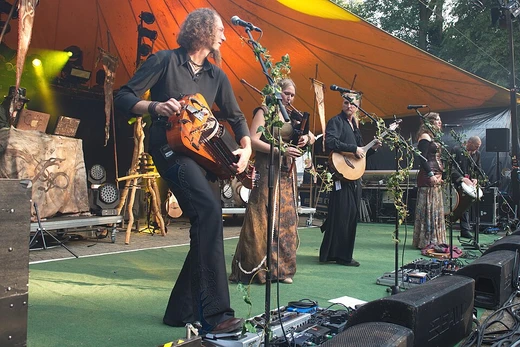
Sol Invictus (band)
British neofolk band formed by Tony Wakeford in 1987.

Michael Moll · CC BY-SA 3.0
Sol Invictus were a British neofolk band formed by Tony Wakeford in 1987. The band is considered one of the most prolific and influential acts associated with neofolk or apocalyptic folk, combining acoustic guitar and neo-classical instrumentation with industrial music elements. Wakeford remained the sole constant member, though numerous musicians contributed over the years.
Quick Facts
- Background
- group_or_band
- Origin
- London, England
- Genre
- Neofolk
- Years Active
- 1987–2023
- Label
- Tursa
- Spinoffs
- Fire + Ice
- Spinoff Of
- Crisis · Death in June · Above the Ruins
- Current Members
- Tony Wakeford / Renee Rosen / Caroline Jago / Lesley Malone / Eilish McCraken
Facts from the source article.
Lore & Background
Tony Wakeford co-founded Death in June before being fired in 1984 for bringing his right-wing leanings into the group. He then formed Above the Ruins, a post-punk band controversial for its right-wing associations. In 1987, Wakeford distanced himself from those views and formed Sol Invictus, taking the name from a pre-Christian cult. He initially denied membership in the National Front and Above the Ruins but later admitted to both, calling his National Front involvement 'probably the worst decision of my life'.
Reader's Guide
Sol Invictus holds significance as a foundational band in the neofolk and apocalyptic folk genres, noted for its prolific output and influence on later artists. The band's music, described by Wakeford as 'folk noir', blends acoustic guitar with neo-classical and industrial elements, often exploring pagan, Mithraist, and anti-Christian themes with a pessimistic view of modern society. Their early albums used a raw sound of acoustic and electric guitars, bass, keyboards, and drums, while later works expanded with cello, violin, orchestral drums, flute, and harp. The band's legacy is complicated by Wakeford's past political affiliations, which led to accusations of neo-fascism, though he later repudiated those views. Sol Invictus' debut album, Against the Modern World (1988), displayed a post-punk sound with martial industrial elements, and their catalog was released through Wakeford's label Tursa, initially distributed by World Serpent Distribution and later by Cold Spring.
Did You Know?
- Sol Invictus took its name from a cult that predated Christianity.
- Tony Wakeford formed his own record label, Tursa, in 1990.
- The band's debut album, Against the Modern World, was released in 1987.
- Wakeford described his National Front membership as 'probably the worst decision of my life'.
Origins & Political Reckoning
Sol Invictus emerged in 1987 as a deliberate break from a turbulent past. Tony Wakeford, who would remain the group's sole permanent member throughout its entire existence, had previously co-founded Death in June and, in early 1984, openly supported the National Front in Britain. His right-wing sympathies proved so disruptive that he was dismissed from Death in June, after which he launched Above the Ruins, a post-punk outfit that attracted controversy for its political associations. By 1987, Wakeford had consciously moved away from those affiliations and channelled his creative energy into Sol Invictus, borrowing the name from a pre-Christian cult. The shadow of his earlier years, however, never fully dissipated. The band has repeatedly faced accusations of neo-fascism, and Wakeford himself initially denied any membership in the National Front or Above the Ruins before eventually acknowledging both. In a 2007 reflection, he called his National Front involvement "probably the worst decision of my life," a statement that underscores how the group's identity has been perpetually entangled with the question of whether an artist can truly outgrow a politically charged past.
Sound & Sonic Evolution
Critics have consistently placed Sol Invictus among the most prolific and influential acts in the neo-folk and apocalyptic folk traditions. Wakeford himself prefers the label "folk noir," a term that captures the band's blend of acoustic guitar work, neo-classical instrumentation, and industrial textures. The debut album Against the Modern World (1988) carried a distinctly post-punk edge, weaving in elements that would later be categorised as martial industrial. The first four records relied on a starkly unadorned palette—acoustic and electric guitars, bass, keyboards, and drums—that evoked, in the words of critic Peter Webb, a premodern world grappling with paganism, English eccentricity, anti-American sentiment, and broader European traditions. As the catalogue expanded, the sonic architecture grew considerably richer. Later releases incorporated cello, violin, orchestral drums, flute, and harp, broadening the emotional and textural range while the lyrical focus shifted toward more personal subject matter. This gradual layering of instruments marked a clear trajectory from angular post-punk toward a more orchestral and intimate sound.
Thematic World & Pagan Identity
The name Sol Invictus itself—drawn from a sun-worshipping cult that existed before the rise of Christianity—signals the band's deep engagement with pre-Christian and heathen subject matter. Wakeford and various collaborators were actively involved in neopagan groups, and that spiritual orientation permeates the lyrics. The music frequently channels Mithraist and heathen imagery, often with an explicit antipathy toward Christianity, positioning the group firmly within a pagan intellectual tradition rather than a merely aesthetic one. Beyond religious themes, the early work explored England's cultural quirks, expressed anti-Americanism, and looked broadly toward European heritage. A consistent undercurrent of pessimism and apathy toward modern society runs through the lyrics, lending the music a dark, world-weary quality that aligns with the "apocalyptic folk" descriptor. Over time, however, the lyrical content became more introspective and personal, moving away from broad cultural commentary toward individual emotional landscapes. This evolution in thematic focus mirrors the musical shift from raw post-punk to a more layered, orchestral sound, suggesting an artist gradually turning inward as his external references became more refined.
Label, Distribution & Collaborative Structure
A defining feature of Sol Invictus's operational history is its independence. In 1990, Wakeford established his own record label, Tursa, which became the primary vehicle for releasing the band's numerous albums, beginning with Trees in Winter. For distribution, Tursa partnered with World Serpent Distribution, a relationship that sustained the label's output for many years. When World Serpent dissolved in the 2000s, Cold Spring stepped in to take over distribution duties, ensuring continuity for the catalogue. The collaborative structure of the band itself is equally notable: although Wakeford has been the sole constant member since 1987, a rotating cast of musicians has contributed and collaborated under the Sol Invictus name over the decades. This fluid, project-like approach allowed the sound to evolve organically as different instrumentalists brought their own skills—cello, violin, harp, flute—into the mix. The combination of label ownership, shifting distribution partners, and an ever-changing roster of collaborators gave the project a remarkable longevity and creative flexibility that distinguished it from more rigidly structured bands in the neo-folk scene.
Gallery
Frequently Asked Questions
Who is Sol Invictus (band)?
Sol Invictus is a British neofolk project created by Tony Wakeford in 1987. It is widely regarded as one of the most prolific and recognizable acts in the apocalyptic folk and folk noir scenes.
What kind of music does Sol Invictus (band) make?
The project layers acoustic guitar and neo-classical arrangements over industrial textures to produce a dark, atmospheric sound. Their work is generally classified under neofolk, apocalyptic folk, and folk noir.
Who is the only permanent member of Sol Invictus (band)?
Tony Wakeford has been the sole constant member since the project began in 1987. While numerous guest musicians have contributed to recordings over the years, Wakeford remains the central creative force behind all releases.
Why is Sol Invictus (band) considered important in the neofolk genre?
The project's decades-long catalog helped define the sonic and aesthetic boundaries of neofolk and apocalyptic folk for a generation of artists. Its sheer volume of output and distinctive blend of acoustic and industrial elements made it a major reference point in the scene.
What label releases Sol Invictus (band) music?
Much of the project's catalog was put out on Wakeford's own imprint, Tursa, which was distributed through World Serpent Distribution and later Cold Spring. This independent setup allowed the project to maintain full creative control over its releases.
More in Modern pagan musical groups 1-24
Spotted an error? Know more?
Reader corrections go straight into our review queue. Suggest an edit · How this site is sourced