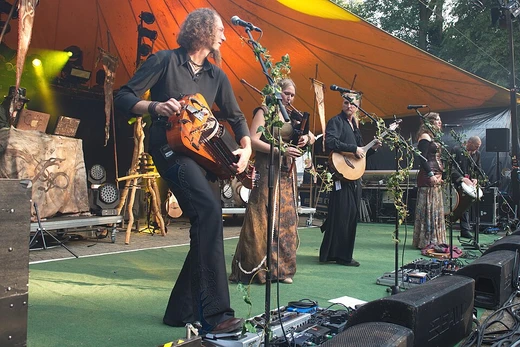
Gaia Consort
Seattle folk rock band with a free-music ethos and pagan themes.

Gaia Consort is a Seattle-based folk rock band founded in 1997 by Christopher Bingham and Sue Tinney. The group made its live debut at Nudestock 97. Over the years, many musicians from the Pacific Northwest collaborated with the band, including Dan Ochipinti. Gaia Consort released four albums: *Gaia Circles* (1999), *Secret Voices* (2001), *Evolve* (2004), and *Vitus Dance* (2007). Rather than playing traditional music venues, the band focused on house concerts, self-produced shows, and events like Faerieworlds and the Heartland Pagan Festival. Their songs frequently addressed neopaganism, positive sexuality, and polyamory, making them a favorite within the region’s pagan and sexual subcultures. The band’s strong fan base was evident in that all albums were funded by listener donations. Gaia Consort’s philosophy was unusual in the music industry: most of their music was available for free on their website, and they encouraged non-commercial sharing of MP3 files, stating that “music should not be bottled up” for those who could afford it. A major theme in their work was the impact of the wider world on personal life, with songs targeting religion and expressing an anti-war sentiment—one asking, “What will it come to when we’ve finally had enough?”
Quick Facts
- Background
- group_or_band
- Origin
- Seattle
- Genre
- Folk rock, Psychedelic rock, Pagan rock
- Current Members
- Christopher Bingham, Sue Tinney, Larry Golding, Sunnie Reed, T.J. Morris, Jay Kenney, Betsy Tinney, Dan Mohler
Facts from the source article.
Lore & Background
Gaia Consort was founded in 1997 by Christopher Bingham and Sue Tinney, debuting at Nudestock 97. The group collaborated with many Pacific Northwest musicians, including Dan Ochipinti. They released four albums: Gaia Circles (1999), Secret Voices (2001), Evolve (2004), and Vitus Dance (2007).
Rather than pursuing traditional venues, Gaia Consort focused on house concerts, self-produced shows, and events such as Faerieworlds and Heartland Pagan Festival. Their songs frequently addressed neopaganism, positive sexuality, and polyamory, making them a favorite of pagan and sexual subcultures in the region. All albums were financed by donations from the listening community.
The group's philosophy was unusual: most of their music was freely available on their website, and they actively encouraged non-commercial sharing, stating that 'music should not be bottled up' for the few who could afford it. A major theme of their work was the greater world and its impact on lives, including anti-war songs.
Reader's Guide
Gaia Consort's significance lies in its role as a precursor to Bone Poets Orchestra and as a cultural touchstone for the Pacific Northwest's pagan and polyamory communities. By eschewing traditional music industry channels in favor of house concerts and festivals like Faerieworlds, the group built a dedicated fan base that directly funded all four albums. Their open distribution model—offering music for free and encouraging sharing—was ahead of its time and reflected a communal ethos. Thematically, the band addressed neopagan spirituality, positive sexuality, and anti-war sentiments, resonating with audiences seeking alternative perspectives. Their legacy is carried forward by Bone Poets Orchestra, but Gaia Consort remains notable for its grassroots approach and the explicit integration of subcultural values into both music and business practice.
Did You Know?
- Gaia Consort's first performance was at Nudestock 97.
- All of Gaia Consort's albums were financed by donations from the listening community.
- Gaia Consort actively encouraged non-commercial sharing of their MP3-format songs.
Origins and Early Identity
Gaia Consort emerged in 1997 as the creative project of Christopher Bingham and Sue Tinney, two musicians based in Seattle who would go on to shape a distinctive voice in the Pacific Northwest folk rock scene. The duo's very first public performance took place at Nudestock 97, an event that set the tone for a group that would always prioritize community gatherings over conventional stage appearances. From the start, their sound blended folk traditions with rock energy, creating a texture that resonated deeply with listeners in the region. Over time, Gaia Consort would evolve into what is now known as Bone Poets Orchestra, but the foundational identity established during those early years remained central to the project's character. The band's popularity was concentrated in the Pacific Northwest, where they cultivated a devoted following through intimate performances and a lyrical worldview that spoke directly to the spiritual and personal concerns of their audience. Their early collaborations with fellow regional musicians helped establish them as a key node in Seattle's eclectic music community.
Discography and Collaborative Networks
Between 1999 and 2007, Gaia Consort released four studio albums that charted a clear artistic progression. Their debut, Gaia Circles, arrived in 1999, followed by Secret Voices in 2001, Evolve in 2004, and Vitus Dance in 2007. Each record reflected the band's growing confidence and expanding sonic palette while maintaining the folk rock foundation that defined their identity. A hallmark of their creative process was the willingness to work with a wide circle of Pacific Northwest musicians. Among the most notable collaborators were Heather Alexander and Dan Ochipinti, both members of the Celtic folk-rock group Uffington Horse. These partnerships enriched Gaia Consort's arrangements and broadened their musical vocabulary beyond a simple duo format. The band's approach to recording and release was equally unconventional: rather than pursuing major-label distribution, they relied on the generosity of their audience, with every album financed entirely through donations from listeners. This model reinforced the sense that the music belonged to the community as much as to the performers themselves.
Community, Subculture, and the Live Experience
Gaia Consort deliberately eschewed the traditional concert circuit, choosing instead to perform at house concerts, self-produced events, and festivals rooted in specific subcultures. Venues like Faerieworlds and the Heartland Pagan Festival became natural homes for the band, reflecting the spiritual and countercultural leanings woven throughout their songwriting. Their lyrics frequently explored neopaganism, positive sexuality, and polyamory, themes that resonated powerfully with the pagan and sexual subcultures thriving in the Pacific Northwest. This alignment forged an exceptionally loyal fan base, one that sustained the band financially through donations that covered the production costs of every album. The group's visual identity was further shaped by Seattle filmmaker and polyamory advocate Terisa Greenan, who directed several music videos for the band. Together, these elements created a tight-knit ecosystem in which music, spirituality, and community support reinforced one another, making Gaia Consort far more than a performing act; they became a cultural touchstone for a particular slice of Pacific Northwest life.
Philosophy, Lyrics, and the Politics of Sharing
One of Gaia Consort's most distinctive contributions to the music landscape was their radical stance on ownership and access. The majority of their catalog was made freely available on their own website, and the band actively encouraged listeners to share the MP3 files non-commercially. Their guiding principle was simple: music should not be bottled up and reserved for those who could afford to purchase it. This philosophy extended into their lyrical content, where the greater world and its impact on individual lives served as a recurring subject. Religion was frequently examined and questioned, while other tracks carried a pronounced anti-war sentiment; one song posed the question of what would happen when people had finally had enough. Themes of neopagan spirituality, consensual non-monogamy, and personal liberation ran throughout their body of work. By combining accessible distribution with politically and spiritually engaged songwriting, Gaia Consort carved out a space in the music industry that prioritized collective ownership and honest expression over commercial convention.
Frequently Asked Questions
Who is Gaia Consort?
Gaia Consort is a Seattle-based folk rock band that started in 1997, co-founded by Christopher Bingham and Sue Tinney. They made their first live appearance at the Nudestock 97 festival and have since become a fixture of the Pacific Northwest pagan music scene.
What is Gaia Consort known for?
The group is best recognized for writing songs that explore neopagan spirituality and polyamory within a folk rock framework. They also gained a distinctive reputation for offering their music to listeners for free rather than selling it through conventional channels.
What albums has Gaia Consort released?
Over roughly a decade the band put out four studio records: Gaia Circles (1999), Secret Voices (2001), Evolve (2004), and Vitus Dance (2007). Their catalog grew with collaborations from other Pacific Northwest musicians, including Dan Ochipinti.
Why does Gaia Consort give their music away for free?
The band adopted a free-distribution model as a core part of their identity, preferring to share recordings directly with their community rather than funneling sales through commercial labels. This ethos aligned with their broader DIY approach to touring and self-produced performances.
Where does Gaia Consort typically perform?
Rather than booking mainstream concert venues, the group gravitated toward intimate house concerts, self-organized shows, and pagan-community gatherings. They have been regulars at events such as Faerieworlds and the Heartland Pagan Festival.
More in Modern pagan musical groups 1-24
Spotted an error? Know more?
Reader corrections go straight into our review queue. Suggest an edit · How this site is sourced