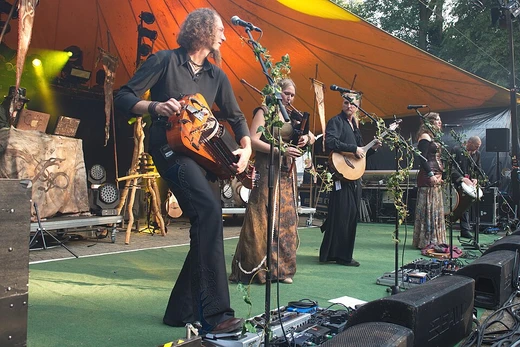
Kūlgrinda (band)
Lithuanian neopagan ritual folk group founded in 1989.

Kūlgrinda is a folk music group based in Vilnius, Lithuania, founded in 1989 by Inija Trinkūnienė and Jonas Trinkūnas. The band is tied to the Lithuanian neopagan movement Romuva and regularly takes part in its rituals. From its beginning, Kūlgrinda has served as the musical voice of this movement, and some of its recordings are considered "musical scriptures" by Romuva followers. The group’s name comes from *kūlgrinda*, a type of hidden underwater path used in Samogitia. Their sound is built on straightforward folk performances with minimal studio effects, emphasizing vocals. They focus on *sutartinės*, a traditional polyphonic singing style in which several voices weave interlocking melodies through rhythmic repetition. Musicologist Daiva Račiūnaitė-Vyčinienė has likened this technique to weaving a multicolored cloth. Kūlgrinda has worked with other artists, including electronic musician Donis, singer Rasa Serra, and heavy metal band Ugnėlakis. That last collaboration led to the formation of the folk rock group Žalvarinis. Their early albums were released by Dangus Records, later moving to Aurea Studija. Their discography includes: *Kūlgrinda* (1996, cassette), *Ugnėlakis su Kūlgrinda* (2002, with Ugnėlakis), *Ugnies Apeigos* (2002), *Sotvaras* (2003, with Donis), *Perkūno Giesmės* (2003), *Prūsų Giesmės* (2005, sung in Old Prussian), *Giesmės Saulei* (2007), *Giesmės Valdovui Gediminui* (2009), *Giesmės Žemynai* (2013, with Donis), *Laimos Giesmės* (2014), and *Giesmės Austėjai* (2018).
Quick Facts
- Background
- group_or_band
- Origin
- Vilnius, Lithuania
- Genre
- Folk music / Religious music
- Years Active
- 1989 – present
- Label
- Dangus Records / Aurea Studija
- Associated Acts
- Žalvarinis
- Current Members
- Inija Trinkūnienė
- Past Members
- Jonas Trinkūnas
Facts from the source article.
Lore & Background
Kūlgrinda was founded in 1989 by Jonas Trinkūnas and his wife Inija Trinkūnienė, who also led the modern Pagan movement Romuva. The band has from the start functioned as the musical expression of this movement. Some of the recorded material has functioned as 'musical scriptures' for the Romuva members, and the band has regularly participated as an integral part of the movement's events. On the website of Romuva, Kūlgrinda is described as a 'ritual folklore group'.
The band owes its name to kūlgrinda – a secret Samogitian underwater causeway. Kūlgrinda's music typically consists of straightforward folk music performances with little studio enhancement and a focus on the vocal performances. It has specialised on sutartinės, a traditional form of polyphonic song-chant where several vocalists perform interlocking melodies that through rhythmic repetition create a pattern of musical expression. The musicologist Daiva Račiūnaitė-Vyčinienė has compared this technique to the weaving of a multicoloured cloth.
The band has collaborated with other artists such as the electronic musician Donis, the singer Rasa Serra and the heavy metal band Ugnėlakis. The latter collaboration resulted in the forming of the folk rock group Žalvarinis.
Reader's Guide
Kūlgrinda holds significance as the musical arm of the Romuva neopagan movement, providing ritual music and 'musical scriptures' for its adherents. Their focus on sutartinės, an ancient polyphonic chant form, preserves and promotes a distinctive Lithuanian folk tradition. By collaborating with electronic and metal artists, they have extended their influence beyond strictly pagan circles, contributing to the broader genre of neopagan music. Their discography, including albums sung in the extinct Old Prussian language, reflects a commitment to reviving pre-Christian Baltic spirituality and language. The band's longevity since 1989 and their integration into Romuva ceremonies underscore their role as both cultural preservers and contemporary spiritual practitioners.
Did You Know?
- Kūlgrinda was founded in 1989 by Jonas Trinkūnas and Inija Trinkūnienė, who also led the Romuva neopagan movement.
- The band's name comes from a secret Samogitian underwater causeway called kūlgrinda.
- Kūlgrinda specializes in sutartinės, a polyphonic song-chant compared by a musicologist to weaving a multicolored cloth.
- Collaboration with the heavy metal band Ugnėlakis led to the formation of the folk rock group Žalvarinis.
Founding & the Romuva Movement
Kūlgrinda emerged in Vilnius in 1989, born from the creative partnership of Jonas Trinkūnas and his wife Inija Trinkūnienė. Far from being a conventional folk ensemble, the group was conceived from its very inception as the sonic arm of Romuva, the modern Lithuanian neopagan movement that the Trinkūnases themselves led. This inseparable bond between music and faith meant that the band's output was never purely entertainment; recorded material doubled as what the movement's own website calls "musical scriptures," guiding members through their spiritual practice. The group regularly performed as an integral component of Romuva's ceremonies and gatherings, functioning as what the movement describes on its site as a "ritual folklore group." Even the name carries cultural depth: kūlgrinda refers to a hidden Samogitian underwater causeway, a secret passage beneath the surface, evoking something ancient and concealed. The band thus became both a musical project and a living vessel for a revived Lithuanian spiritual identity.
The Art of Sutartinės
The sonic signature of Kūlgrinda is deliberately unadorned. Their performances favour raw vocal power over studio production, keeping arrangements straightforward and letting the human voice carry the full weight of each piece. At the heart of their repertoire lies sutartinės, a centuries-old Lithuanian tradition of polyphonic song-chant in which multiple singers weave interlocking melodic lines. Through rhythmic repetition, these overlapping voices build a layered pattern of expression that feels almost architectural in its construction. Musicologist Daiva Račiūnaitė-Vyčinienė has drawn a vivid comparison, likening the technique to the weaving of a multicoloured cloth, where each individual thread of melody contributes to a larger, intricate tapestry. This commitment to vocal-centric, minimally produced folk performance sets Kūlgrinda apart from more polished contemporary ensembles and reinforces their role as custodians of a living oral tradition rather than mere entertainers.
A Catalogue of Hymns
From their first cassette in 1996 through to 2018, Kūlgrinda built a discography that reads almost like a devotional calendar, each release honouring a different figure from the Lithuanian and broader Baltic pantheon. Early recordings were issued on Dangus Records before the band moved to Aurea Studija. The thematic arc is striking: "Hymns of Perkūnas" (2003) gave voice to the thunder god, followed by "Prussian Hymns" (2005), a remarkable project sung in the extinct Old Prussian language. Subsequent albums addressed the Sun (2007), the historical King Gediminas (2009), the earth goddess Žemyna (2013), the fate-goddess Laima (2014), and the weaver-goddess Austėja (2018). Alongside these sacred works, the band released "Rite of Fire" in 2002 and collaborative pieces such as "Sotvaras" with electronic producer Donis. The result is a body of work that maps a spiritual and cultural landscape, moving from mythological deities to historical figures and back, all filtered through the intimate lens of unadorned vocal folk music.
Crossing Musical Boundaries
Although rooted in traditional vocal folk, Kūlgrinda has never been a hermetically sealed project. The band has opened its sound to a range of collaborators who pull it into adjacent genres. Electronic musician Donis joined forces with them on the 2003 album "Sotvaras" and returned for "Hymns to Žemyna" in 2013, blending electronic textures with the group's polyphonic chants. Singer Rasa Serra also contributed to their work, adding another dimension to the vocal palette. Perhaps the most genre-defying partnership was with the heavy metal band Ugnėlakis; their 2002 joint release "Ugnėlakis su Kūlgrinda" fused distorted guitars with ancient song-chant, and the collaboration proved so fruitful that it spawned the folk-rock group Žalvarinis. These forays demonstrate that the band's core identity – the interlocking voices of sutartinės – is flexible enough to sit alongside synthesizers, electric instruments, and rock energy without losing its essential character.
Frequently Asked Questions
Who is Kūlgrinda (band)?
Kūlgrinda is a Vilnius-based Lithuanian folk and ritual music ensemble established in 1989 by Inija Trinkūnēnė and Jonas Trinkūnas. The group is closely linked to the Romuva neopagan movement and has functioned as its primary musical voice since its inception.
What is Kūlgrinda (band)'s musical specialty and sound?
The band centers its repertoire on sutartinės, a traditional Lithuanian polyphonic song-chant form. Their recordings are deliberately stripped-down, relying on unadorned vocal delivery with very little studio processing to preserve an authentic, ritual feel.
What is Kūlgrinda (band)'s role within Romuva?
Kūlgrinda regularly performs at Romuva ceremonies and is regarded by followers as the movement's musical arm. Certain recordings are treated almost as sacred texts, earning the label of 'musical scriptures' among Romuva adherents.
What does the name 'Kūlgrinda' mean?
The title references a kūlgrinda, a concealed underwater route historically used in the Samogitia region of Lithuania. The founders chose it to evoke hidden, ancient pathways—mirroring the band's aim of surfacing pre-Christian Lithuanian musical traditions.
Why is Kūlgrinda (band) important in modern pagan music?
As one of the earliest groups to fuse living folk performance with an explicitly neopagan ritual purpose, Kūlgrinda helped legitimize pagan music as a serious artistic and spiritual practice in the post-Soviet era. Their sustained association with Romuva since 1989 has made them a reference point for other contemporary pagan ensembles across the Baltic region.
More in Modern pagan musical groups 1-24
Spotted an error? Know more?
Reader corrections go straight into our review queue. Suggest an edit · How this site is sourced