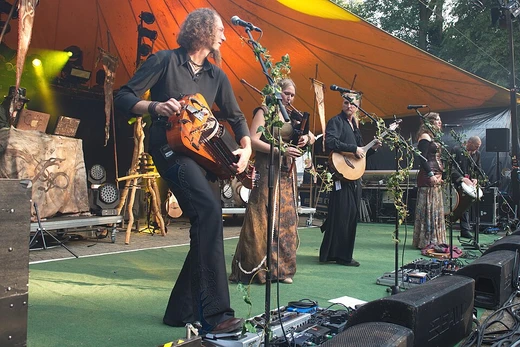
Falkenbach
German viking/pagan metal project founded in 1989 by Vratyas Vakyas.

Gerd Eichmann · CC BY 4.0
Falkenbach is a German viking/pagan metal project formed in 1989, one of the earliest bands in the viking metal genre. The sole permanent member is Vratyas Vakyas (real name Markus Tümmers), who was born in Germany but lived in Iceland in the late 1980s. The project is noted for its connection to pagan religiosity and its use of Old Norse, Latin, and Old German lyrics drawn from heathen literature.
Quick Facts
- Background
- group_or_band
- Origin
- Düsseldorf, Germany
- Genre
- Viking metal, pagan metal, black metal, folk metal
- Years Active
- 1989–present
- Label
- Napalm, Prophecy
- Current Members
- Vratyas Vakyas
Facts from the source article.
Lore & Background
Falkenbach was formed in Iceland in 1989, where the Hávamál demo was recorded. The project released a total of seven demos, though only five are known; early demos such as Skínn af sverði sól valtíva and Ásynja were limited to only a few copies each, though the exact number is unverified. In 1995, recording began for the debut album Fireblade, but equipment troubles halted production before mixing, and the album was never released. Instead, ...En their medh ríki fara... was recorded from December 1995 to March 1996 and became the actual debut album, featuring cover art by an unknown artist.
After the 1998 album ...Magni blandinn ok megintiri..., Vratyas stopped recording to focus on his record label Skaldic Art Productions. He returned in 2003 with Ok nefna tysvar Ty, recorded with three session musicians. The 2005 album Heralding – The Fireblade reused those session musicians and incorporated material from the abandoned Fireblade album. In 2006, Skaldic Arts Productions released a tribute album, An Homage to Falkenbach, featuring 16 covers by bands including Eluveitie, Folkearth, and Bewitched.
Reader's Guide
Falkenbach holds significance as one of the earliest viking metal projects, emerging in 1989 alongside the genre's formative years. The project's music evolved from clean folk on the Hávamál demo to a raw, black metal-influenced sound, later maturing into an epic metal style. Lyrically, Falkenbach draws heavily on heathen literature, with Old Norse passages taken directly from poems of the Elder Edda, such as Grímnismál. Vratyas Vakyas distinguishes Falkenbach from bands like Bathory by grounding his music in a pagan animistic worldview, rejecting a boundary between person and outer world. The project's use of the Wild Hunt motif on its debut album cover connects it to a tradition in metal music established by Bathory's Blood Fire Death. Despite being a one-person project in studio, Falkenbach has maintained a consistent thematic and sonic identity over decades, influencing later pagan and folk metal acts. The tribute album from 2006, featuring diverse metal bands, underscores its impact within the underground scene.
Did You Know?
- Falkenbach was formed in Iceland in 1989, though its sole member Vratyas Vakyas was born in Germany.
- The debut album Fireblade was recorded in 1995 but never released due to equipment troubles before mixing.
- Only a few copies are known to exist of the early demos Skínn af sverði sól valtíva and Ásynja, though the exact number is unverified.
- The album cover of ...En their medh ríki fara... features an illustration of the Wild Hunt by an unknown artist.
Origins in Iceland and the Myth of Scarcity
Falkenbach traces its roots to 1989, when Markus Tümmers — performing under the name Vratyas Vakyas — recorded the Hávamál demo in Iceland, where he had been living in the late 1980s. That single tape placed the project among the earliest acts to be identified with what would later be called viking or pagan metal. The name itself, meaning "Falconbrook" in German, evokes a distinctly Northern sensibility. What made those early years remarkable was their extreme scarcity: after Hávamál, Vratyas produced a total of seven demos, yet only five are known to exist, and three of the later releases — Skínn af sverði sól valtíva, Læknishendr, and Ásynja — were pressed in runs of just nine copies each, with Læknishendr being the sole exception. This near-mythic rarity, combined with the project's Old Norse titles and heathen imagery, cemented Falkenbach's reputation as a foundational, almost underground pillar of the pagan metal tradition long before the genre gained wider recognition.
The Fireblade Saga and a Pattern of Silence
One of the most storied threads in Falkenbach's history is the tale of Fireblade. Recording for that album began in 1995, but equipment problems forced Vratyas to halt production just before the mixing stage, and the record was never released. The material did not vanish entirely; in 2005, when he re-entered the studio with the same trio of session musicians — Hagalaz on guitars, Tyrann on vocals, and Boltthorn on drums — he reworked those abandoned tracks alongside new compositions to produce Heralding – The Fireblade. Between those two milestones, Vratyas stepped away from recording altogether after the 1998 release of ...Magni blandinn ok megintiri..., redirecting his energy toward his own label, Skaldic Art Productions. The 2003 album Ok nefna tysvar Ty marked his return to the studio with three close friends, and it set the template for the small-team collaborative approach he would maintain through Heralding and the 2011 album Tiurida, where Albion joined on bass. This pattern of long silences punctuated by focused recording sessions has defined the project's output since its inception.
Lyrical Philosophy and Animistic Pagan Identity
Falkenbach's lyrics are written primarily in English, but Vratyas also composes in Old Norse, Latin, and Old German. The Old Norse passages are not merely decorative; they are drawn directly from heathen literary sources. The chorus of "Donar's Oak," for instance, lifts verses four and five from Grímnismál, a poem preserved in the Elder Edda, while the project's very first demo takes its name from Hávamál, another Eddic poem. This deep textual grounding distinguishes Falkenbach from contemporaries who borrowed Norse imagery more loosely. Vratyas himself has explained that what separates his work from a band like Bathory is an underlying pagan religiosity. He describes his personal approach to paganism as animistic — a worldview that refuses to draw a hard boundary between the individual and the surrounding world. This philosophical stance, rather than mere aesthetic quotation, is what he considers the true foundation of the music, giving the project a spiritual coherence that extends well beyond its sonic surface.
Legacy, the Wild Hunt Lineage, and the 2006 Tribute
Falkenbach's influence on the pagan and viking metal landscape is difficult to overstate, given how early the project emerged. By 1996, with the release of ...En their medh ríki fara..., the band had already positioned itself within a lineage that linked metal to the Wild Hunt motif — a tradition traceable back to Bathory's 1988 album Blood Fire Death. The cover art for that debut features a fragment of an illustration by Friedrich Wilhelm Heine, originally created for Wilhelm Wägner's 1882 volume Nordisch-germanische Götter und Helden, a detail that underscores the project's commitment to deep historical and artistic roots. In 2006, Skaldic Art Productions released An Homage to Falkenbach, a two-part tribute album limited to 500 copies per part, featuring sixteen cover versions by acts including Eluveitie, Folkearth, and Bewitched. The fact that such a diverse roster of bands chose to reinterpret Falkenbach's material speaks to the project's gravitational pull within the neopagan metal community, even as Vratyas continues to work from his home in Düsseldorf, Germany, as the sole permanent member.
Gallery
Frequently Asked Questions
Who is Falkenbach?
Falkenbach is a German viking/pagan metal project that has existed since 1989, making it one of the earliest dedicated acts in the viking metal scene. It operates as a solo, long-running creative vehicle rather than a conventional multi-member band.
Who is Vratyas Vakyas?
Vratyas Vakyas is the stage name of Markus Tümmers, the sole permanent member behind Falkenbach. He was born in Germany and spent the late 1980s living in Iceland before launching the project.
What is Falkenbach's debut album?
The first full-length release under the Falkenbach name was "...En their medh ríki fara...", issued in 1995. It established the project's signature blend of heathen subject matter and atmospheric metal.
What languages does Falkenbach sing in?
Falkenbach's lyrics are drawn from Old Norse, Latin, and Old German sources rooted in heathen literature. This multilingual, textually grounded approach is a defining hallmark of the project's identity.
Why is Falkenbach considered important in viking metal?
Founded in 1989, Falkenbach predates most of the genre's more widely recognized bands and is frequently cited as a pioneering force in viking/pagan metal. Its sustained, solo-driven format and deep commitment to pagan textual traditions helped shape the genre's early identity.
More in Modern pagan musical groups 1-24
Spotted an error? Know more?
Reader corrections go straight into our review queue. Suggest an edit · How this site is sourced