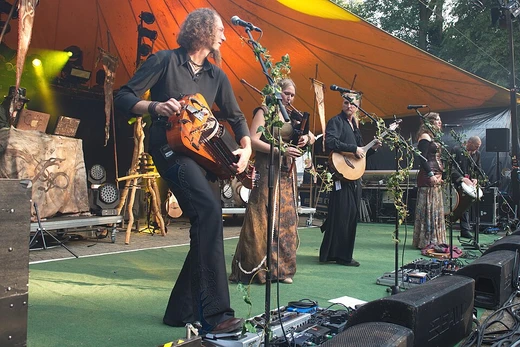
Žalvarinis
Lithuanian folk rock band blending ancient songs with heavy metal.

Žalvarinis (Lithuanian for 'made from brass, brazen') is a folk rock band from Vilnius, Lithuania. Formed in 2001 as a collaboration between the pagan metal group Ugnėlakis and the pagan folk group Kūlgrinda, the band blends traditional Lithuanian folk music with heavy metal and progressive rock. Their debut album, Ugnėlakis su Kūlgrinda, was released in 2002.
Quick Facts
- Background
- group_or_band
- Origin
- Vilnius, Lithuania
- Genre
- Folk rock, World music
- Years Active
- 2001–present
- Label
- None
- Spinoff Of
- Ugnėlakis / Kūlgrinda
- Current Members
- Robertas Semeniukas / Sigita Jonynaitė-Žostautienė
Facts from the source article.
Lore & Background
Žalvarinis was formed in 2001 as a collaboration between the pagan metal group Ugnėlakis and the pagan folk group Kūlgrinda. This collaboration is reflected in the title of their debut album, Ugnėlakis su Kūlgrinda (2002). The band's lyrics are usually taken from Lithuanian folklore and sung in the original Lithuanian language, preserving authentic pronunciation and ancient words. Their music frequently features the traditional Lithuanian sutartinė singing technique, performed by the band's three female singers, as heard in tracks like 'Ailiom susėdom', 'Dijūta', and 'Ožys'. As a legacy of Kūlgrinda, the band also includes several folk songs of Old Prussians.
On 19 December 2023, Žalvarinis was announced among the competing artists of Eurovizija.LT, the Lithuanian national final for the Eurovision Song Contest 2024, with the song 'Gaudė vėjai'. They came second in the second semi-final on 20 January 2024, qualifying for the final. The band's sound, while influenced by traditional Lithuanian folk music, is more modern—generally a mix of traditional heavy metal and progressive rock. Their first album was metal-influenced, but later albums became more progressive.
Reader's Guide
Žalvarinis occupies a unique niche in Lithuanian music by bridging ancient folk traditions with contemporary rock and metal. Their use of sutartinė—a form of glee—and preservation of archaic Lithuanian language and Old Prussian songs distinguishes them within the folk rock genre. The band's inclusion in the 2006 compilation Transformations in Lithuanian Song, published by the Lithuanian-American journal Lituanus, highlights their role in documenting the evolution of Lithuanian folk music. Their participation in Eurovizija.LT in 2024 brought them wider national attention. With a discography spanning from 2002 to 2026, including albums like Žalio vario (2005) and Šventaragis (2026), Žalvarinis has maintained a consistent output. Their significance lies in their ability to modernize traditional sounds without losing authenticity, serving as a cultural bridge between Lithuania's pagan past and its contemporary music scene.
Did You Know?
- The band's song 'Aš kanapį sėjau' from the 2005 album Žalio vario was featured on the 2006 compilation Transformations in Lithuanian Song.
- On 19 December 2023, they were announced as competing artists in Eurovizija.LT for the Eurovision Song Contest 2024 with the song 'Gaudė vėjai'.
More in Modern pagan musical groups 1-24
Spotted an error? Know more?
Reader corrections go straight into our review queue. Suggest an edit · How this site is sourced