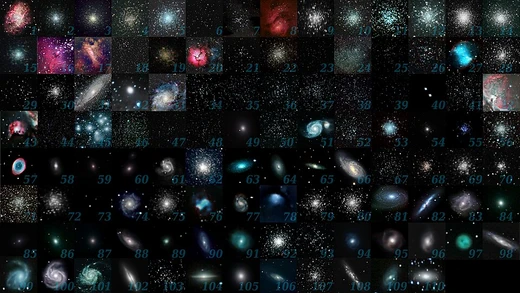
Messier 12
A loosely packed globular cluster in Ophiuchus.

Messier 12 (also known as NGC 6218) is a globular cluster located in the constellation Ophiuchus. French astronomer Charles Messier first spotted it on May 30, 1764, calling it a "nebula without stars." Under dark skies, it can be faintly glimpsed through binoculars, but resolving individual stars requires a telescope with an aperture of at least 8 inches (20 cm). With a 10-inch (25 cm) scope, the cluster’s granular core appears about 3 arcminutes across, surrounded by a halo of stars spanning 10 arcminutes.
The cluster lies roughly 3° northwest of the globular cluster M10 and 5.6° east-southeast of the star Lambda Ophiuchi, near the 6th-magnitude star 12 Ophiuchi. It is about 16,400 light-years (5,000 parsecs) from Earth and has a spatial diameter of roughly 75 light-years. Its brightest stars are of 12th magnitude. M10 and M12 are only a few thousand light-years apart; from the vantage point of one, the other would appear at about magnitude 4.5. With a Shapley-Sawyer concentration class of IX, M12 is unusually loose for a globular cluster and was once mistaken for a tightly packed open cluster. Thirteen variable stars have been identified within it. The cluster is approaching Earth at a velocity of 16 km/s.
A 2006 study found that M12 has an unusually low number of low-mass stars. Researchers suggest these stars were stripped away as the cluster passed through the dense plane of the Milky Way.
Quick Facts
- Epoch
- J2000
- Class
- IX
- Constellation
- Ophiuchus
- Ra
- 16 · 47 · 14.18
- Dec
- –01 · 56 · 54.7
- Dist Ly
- 5.04 ±
- Appmag V
- 6.7
- Radius Ly
- 37.2 ly
- Metal Fe
- –1.14
- Age
- 13.8 ± 1.1 Gyr
- Names
- NGC 6218
Facts from the source article.
Lore & Background
Messier 12 was discovered by Charles Messier on May 30, 1764, who recorded it as a 'nebula without stars'. In dark conditions, it can be faintly seen with binoculars, but resolving its stars requires a telescope with an aperture of 8 inches (20 cm) or greater. Through a 10-inch (25 cm) scope, the granular core appears 3 arcminutes in diameter, surrounded by a 10-arcminute halo of stars. The cluster is located roughly 3° northwest of M10 and 5.6° east southeast of Lambda Ophiuchi, near the 6th magnitude star 12 Ophiuchi. With a Shapley-Sawyer rating of IX, it is rather loosely packed for a globular cluster and was once mistaken for a tightly concentrated open cluster. Thirteen variable stars have been recorded in M12. The cluster is approaching Earth at a velocity of 16 km/s.
Reader's Guide
Messier 12 is significant as a globular cluster that challenges typical expectations of such objects due to its loose structure, classified as Shapley-Sawyer IX. Its discovery by Charles Messier in 1764 as a 'nebula without stars' reflects the observational limits of the era. The cluster's proximity to M10—only a few thousand light-years apart—means each would appear at about magnitude 4.5 from the other. A 2006 study found an unusually low number of low-mass stars in M12, suggesting they were stripped by passage through the matter-rich plane of the Milky Way. This finding highlights the dynamic interactions between globular clusters and the galactic environment. For amateur astronomers, M12 is accessible with binoculars under dark skies, while larger telescopes reveal its granular core and halo. Its legacy includes ongoing research into stellar evolution and cluster dynamics.
Did You Know?
- M12 was discovered by Charles Messier on May 30, 1764, who described it as a 'nebula without stars'.
- It has a Shapley-Sawyer rating of IX, making it unusually loosely packed for a globular cluster.
- A 2006 study found M12 has an unusually low number of low-mass stars, possibly stripped by the Milky Way's plane.
- M12 and M10 are only a few thousand light-years apart and would each appear at about magnitude 4.5 from the other.
Frequently Asked Questions
Who is Messier 12?
Messier 12, also cataloged as NGC 6218, is a globular cluster sitting in the constellation Ophiuchus. French astronomer Charles Messier first noted it on May 30, 1764, describing it as a 'nebula without stars.'
What are Messier 12's powers/role?
M12 is a loosely packed globular cluster roughly 75 light-years in diameter, making it one of the more spread-out members of its class. It sits about 16,400 light-years from Earth, placing it well within our Milky Way's halo.
Why is Messier 12 important?
M12 holds a place in the original Messier catalog and serves as a useful comparison point for studying loosely structured globular clusters versus denser ones like M13. It also sits only about three degrees from M10, making it a handy double-target evening for observers in Ophiuchus.
How do I meet Messier 12?
Under truly dark skies you can catch a faint smudge through binoculars, but pulling out individual stars demands at least an 8-inch (20 cm) telescope. A 10-inch scope will reveal a granular core roughly 3 arcminutes wide wrapped in a stellar halo stretching about 10 arcminutes.
More in Messier Objects 1-24
Spotted an error? Know more?
Reader corrections go straight into our review queue. Suggest an edit · How this site is sourced